Showing posts with label Secrets of the universe. Show all posts

Wednesday, July 11, 2012

Is Nibiru (Planet X) Approaching?


Russian scientists have discovered in a documentary called "Military Secret - Nibiru" that the great danger threatens to humanity in February 2013th. Earth and the planet cald Nibiru then will be in closest distance. A fact circulating the Internet that NASA expects to get a crash 21st July this year, but the U.S. Agency flatly denied. NASA themselves officially recognized the possibility of Planet X, with an announce-ment that 'some kind of mystery object is really there - far beyond the outermost planets'.
The Nibiru collision with Earth in 2012 has been predicted for a long time, but astrophysicists, cosmologists and astronomers around the world have now come to a consensus that Earth will indeed collide with the planet.

Thursday, May 24, 2012

UFO Sphere Shocks Brazil

 
An unidentified metal sphere has plunged from the sky on unsuspecting villagers in northern Brazil, causing an uproar.

Sunday, April 29, 2012

Weird spirals on Mars' surface


Giant coils of lava on Mars suggest a mysterious network of valleys on the planet was born from volcanoes, researchers say. The origin of the Athabasca Valles region near the equator of Mars has been debated for more than a decade. Some researchers have proposed that lava once shaped the valleys, while others have thought ice was responsible.

Thursday, February 2, 2012

Hollow moon - alien base?

The United States and the Soviet Union started to send probes to the Moon in the late fifties. Most of these initial probes met with miserable failure. It is posited here that the reason for these early failures were due to a miscalculation of the lunar gravitational gradient.
This is because in the case of a hollow spheroid the center of mass is much closer to the surface of the moon if in fact the moon is hollow than if it really were a homogenous mass of rock. The location of the center of mass of any celestial object is critical in determining it's gravitational gradient, hence the final velocity of any object required to soft-land or otherwise come in contact with the moon would not be known unless the location of the center of mass is somehow determined.

Tuesday, January 24, 2012

Directed panspermia


Panspermia - the idea that life exist across the whole Universe and it can be transferred from one location to another.

Directed panspermia - the idea that life might have been intentionally spread throughout space and seeded on the surface of other worlds by a guiding intelligence.


Thursday, October 21, 2010

Oldest galaxy?

Astronomers believe they've found the oldest thing they've ever seen in the universe: It's a galaxy far, far away from a time long, long ago.
Hidden in a Hubble Space Telescope photo released earlier this year is a small smudge of light that European astronomers now calculate is a galaxy from 13.1 billion years ago. That's a time when the universe was very young, just shy of 600 million years old. That would make it the earliest and most distant galaxy seen so far.
By now the galaxy is so ancient it probably doesn't exist in its earlier form and has already merged into bigger neighbors, said Matthew Lehnert of the Paris Observatory, lead author of the study published online Wednesday in the journal Nature.
Remove Formatting from selection"We're looking at the universe when it was a 20th of its current age," said California Institute of Technology astronomy professor Richard Ellis, who wasn't part of the discovery team. "In human terms, we're looking at a 4-year-old boy in the life span of an adult."
While Ellis finds the basis for the study "pretty good," there have been other claims about the age of distant space objects that have not held up to scrutiny. And some experts have questions about this one. But even the skeptics praised the study as important and interesting.
The European astronomers calculated the age after 16 hours of observations from a telescope in Chile that looked at light signatures of cooling hydrogen gas.
Earlier this year, astronomers had made a general estimate of 600 to 800 million years after the Big Bang for the most distant fuzzy points of light in the Hubble photograph, which was presented at an astronomy meeting back in January.
In the new study, researchers focused on a single galaxy in their analysis of hydrogen's light signature, further pinpointing the age. Garth Illingworth of the University of California, Santa Cruz, who was the scientist behind the Hubble image, said it provides confirmation for the age using a different method, something he called amazing "for such faint objects."
The new galaxy doesn't have a name — just a series of letters and numbers. So Lehnert said he and colleagues have called it "the high red-shift blob. "Because it takes so long for the light to travel such a vast time and distance, astronomers are seeing what the galaxy looked like 13.1 billion years ago at a time when it was quite young — maybe even as young as 100 million years old — Lehnert said. It has very little of the carbon or metal that we see in more mature stars and is full of young, blue massive stars, he said.
What's most interesting to astronomers is that this finding fits with theories about when the first stars and galaxies were born. This galaxy would have formed not too soon after them.
"We're looking almost to the edge, almost within 100 million years of seeing the very first objects," Ellis said. "One hundred million years to a human seems an awful long time, but in astronomical time periods, that's nothing compared to the life of the stars."

Wednesday, September 29, 2010

EMP Attack and Solar Storms

How much do we need to worry?

So, do we really need to worry about a huge solar storm burning out the electrical systems of half the world in 2013? Masochists that we are here at the Telegraph, we love to shoot down our own stories, and I was cracking my knuckles for this one. It’s got all the ingredients – white-coated authority, grave warnings of impending doom, exciting sciencey nuclear nemesis in space. NASA! Solar flares! Planes falling out of the sky! Etc.
But I read the piece, and spoke to the reporter, and – while always remembering that I am no more an astrophysicist than I am a black belt in tae kwon do – it sounded pretty solid. Dr Richard Fisher, the director of Nasa’s Heliophysics division, is very clear in the quotes, and our reporter, Andrew Hough, was very careful to check his facts with Dr Fisher before publishing. It sounds like a lot of serious people think that this is a real danger.
Apparently the concern is in 2013, the sun will reach a stage of its cycle when these large events are more likely. This might strike you as a bit strange, as you’ve probably heard (as have I) that the sun has been especially active for the last half-century or so and is expected to die down in the next couple of years – I spoke to Marcus Chown, the physicist and author of We Need to Talk about Kelvin, who said “Solar activity has been abnormally high for the past 50 years, but the extremely feeble start to the latest 11-year cycle suggests this activity is coming to an end and things are going to be quiet on the Sun for quite a few years.” Dr Ruth Bamford, a plasma physicist at the Rutherford-Appleton Laboratory, agrees: “The sun has been particularly quiet for the last few years in a protracted solar minimum. It has just woken up, as it were, and started its usual 11-year cycle a bit later than most.”
So what’s going on? Well, something similar has happened before. In 1859 a huge solar storm burned out telegraph wires across Europe and the United States. Dr Stuart Clark has written a book, The Sun Kings, about when that happened. He says that the “Carrington flare”, as it was known, “smothered two-thirds of the Earth’s skies in a blood-red aurora a night later, and crippled all of global navigation and global communication, such as it was at that time. Compasses span uselessly and the telegraph network went down as phantom electricity surged through the wire.”
The sun had indeed been running at a record high for the latter half of the 20th century, and has now died down to its lowest level for a century. But Dr Clark warns that “average levels of solar activity has fallen does not mean that the Sun is immune from large flares or even giant ones. Low average levels of activity may even promote the giant flares.
“Perhaps like earthquakes, when there are constant flares/tremors the energy is dissipated evenly over long periods of time. But in periods of quiet, that energy can build up and then suddenly be released in a giant event. This remains speculation, however.”
2013 is when the next peak in the sun’s cycle of activity is expected, and while we cannot predict individual flares, Dr Clark says that the largest flares are often shortly after the peak.
Of course, if a proper “Carrington event” happens again, it has the potential to be far more problematic now than in 1859 when electric communication was barely in its infancy. Dr Clark says “There is absolutely no reason to believe that we are heading for solar armageddon in 2013, but sooner or later we should expect there to be another Carrington event and that is what these scientists [at NASA] are trying to prevent. Legislation in the US has just passed Congress to help harden the grid against solar flares.”
So – it’s a real thing, and we should be concerned. But preventive measures can be taken – satellites can be sent offline during big flares, power grids and communication networks can be shielded against electromagnetic radiation and so on. As Dr Bamford says: “The extreme events like the 1859 Carrington Event are 1-in-100-year probabilities, about the same probability as a storm of the level of Katrina hitting New Orleans – and New Orleans did not build their defences to withstand the extreme-but-unlikely magnitude. 100 years isn’t that long.
“But the end of the world it is not. Maybe as disruptive as an ash cloud, but not as protracted I’m sure.” She gives examples of precautions, like a GPS backup system called eLoran, or active mini-magnetosphere shielding for astronauts and satellites that her team have designed.
Of course, if those precautions are taken, and actually work, and no damage is done, then everyone will cry that it was all a big fuss over nothing, like they always do. So the scientists can’t win, really. But that’s just how it is.

A Guide
An Electromagnetic Pulse (EMP), is generated from the detonation of a nuclear device. A similar waveform is created by extreme solar activity, such as that which was experienced in 1859, 1921, 1989 and as recent as 1994. The US Government and military have studied these phenomenon extensively and several reports have been issued regarding EMP effects on vehicles, computer networks, critical infrastructure and more. In this report, we'll briefly cover many of the topics discussed and researched in regards to geomagnetic anomalies, solar storm activity and the effects of an electromagnetic pulse. It should be noted, however, that Congress has largely ignored the EMP Commission's warnings and our hospitals and critical infrastructure remain highly vulnerable.
In the late summer of 1859, a great solar storm hit the planet. This storm was the product of a coronal mass ejection from the Sun. While the science and physics behind these coronal ejections is interesting, it can also be long winded for some readers so I'll keep this brief.
Once in a while - exactly when scientists still cannot predict - an event occurs on the surface of the Sun that releases a tremendous amount of energy in the form of a solar flare or a coronal mass ejection, an explosive burst of very hot, electrified gases with a mass that can surpass that of Mount Everest. I encourage you to research this more if you would like a deeper understanding of the charged plasma that is ejected from the Sun's surface occasionally.
What you need to realize is that these solar storms are not only electrically and magnetically charged, but they bring radiation – across the spectrum, from microwave radiation to gamma rays.
On September 1st and 2nd, 1859, Earth's inhabitants experienced the greatest solar storm in recorded history. "The grid" was in it's infancy, consisting mainly of a few telegraph wires, mostly in larger cities. This storm short-circuited the wires and caused massive fires. The typical light show in the far north, known as the Aurora Borealis, was seen as far south as Cuba, Rome and Hawaii. Due to society's light dependence on any form of an electrical grid at the time, this did not disrupt the world substantially.
In 1989 and 1994, minor solar storms knocked out communication satellites, shut down power plants and disrupted the electrical grid. These were minor solar flares. Imagine if a solar storm the size of 1859's struck our modern society? Delicate wires run everywhere nowadays. Filaments, computer chips, hard drives, cell phones and electrical lines that stretch thousands of miles. Have you stopped to think about your vehicle's computer system? The details might surprise you. We'll get to that in a minute, but first, let's talk briefly about a man-made version of the Perfect Solar Storm – the nuclear EMP event.
Electromagnetic Pulse Attack
According to the 2004 Commission to Assess the Threat to the United States of EMP Attack (Executive Report), “Several potential adversaries have or can acquire the capability to attack the United States with a high-altitude nuclear weapon-generated electromagnetic pulse (EMP). A determined adversary can achieve an EMP attack capability without having a high level of sophistication.”
It goes on to briefly address the effects, “EMP is one of a small number of threats that can hold our society at risk of catastrophic consequences. EMP will cover the wide geographic region within line of sight to the nuclear weapon. It has the capability to produce significant damage to critical infrastructures and thus to the very fabric of US society...” The Commission's chairman has testified that within one year of such an attack, 70% - 90% of Americans would be dead from such causes as disease and violence. It is also highly plausible that many Americans would die of starvation due to the interruption of the national food supply.
According to the Washington Department of Health, Office of Radiation Protection, “A 1.4 Megaton bomb launched about 250 miles above Kansas would destroy most of the electronics that were not protected in the entire Continental United States.”
So, as you can see, both a massive solar storm and an EMP event could quite possibly end civilization as we know it. I know that sounds drastic, but in the United States and other technologically advanced countries, how would the mass population handle a prolonged event with very little or quite possibly, no electricity? As the Commission noted, our society is utterly dependent on our electrical grid for everything.
Trucking and transportation
Gas stations and refineries
Information and communications
Commercial production of food and goods
Water purification and delivery
Most of our military capability
These are only a handful of things that we take for granted because they are always there. If the gas stations were out of order, and no refineries able to produce more fuel, can you imagine how quickly our “civilized society” would break down? With that event alone, grocery store shelves become empty within a matter of days and farmers can't transport any goods. If you were not aware, grocery stores do not stock much extra produce or food “in the back of the store.” In order to maintain a high profit margin, stores maintain only a few days worth of staples until another shipment arrives. This not only conserves space, but allows for them to keep their overhead lower, among other things.
Once the gas stops flowing and the shelves are wiped clean, how long will your neighbor remain civil?
Several tests and scenarios have shown that cell phones will be one of the first tell-tale signs of an electromagnetic event because of the enormous percentage of the population carrying one. If the power grid were to simply go down, this wouldn't effect your cell phone. Depending on your location, your local cell towers probably have back-up power systems, as well. The cell towers, backup power and your cell phone will all be disabled after an electromagnetic event, offering you a clue as to what has just happened.
The Commission went on to assess just how our society would be impacted from an EMP event, including how well cars and trucks can handle the burst of electromagnetic waves.
The Automobile and Trucking Infrastructures
[brief excerpt from the Commission's 2008 report]
"Over the past century, our society and economy have developed in tandem with the automobile and trucking industries. As a consequence, we have become highly dependent on these infrastructures for maintaining our way of life.
Our land-use patterns, in particular, have been enabled by the automobile and trucking infrastructures. Distances between suburban housing developments, shopping centers, schools, and employment centers enforce a high dependence on the automobile. Suburbanites need their cars to get food from the grocery store, go to work, shop, obtain medical care, and myriad other activities of daily life. Rural Americans are just as dependent on automobiles, if not more so. Their needs are similar to those of suburbanites, and travel distances are greater. To the extent that city dwellers rely on available mass transit, they are less dependent on personal automobiles. But mass transit has been largely supplanted by automobiles, except in a few of our largest cities.
As much as automobiles are important to maintaining our way of life, our very lives are dependent on the trucking industry. The heavy concentration of our population in urban and suburban areas has been enabled by the ability to continuously supply food from farms and processing centers far removed. As we noted above, cities typically have a food supply of only several days available on grocery shelves for their customers.
Replenishment of that food supply depends on a continuous flow of trucks from food processing centers to food distribution centers to warehouses and to grocery stores and restaurants. If urban food supply flow is substantially interrupted for an extended period of time, hunger and mass evacuation, even starvation and anarchy, could result.
Trucks also deliver other essentials. Fuel delivered to metropolitan areas through pipelines is not accessible to the public until it is distributed by tanker trucks to gas stations.
Garbage removal, utility repair operations, fire equipment, and numerous other services are delivered using specially outfitted trucks. Nearly 80 percent of all manufactured goods at some point in the chain from manufacturer to consumer are transported by truck.
The consequences of an EMP attack on the automobile and trucking infrastructures would differ for the first day or so and in the longer term. An EMP attack will certainly immediately disable a portion of the 130 million cars and 90 million trucks in operation in the United States. Vehicles disabled while operating on the road can be expected to cause accidents. With modern traffic patterns, even a very small number of disabled vehicles or accidents can cause debilitating traffic jams. Moreover, failure of electronically based traffic control signals will exacerbate traffic congestion in metropolitan areas.
In the aftermath of an EMP attack that occurs during working hours, with a large number of people taking to the road at the same time to try to get home, we can expect extreme traffic congestion."
EMP Vulnerability of the Automobile and Trucking Infrastructures
The Commission tested the EMP susceptibility of traffic light controllers, automobiles and trucks.
The summary of the tests conclude that traffic light controllers will begin to malfunction following exposure to EMP fields as low as a few kV/m, thereby causing traffic congestion.
For automobiles, approximately 10% of the vehicles on the road will stop, at least temporarily, thereby possibly triggering accidents, as well as congestion, at field levels above 25 kV/m. For vehicles that were turned off during the testing, none suffered serious effects and were able to be started.
Of the trucks that were not running during EMP exposure, none were subsequently affected during the test. Thirteen of the 18 trucks exhibited a response while running. Most seriously, three of the truck motors stopped. Two could be restarted immediately, but one required towing to a garage for repair. The other 10 trucks that responded exhibited relatively minor temporary responses that did not require driver intervention to correct. Five of the 18 trucks tested did not exhibit any anomalous response up to field strengths of approximately 50 kV/m.
In regards to the airline industry, “Although commercial aircraft have proven EM protection against naturally occurring EM environments [such as lightning], we cannot confirm safety of flight following [severe or hostile] EMP exposure. Moreover, if the complex air traffic control system is damaged by EMP, restoration of full services could take months or longer.”
In conclusion, you have a very good chance that should an EMP or severe solar storm occur while you are driving home from work, you will be able to make it home as long as you are careful to avoid collisions. Once home, however, is an entirely different story!
There will be no more fuel available. There will be no more food and water for purchase. There will be no more iPhone or internet. And if you do find these things, what will be the price? Your dollars will very likely mean nothing to anyone with common sense. The art of bartering will very quickly take on a new importance for your own survival.
If this event were to occur, you could count on a very prolonged period of great civil unrest, riots, theft and wide spread violence. Repairs will be very slow and new parts for the large generators and power plants will likely have to be manufactured overseas and delivered to the United States. Furthermore, these foreign factories would have to retool their machines to create the specific part that we need if they are not already our supplier. And that is if the other industrialized nations aren't effected, as well.
As for the military and police, you can expect high numbers of deserters, placing an even greater strain on the limited resources of government order. This is not meant as an insult to our uniformed personnel, but from my personal experience of being a New Orleans police officer before, during and after Hurricane Katrina, I witnessed 1/5 of the police department simply walk away the first day. Some chose to leave for family reasons while others left due to stress. I also saw how quickly those we entrust with public safety can become an armed street gang and simply take what you have at gun point. These are all valid topics to consider when speaking about an event such as an EMP or severe solar storm. These are valid points even when the disaster is very localized, such as Hurricane Katrina was.
If you would like to learn more details about the actual tests, continue reading below.
Traffic Lights
In testing the traffic lights, the Commission used the 170E controller which is in use in 80% of all signal intersections. They noted four different types of effects, depending on the power level of the electromagnetic pulse.
The following effects were observed:
1. Forced Cycle: At field levels of 1 to 5 kV/m, the light was forced to cycle from green to red without going through yellow. This is a transient effect that recovers automatically after one cycle.
2. Disrupted Cycle: At field levels of 5 to 10 kV/m, the normally programmed cycle times became corrupted and change to a cycle different from that originally programmed. The controller had either been damaged or needed to be manually reset.
3. No Cycle: At 10 to 15 kV/m, the side street lights at an intersection never turned green. The controller had been damaged.
4. Flash Mode: Also at 10 to 15 kV/m, the intersection went into a mode in which the lights in all directions were flashing. This mode can cause large traffic jams because traffic flow is severely reduced in this situation. The controller has either been damaged or needs to be manually reset.
Based on these results, it can be anticipated that an EMP will trigger moderate to severe traffic congestion in metropolitan areas. The traffic congestion may be exacerbated by the panic reactions possibly attendant to an EMP attack. None of the data predict or suggest life threatening conditions; conflicting green lights did not occur during the tests. All the observed effects would cause less traffic disruption than would a power outage, which results in no working traffic lights.
Automobiles
The potential EMP vulnerability of automobiles derives from the use of built-in electronics that support multiple functions within the vehicle.
With more than 100 microprocessors in modern vehicles, one might think that leaves newer cars more susceptible to being disrupted by an EMP, but due to higher standards in electromagnetic compatibility, this weakness has been mitigated.
The Commission tested a sample of 37 cars in an EMP simulation laboratory, with vehicle years ranging from 1986 through 2002. Automobiles of these vintages include extensive electronics and represent a significant portion of the vehicles on the road today.
Automobiles were subjected to EMP environments under both engine turned off and engine turned on conditions. No effects were subsequently observed in those automobiles that were not turned on during EMP exposure. The most serious effect observed on running automobiles was that the motors in three cars stopped at field strengths of approximately 30 kV/m or above. In an actual EMP exposure, these vehicles would glide to a stop and require the driver to restart them. Electronics in the dashboard of one automobile were damaged and required repair. Other effects were relatively minor. Twenty-five automobiles exhibited malfunctions that could be considered only a nuisance (e.g., blinking dashboard lights) and did not require driver intervention to correct. Eight of the 37 cars tested did not exhibit any anomalous response.
Based on these test results, the Commission expects few automobile effects at EMP field levels below 25 kV/m. Approximately 10 percent or more of the automobiles exposed to higher field levels may experience serious EMP effects, including engine stall, that require driver intervention to correct.
Trucks
As is the case for automobiles, the potential EMP vulnerability of trucks derives from the trend toward increasing use of electronics. The Commission assessed the EMP vulnerability of trucks using an approach identical to that used for automobiles. Eighteen running and non-running trucks were exposed to simulated EMP in a laboratory. The intensity of the EMP fields was increased until either anomalous response was observed or simulator limits were reached. The trucks ranged from gasoline-powered pickup trucks to large diesel- powered tractors. Truck vintages ranged from 1991 to 2003.
Of the trucks that were not running during EMP exposure, none were subsequently affected during the test. Thirteen of the 18 trucks exhibited a response while running. Most seriously, three of the truck motors stopped. Two could be restarted immediately, but one required towing to a garage for repair. The other 10 trucks that responded exhibited relatively minor temporary responses that did not require driver intervention to correct. Five of the 18 trucks tested did not exhibit any anomalous response up to field strengths of approximately 50 kV/m.

Sunday, June 6, 2010

Titan: Nasa scientists discover evidence 'that alien life exists on Saturn's moon'


Researchers at the space agency believe they have discovered vital clues that appeared to indicate that primitive aliens could be living on the planet. Data from Nasa's Cassini probe has analysed the complex chemistry on the surface of Titan, which experts say is the only moon around the planet to have a dense atmosphere.

They have discovered that life forms have been breathing in the planet’s atmosphere and also feeding on its surface’s fuel. Astronomers claim the moon is generally too cold to support even liquid water on its surface. The research has been detailed in two separate studies. The first paper, in the journal Icarus, shows that hydrogen gas flowing throughout the planet’s atmosphere disappeared at the surface. This suggested that alien forms could in fact breathe. The second paper, in the Journal of Geophysical Research, concluded that there was lack of the chemical on the surface. Scientists were then led to believe it had been possibly consumed by life. Researchers had expected sunlight interacting with chemicals in the atmosphere to produce acetylene gas. But the Cassini probe did not detect any such gas. Chris McKay, an astrobiologist at Nasa Ames Research Centre, at Moffett Field, California who led the research, said: “We suggested hydrogen consumption because it's the obvious gas for life to consume on Titan, similar to the way we consume oxygen on Earth. "If these signs do turn out to be a sign of life, it would be doubly exciting because it would represent a second form of life independent from water-based life on Earth.” Professor John Zarnecki, of the Open University, added: “We believe the chemistry is there for life to form. It just needs heat and warmth to kick-start the process. “In four billion years’ time, when the Sun swells into a red giant, it could be paradise on Titan.” They warned, however, that there could be other explanations for the findings. But taken together, they two indicate two important conditions necessary for methane-based life to exist.

Friday, April 16, 2010

Black Hole - a Doorways into Alternate Realities

Like part of a cosmic Russian doll, our universe may be nested inside a black hole that is itself part of a larger universe.

In turn, all the black holes found so far in our universe—from the microscopic to the supermassive—may be doorways into alternate realities.

According to a mind-bending new theory, a black hole is actually a tunnel between universes—a type of wormhole. The matter the black hole attracts doesn't collapse into a single point, as has been predicted, but rather gushes out a "white hole" at the other end of the black one, the theory goes.

In a recent paper published in the journal Physics Letters B, Indiana University physicist Nikodem Poplawski presents new mathematical models of the spiraling motion of matter falling into a black hole. His equations suggest such wormholes are viable alternatives to the "space-time singularities" that Albert Einstein predicted to be at the centers of black holes.

According to Einstein's equations for general relativity, singularities are created whenever matter in a given region gets too dense, as would happen at the ultradense heart of a black hole.

Einstein's theory suggests singularities take up no space, are infinitely dense, and are infinitely hot—a concept supported by numerous lines of indirect evidence but still so outlandish that many scientists find it hard to accept.

If Poplawski is correct, they may no longer have to.

According to the new equations, the matter black holes absorb and seemingly destroy is actually expelled and becomes the building blocks for galaxies, stars, and planets in another reality.

Wormholes Solve Big Bang Mystery?

The notion of black holes as wormholes could explain certain mysteries in modern cosmology, Poplawski said.

For example, the big bang theory says the universe started as a singularity. But scientists have no satisfying explanation for how such a singularity might have formed in the first place.

If our universe was birthed by a white hole instead of a singularity, Poplawski said, "it would solve this problem of black hole singularities and also the big bang singularity."

Wormholes might also explain gamma ray bursts, the second most powerful explosions in the universe after the big bang.

Gamma ray bursts occur at the fringes of the known universe. They appear to be associated with supernovae, or star explosions, in faraway galaxies, but their exact sources are a mystery.

Poplawski proposes that the bursts may be discharges of matter from alternate universes. The matter, he says, might be escaping into our universe through supermassive black holes—wormholes—at the hearts of those galaxies, though it's not clear how that would be possible.

"It's kind of a crazy idea, but who knows?" he said.

There is at least one way to test Poplawski's theory: Some of our universe's black holes rotate, and if our universe was born inside a similarly revolving black hole, then our universe should have inherited the parent object's rotation.

If future experiments reveal that our universe appears to rotate in a preferred direction, it would be indirect evidence supporting his wormhole theory, Poplawski said.

Wormholes Are "Exotic Matter" Makers?

The wormhole theory may also help explain why certain features of our universe deviate from what theory predicts, according to physicists.

Based on the standard model of physics, after the big bang the curvature of the universe should have increased over time so that now—13.7 billion years later—we should seem to be sitting on the surface of a closed, spherical universe.

But observations show the universe appears flat in all directions.

What's more, data on light from the very early universe show that everything just after the big bang was a fairly uniform temperature.

That would mean that the farthest objects we see on opposite horizons of the universe were once close enough to interact and come to equilibrium, like molecules of gas in a sealed chamber.

Again, observations don't match predictions, because the objects farthest from each other in the known universe are so far apart that the time it would take to travel between them at the speed of light exceeds the age of the universe.

To explain the discrepancies, astronomers devised the concept of inflation.

Inflation states that shortly after the universe was created, it experienced a rapid growth spurt during which space itself expanded at faster-than-light speeds. The expansion stretched the universe from a size smaller than an atom to astronomical proportions in a fraction of a second.

The universe therefore appears flat, because the sphere we're sitting on is extremely large from our viewpoint—just as the sphere of Earth seems flat to someone standing in a field.

Inflation also explains how objects so far away from each other might have once been close enough to interact.

But—assuming inflation is real—astronomers have always been at pains to explain what caused it. That's where the new wormhole theory comes in.

According to Poplawski, some theories of inflation say the event was caused by "exotic matter," a theoretical substance that differs from normal matter, in part because it is repelled rather than attracted by gravity.

Based on his equations, Poplawski thinks such exotic matter might have been created when some of the first massive stars collapsed and became wormholes.

"There may be some relationship between the exotic matter that forms wormholes and the exotic matter that triggered inflation," he said.

Wormhole Equations an "Actual Solution"

The new model isn't the first to propose that other universes exist inside black holes. Damien Easson, a theoretical physicist at Arizona State University, has made the speculation in previous studies.

"What is new here is an actual wormhole solution in general relativity that acts as the passage from the exterior black hole to the new interior universe," said Easson, who was not involved in the new study.

"In our paper, we just speculated that such a solution could exist, but Poplawski has found an actual solution," said Easson, referring to Poplawski's equations.

Nevertheless, the idea is still very speculative, Easson said in an email.

"Is the idea possible? Yes. Is the scenario likely? I have no idea. But it is certainly an interesting possibility."

Future work in quantum gravity—the study of gravity at the subatomic level—could refine the equations and potentially support or disprove Poplawski's theory, Easson said.

Wormhole Theory No Breakthrough


Overall, the wormhole theory is interesting, but not a breakthrough in explaining the origins of our universe, said Andreas Albrecht, a physicist at the University of California, Davis, who was also not involved in the new study.

By saying our universe was created by a gush of matter from a parent universe, the theory simply shifts the original creation event into an alternate reality.

In other words, it doesn't explain how the parent universe came to be or why it has the properties it has—properties our universe presumably inherited.

"There're really some pressing problems we're trying to solve, and it's not clear that any of this is offering a way forward with that," he said.

Still, Albrecht doesn't find the idea of universe-bridging wormholes any stranger than the idea of black hole singularities, and he cautions against dismissing the new theory just because it sounds a little out there.

"Everything people ask in this business is pretty weird," he said. "You can't say the less weird [idea] is going to win, because that's not the way it's been, by any means."

Friday, October 2, 2009

Venezuela's Everlasting Storm

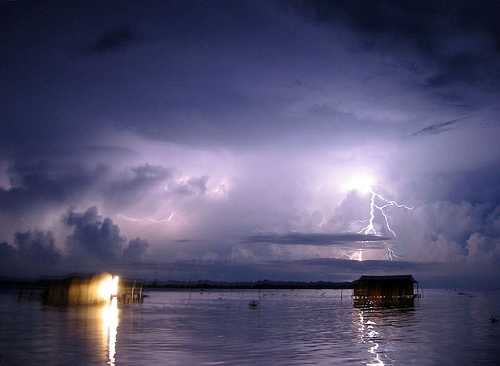
The mysterious "Relámpago del Catatumbo" (Catatumbo lightning) is a unique natural phenomenon in the world. Located on the mouth of the Catatumbo river at Lake Maracaibo (Venezuela), the phenomenon is a cloud-to-cloud lightning that forms a voltage arc more than five kilometre high during 140 to 160 nights a year, 10 hours a night, and as many as 280 times an hour. This almost permanent storm occurs over the marshlands where the Catatumbo River feeds into Lake Maracaibo and it is considered the greatest single generator of ozone in the planet, judging from the intensity of the cloud-to-cloud discharge and great frequency.

The area sees an estimated 1,176,000 electrical discharges per year, with an intensity of up to 400,000 amperes, and visible up to 400 km away. This is the reason why the storm is also known as the Maracaibo Beacon as light has been used for navigation by ships for ages. The collision with the winds coming from the Andes Mountains causes the storms and associated lightning, a result of electrical discharges through ionised gases, specifically the methane created by the decomposition of organic matter in the marshes. Being lighter than air, the gas rises up to the clouds, feeding the storms. Some local environmentalists hope to put the area under the protection of UNESCO, as it is an exceptional phenomenon, the greatest source of its type for regenerating the planet's ozone layer.


Monday, February 23, 2009

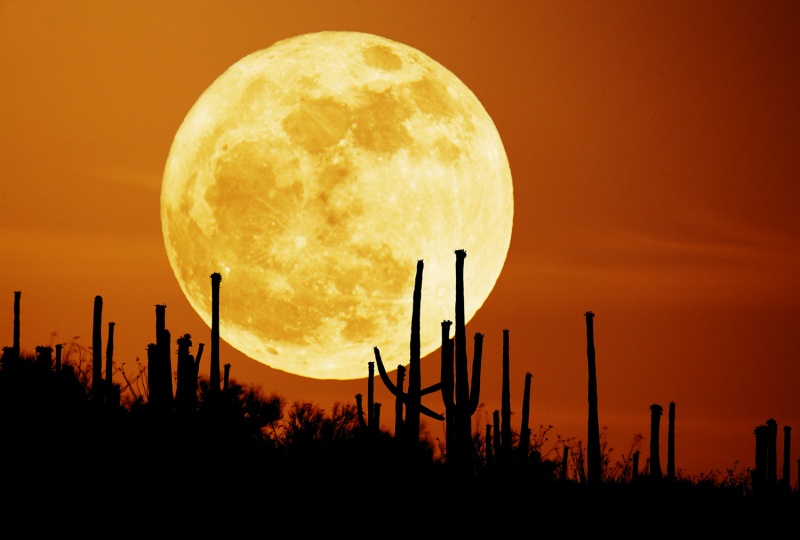
Does a full moon really trigger strange behavior?

Across the centuries, many a person has uttered the phrase “There must be a full moon out there” in an attempt to explain weird happenings at night. Indeed, the Roman goddess of the moon bore a name that remains familiar to us today: Luna, prefix of the word “lunatic.” Greek philosopher Aristotle and Roman historian Pliny the Elder suggested that the brain was the “moistest” organ in the body and thereby most susceptible to the pernicious influences of the moon, which triggers the tides. Belief in the “lunar lunacy effect,” or “Transylvania effect,” as it is sometimes called, persisted in Europe through the Middle Ages, when humans were widely reputed to transmogrify into werewolves or vampires during a full moon.
Even today many people think the mystical powers of the full moon induce erratic behaviors, psychiatric hospital admissions, suicides, homicides, emergency room calls, traffic accidents, fights at professional hockey games, dog bites and all manner of strange events. One survey revealed that 45 percent of college students believe moonstruck humans are prone to unusual behaviors, and other surveys suggest that mental health professionals may be still more likely than laypeople to hold this conviction. In 2007 several police departments in the U.K. even added officers on full-moon nights in an effort to cope with presumed higher crime rates.

Water at Work?

Following Aristotle and Pliny the Elder, some contemporary authors, such as Miami psychiatrist Arnold Lieber, have conjectured that the full moon’s supposed effects on behavior arise from its influence on water. The human body, after all, is about 80 percent water, so perhaps the moon works its mischievous magic by somehow disrupting the alignment of water molecules in the nervous system.
But there are at least three reasons why this explanation doesn’t “hold water,” pardon the pun. First, the gravitational effects of the moon are far too minuscule to generate any meaningful effects on brain activity, let alone behavior. As the late astronomer George Abell of the University of California, Los Angeles, noted, a mosquito sitting on our arm exerts a more powerful gravitational pull on us than the moon does. Yet to the best of our knowledge, there have been no reports of a “mosquito lunacy effect.” Second, the moon’s gravitational force affects only open bodies of water, such as oceans and lakes, but not contained sources of water, such as the human brain. Third, the gravitational effect of the moon is just as potent during new moons—when the moon is invisible to us—as it is during full moons.
There is a more serious problem for fervent believers in the lunar lunacy effect: no evidence that it exists. Florida International University psychologist James Rotton, Colorado State University astronomer Roger Culver and University of Saskatchewan psychologist Ivan W. Kelly have searched far and wide for any consistent behavioral effects of the full moon. In all cases, they have come up empty-handed. By combining the results of multiple studies and treating them as though they were one huge study—a statistical procedure called meta-analysis—they have found that full moons are entirely unrelated to a host of events, including crimes, suicides, psychiatric problems and crisis center calls. In their 1985 review of 37 studies entitled “Much Ado about the Full Moon,” which appeared in one of psychology’s premier journals, Psychological Bulletin, Rotton and Kelly humorously bid adieu to the full-moon effect and concluded that further research on it was unnecessary.
Persistent critics have disagreed with this conclusion, pointing to a few positive findings that emerge in scattered studies. Still, even the handful of research claims that seem to support full-moon effects have collapsed on closer investigation. In one study published in 1982 an author team reported that traffic accidents were more frequent on full-moon nights than on other nights. Yet a fatal flaw marred these findings: in the period under consideration, full moons were more common on weekends, when more people drive. When the authors reanalyzed their data to eliminate this confounding factor, the lunar effect vanished.

Where Belief Begins

So if the lunar lunacy effect is merely an astronomical and psychological urban legend, why is it so widespread? There are several probable reasons. Media coverage almost surely plays a role. Scores of Hollywood horror flicks portray full-moon nights as peak times of spooky occurrences such as stabbings, shootings and psychotic behaviors.
Perhaps more important, research demonstrates that many people fall prey to a phenomenon that University of Wisconsin–Madison psychologists Loren and Jean Chapman termed “illusory correlation”—the perception of an association that does not in fact exist. For example, many people who have joint pain insist that their pain increases during rainy weather, although research disconfirms this assertion. Much like the watery mirages we observe on freeways during hot summer days, illusory correlations can fool us into perceiving phenomena in their absence.
Illusory correlations result in part from our mind’s propensity to attend to—and recall—most events better than nonevents. When there is a full moon and something decidedly odd happens, we usually notice it, tell others about it and remember it. We do so because such co-occurrences fit with our preconceptions. Indeed, one study showed that psychiatric nurses who believed in the lunar effect wrote more notes about patients’ peculiar behavior than did nurses who did not believe in this effect. In contrast, when there is a full moon and nothing odd happens, this nonevent quickly fades from our memory. As a result of our selective recall, we erroneously perceive an association between full moons and myriad bizarre events.
Still, the illusory correlation explanation, though probably a crucial piece of the puzzle, does not account for how the full-moon notion got started. One intriguing idea for its origins comes to us courtesy of psychiatrist Charles L. Raison, now at Emory University, and several of his colleagues. According to Raison, the lunar lunacy effect may possess a small kernel of truth in that it may once have been genuine. Raison conjectures that before the advent of outdoor lighting in modern times, the bright light of the full moon deprived people who were living outside—including many who had severe mental disorders—of sleep. Because sleep deprivation often triggers erratic behavior in people with certain psychological conditions, such as bipolar disorder (formerly called manic depression), the full moon may have been linked to a heightened rate of bizarre behaviors in long-bygone eras. So the lunar lunacy effect is, in Raison and his colleagues’ terms, a “cultural fossil.”
We may never know whether this ingenious explanation is correct. But in today’s world at least, the lunar lunacy effect appears to be no better supported than is the idea that the moon is made of green cheese.

Sunday, February 22, 2009

Liquid Water discoverd on Mars?

Strange globs seen on the landing strut of the Phoenix Mars lander could be the first proof that modern Mars hosts liquid water, a new paper reports.
Images from the robotic craft show what appear to be liquid droplets growing, merging, and dripping on the lander's leg over the course of a Martian month.
Phoenix landed near Mars's north pole last May, and several "self portraits" taken to assess the craft's health show material spattered on the legs.
This substance is probably saline mud that splashed up as the craft landed, study leader and Phoenix co-investigator Nilton Renno of the University of Michigan told National Geographic News.
Salt in the mud then absorbed water vapor from the atmosphere, forming the watery drops, Renno said.
The water can stay liquid even in the frigid Martian arctic because it contains a high amount of perchlorates, a salt "with properties like the antifreeze used to melt snow here in Michigan," said Renno, who will present the work next month at the 40th Lunar and Planetary Science Conference.
Finding liquid water under these conditions carries possible implications for Mars's habitability, the scientists say.

Dripping And Shrinkage

Renno admits that the images showing droplets are not high enough resolution to examine small details.
He also notes that instruments on board Phoenix meant to look for liquid water near the surface didn't find anything.
But he and his team are convinced that what they are seeing matches the behavior of liquid water.
"As it cooled down toward the end of the mission and we're seeing the formation of frost everywhere, the drops almost disappear," he said.
"This is consistent with [liquid] drops freezing and losing water to the atmosphere as it gets colder."
What's more, the images suggest one of the largest globs started to drip down the lander's leg when it got bigger than about 0.4 inch (a centimeter) wide.
"Before it drips it becomes dark, and that's consistent with ice melting," said Renno, referring to the fact that ice is more reflective than liquid water.

Salty Brew

It's certainly possible that liquid water could exist at least fleetingly on the Martian surface, said Nicholas Tosca, a geochemist at Harvard University who was not involved in the study.
With perchlorate present, Tosca agrees Mars could support liquid water even down to -94 degrees Fahrenheit (-70 degrees Celsius)—close to the lowest possible temperature around the lander's legs at the time the images were taken.
But daily temperatures fluctuate greatly on Mars, so even very salty water would probably go through cycles of freezing and melting. Liquids therefore wouldn't be present for very long periods of time, he said.
Study leader Renno thinks that the drops seen on Phoenix were liquid during the warmest part of the day but partially froze at night.
Overall, Tosca said, the paper makes a plausible case for liquid water on Mars, "but the nature of the water … doesn't bode well for life."
Even if a layer of liquid does persist deep under Mars's surface, it wouldn't be very hospitable, he said.
"If you make the case that life could have started on Mars and could be hiding out somewhere," Tosca said, "it's not likely to be in this cold, salty water."

Saturday, December 20, 2008

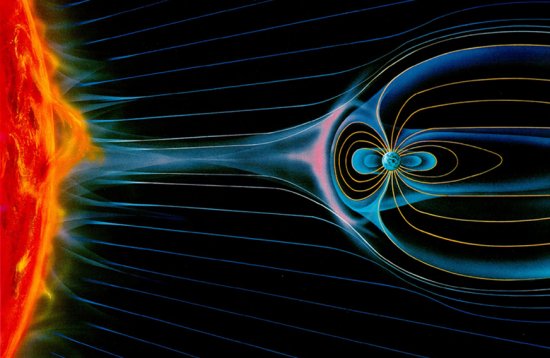
Does Earth's magnetic field leaking?

Scientists have found two large leaks in Earth's magnetosphere, the region around our planet that shields us from severe solar storms. The leaks are defying many of scientists' previous ideas on how the interaction between Earth's magnetosphere and solar wind occurs: The leaks are in an unexpected location, let in solar particles in faster than expected and the whole interaction works in a manner that is completely the opposite of what scientists had thought.

The findings have implications for how solar storms affect the our planet. Serious storms, which involved charged particles spewing from the sun, can disable satellites and even disrupt power grids on Earth.

The new observations "overturn the way that we understand how the sun's magnetic field interacts with the Earth's magnetic field," said David Sibeck of NASA's Goddard Space Flight Center in Greenbelt, Md., during a press conference today at the annual meeting of the American Geophysical Union in San Francisco.

The face on Mars

You're looking at a partial high-resolution image of the notorious Face on Mars, universally "debunked" by mainstream media outlets due in no small part to the baseless pronouncements of a single pseudoscientific pundit.

I suspect many readers will agree that the highlighted feature at least resembles a humanoid eye, down to the well-defined elliptical structure surrounding the central protruding "pupil." But how do we go about testing the notion that the Face on Mars boasts an anatomically accurate "eye"? After all, aren't we merely seeing what we want to see?

In this case, no.


Long before the Mars Global Surveyor spacecraft returned provocative images of the Cydonia Mensae region of Mars, the presence of secondary facial characteristics had been predicted by proponents of what became known as the Artificiality Hypothesis.

Thursday, December 18, 2008

Flower of Life

The "Flower of Life" can be found in all major religions of the world.
It contains the patterns of creation as they emerged from the "Great Void". Everything is made from the Creator's thought.
After the creation of the Seed of Life the same vortex's motion was continued, creating the next structure known as the Egg of Life.
This structure forms the basis for music, as the distances between the spheres is identical to the distances between the tones and the half tones in music. It is also identical to the cellular structure of the third embryonic division (The first cell divides into two cells, then to four cells then to eight). Thus this same structure as it is further developed, creates the human body and all of the energy systems including the ones used to create the Merkaba. If we continue creating more and more spheres we will end up with the structure called the Flower of Life.The flower of life holds a secret symbol created by drawing 13 circles out of the Flower of Life. By doing this, one can discover the most important and sacred pattern in the universe. This is the source of all that exists; it's called the Fruit of Life. It contains 13 informational systems. Each one explains another aspect of reality. Thus these systems are able to give us access to everything ranging from the human body to the galaxies. In the first system, for example, it's possible to create any molecular structure and any living cellular structure that exists in the universe. In short every living creature.

The most common form of the "Flower of Life" is hexagonal pattern (where the center of each circle is on the circumference of six surrounding circles of the same diameter), made up of 19 complete circles and 36 partial circular arcs, enclosed by a large circle.

The "Seed of Life" is formed from seven circles being placed with sixfold symmetry, forming a pattern of circles and lenses, which acts as a basic component of the Flower of Life's design.

The Temple of Osiris at Abydos, Egypt contains the oldest to date example. it is carved in granite and may possibly represent the Eye of Ra a symbol of the authority of the pharaoh. Other examples can be found in Phoenician, Assyrian, Indian, Asian, Middle Eastern, and medieval art.

* Leonardo da Vinci has studied the Flower of Life's form and its mathematical properties. He has drawn the Flower of Life itself, as well as components therein, such as the Seed of Life. He has drawn geometric figures representing shapes such as the platonic solids, a sphere, a torus, etc., and has also used the golden ratio of phi in his artwork; all of which may be derived from the Flower of Life design. *
Where Math, Geometry and Spirituality meets
The flower of life shape contains a secret shape known as the fruit of life that consists of 13 spheres that hold many mathematical and geometrical laws. These laws represent the whole universe. Giving the flower of life to someone is like giving them the whole universe in one jewel.

The Flower of Life can be found in all major religions of the world. In Egypt, the source of all the monotheistic religions, the "Flower of Life", can be found in the ancient Temple of Abydos. In Israel, it can be found in ancient synagogues in the Galilee and in Mesada.

People reported physical and psychological changes after wearing this pendant - faster heart beats, prophetic dreams, breaking of illusions, seeing the reality as it is and becoming free from long time fears.

The flower of life is one of the strongest sacred geometric shapes!
The whole universe in one jewel! The Flower of life pendant is excellent for healing and helps in connecting to the higher self.