Showing posts with label Historical Figures. Show all posts

Wednesday, September 19, 2012

Jesus’ Wife Mentioned on Fourth-Century Papyrus Fragment

A papyrus fragment dated to the fourth century written on it in the ancient Coptic language, contains a phrase: "Jesus said to them, my wife...". This discovery reopening the debate about whether Jesus was married, as some early Christians believed.


Monday, February 27, 2012

Chronology of Vampires


Vampires appear in various lore, folklore and legends throught history. They are mentioned in many cultures, in different parts of the world in different time periods.

Wednesday, January 26, 2011

340-year-old Bible found in a Wisconsin Lutheran church

A 340-year-old Bible has been discovered tucked away in a pantry-sized room filled with old books, historical records and pamphlets at a 148-year-old Lutheran church and school located in Wisconsin. Middle school teacher Debra Court first found the Bible two years ago, while searching for baptism records for a class. When she saw it she thought it was just an old book and didn’t think much about it, according to FOX news. "I was looking for the old baptism records to show my students and then up here in the corner was where the Bible was tucked," said Court.

The 17th century Bible was found at St. Paul Lutheran School by Court who showed the Bible to Church Pastor Timothy Shoup. "When I did open it up and look at the title page I saw the roman numerals at the bottom I kept coming up with 1670 and I concluded whatever that is I've got it added up wrong." So Shoup contacted Concordia Seminary Library in St. Louis, according to Channel 5 News WFRV. A cataloger at Concordia was able to authenticate the 340-year-old book. The German Bible was printed in Nuremberg in 1670, hand-pressed, rare and at a weight of twenty pounds. It's made of pigskin over boards with brass corners and clasps, reports WFRV.

Lyle Buettner, who works in Special Collections at Concordia Seminary Library, said he believes the Bible is one of about 40 remaining copies known to exist in the world. Buettner said the illustrations were also impressive. He told news reporters "Each time I see an illustration like this, I just think of how beautiful it looks and how much of a labor of love it must have been for the person who actually drew it." Reports said that church officials don’t know how they got the book and no one seems to remember how it got into the safe. Many of the church elders have been asked but nobody seems to recall ever hearing of the existence of the this piece of church history. The church is considering donating the centuries old Bible to a library in St. Louis in the future. But for now church leaders are looking to have a climate-controlled display box made and will keep it until their 150th anniversary in 2013, according to the news reports.

Tuesday, November 23, 2010

The Sacred Geometry and Symbols of Washington DC

Symbols are seen as a concept or intention, and also stand-for a referent or extension from anything, from religion to a chemical compound and most importantly, secrete society's. Symbols have been around sense the beginning of time. With out symbols we would have no written language. Numbers are symbols, letters are symbols and they each have their specific meaning. Obvious, right? The thing is, most people don't realize many of the symbols that surround them, nor do they understand their true meaning. Do you ever remember taking a class in high school about symbols? No, of course not, and why? Because if people knew the true meanings of all the symbols that are in the Capitol, the public would be much clearer on the origin's of certain club's and secret society's that control the United States and much of world. Once we start to connect the dots, the truth about secrete society's controlling the United States starts to become very clear and just as obvious as any number or letter. Once you make the conscious effort to recognize the true meaning of the symbols that are laid throughout in the Geometry of Washington D.C. you will be astonished to what you'll find.

The one secret society that seems to have the most influence throughout Washington D.C. are the Freemasons. Now some may say that the Freemasons are not a secret at all and that they have nothing to hide. But on the other hand when out break down the history of masonic symbols, their meanings and the positioning of these symbols throughout the city you'll truly see how influencing these masons really were. So lets take a look at the layout of the roads and the positioning of important sites throughout the city. Just for fun take a map of Washington DC , a pencil, ruler and a compass. You'll be able to map out all sorts of pentagrams, hexagrams, triangles, crosses and even a pentagram (upside-down five pointed star). It's doesn't take a genius to see them, it's quite obvious. So what's the significance? Well for starters many of the Freemason symbols are very heavily influenced by the ancient Egyptians and It's important to understand that Egyptians were heavily influenced by the stars, like how they built the pyramids in perfect alignment with the belt of Orion. It's still unexplained on how the Egyptians were so accurate with their astronomy.


Here we have the great pyramid showing the king and queens chambers along with the holes that go through to the outside in order for certain stars to shine through them at a particular time of the year. What is so fascinating about this is how perfect the angles are through out the entire pyramid and how they relate the are earths Ecliptic plane, Ecliptic Pole, Axis or Celestial Pole and the Equator.


Let's mention the most important angle of all, 23.5 degrees or 23.42 to be precise. This is the angle that our earths axis is tilted at from the Ecliptic Plane. What gives this angle such significance is the fact that the ancient Egyptians knew about this angle of the earths axis at a time when the tools of astronomy were archaic, how they were able to figure it out is still a mystery today.


Now here is a picture that reveals the angles that connect the apex and the two bottom corners to the king and queens chambers and as well the chambers themselves.


Here is a diagram to make these angles a little clearer for you. The angles exist only between five significant points. Gray points out that this is no random occurrence.

The five points are:
1- The Apex
2&3 - The two corners
4&5 - The two chambers
Here we see the angle 23.5 repeated a few times.


As you can see the line between the two base corners (north and south) and the queens chamber is at an angle of 11.75 which times two = 23.5. Then you'll notice that the line from point two being the south corner going the kings chamber in precisely 23.5. Now the question is how do we know they were actually correlating the angles of the pyramid to the earths axis? We can confirm this by looking at a typical diagram of the earth and over lapping the diagrams on top of one-another. Even know that the capstone of the Great Pyramid is missing, we find that it is actually pointing to it's own location on the earth via it's Apex.

How did Osborn come to this conclusion? If you look at the diagram above the king's chamber is at an offset from the Apex by 6.5 degrees. These angles match the geophysical picture of the tilted axis of the earth and the Great Pyramids position on the earth. There for in relation from it being 30 degrees from the equator and as the earth turns it comes as close as 6.5 degrees from the Ecliptic Plane. Now subtract 6.5 from 30 and you get 23.5 degrees.


This diagram here shows the two positions of the Great Pyramid on the earth as the earth turns on a daily bases. As you can see it comes as close as 6.5 degrees and as far as 53.5 from the Ecliptic plane.


OK, so the Great Pyramid is precisely 2,125 meters short of being exactly 30 degrees from the equator. It's exact location is 29.98 degrees which would make the calculations something like one millimeter short of a ten feet to put it in perspective.


This diagram is where it really gets exciting. As you can see when you put the diagram of the Great Pyramid in cross section along with the angles we find that everything lines-up perfectly and that the Great Pyramid is actually pointing to it's own location on earth.


So now the the real question becomes,was this done intentionally or mere coincidence.


Lets move on to Washington DC shall we.


Here we have the layout of DC. See anything interesting? Like all the angles of the roads seeming to correlate with the angles used to create the Great Pyramid. Coincidence? I think not, this was very carefully planned by the Freemasons, but the big question is why?


Here is a diagram of the hidden geometry within the angular dimensions of the great pyramid and you'll notice that the precise angle of the sides of the Great Pyramid are actually 51.84 degrees.


Take that diagram and over lap on a map of Washington DC and you'll see that the streets and buildings match exactly to the same geometric angles of the Great Pyramid.


Now here we have what is called the "tree of life" which depicts the 22 paths or channels that connect the Sephiroth levels or spheres. This "tree of life" was said to originate from Sumeria and is very much like the "sacred tree" that has been seen on early Mesopotamian cylinder seals. The same seals that mention the Annunaki or (the people who came from the sky). This "tree of life" has been depicted in many different forms over the centuries and this picture is a depiction by the Qabbalah.


Take a closer look at the pictures above to see the meanings of each specific placement of each point.


Then of-course we lay the older version of the "tree of life" on top of a map of DC and you'll again find a perfect match along with the angles of the Great Pyramid. We also see that many of the points correspond with major landmarks throughout the city.


Jefferson Monument - Malkuth, otherwise known as "the kingdom" this is the lowest level.
Washington Monument - Yesod, also known as "the foundation"
The White House - Tiphereth, otherwise known as "Beauty" (of the human soul).
The Apex of the tree and the Pyramid - Kether, known as "the father" or "Supreme Crown" and also corresponds with the Hindu "Crown Chaka" this is known as the highest level.
The Apex represents the source center of creation or point zero, and there is nothing on the map of any significance at this location.

Well something that is quite interesting though, is the fact that the "all seeing eye" on the dollar bill as we all know is located just under the capstone of the pyramid and just three blocks east or down from the Apex is the "House of the Temple" which is the headquarters of the supreme council, of the 33 degree Scottish Rite of Freemasonry.


If you notice, the all seeing eye is in correspondence with the headquarters of the supreme council, of the 33 degree Scottish Rite of Freemasonry and recently discovered by Dan Brown (Author of "The De Vinci Code") in his new novel "The Lost Symbol" we find that this is the place of the 33rd -degree "initiation ritual". The 33rd degree is the highest level you can reach within the brotherhood of freemasonry. Maybe it's just shear coincidence, maybe not. Lets look at these next pictures and you can put it together for yourself.


So as we see the angle of 23.5 degrees has great significance and it was the Freemasons that designed the layout of Washington DC.


I personally believe that DC was laid out the way it was in order to create specific energy points throughout the city. Just like the Chakras in the human body. I believe this ancient geometry stems down form the Egyptians who got there knowledge from other beings not of this earth. It would only make sense, who ell's would these people of great power be conspiring for. Think about it, the Capital of the United States has been constructed using sacred ancient Egyptian geometry that came from beings not of this world by the Freemasons who still to this day practice satanic rituals by drinking blood-wine out of a human scull. The evidence is right in front of you, it's just a matter of seeing it.

Friday, March 19, 2010

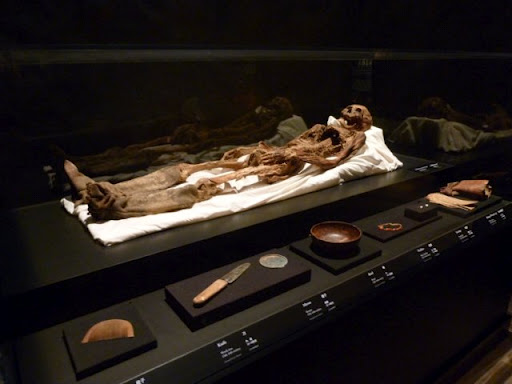
A Host of Mummies, a Forest of Secrets

In the middle of a terrifying desert north of Tibet, Chinese archaeologists have excavated an extraordinary cemetery. Its inhabitants died almost 4,000 years ago, yet their bodies have been well preserved by the dry air.

The cemetery lies in what is now China’s northwest autonomous region of Xinjiang, yet the people have European features, with brown hair and long noses. Their remains, though lying in one of the world’s largest deserts, are buried in upside-down boats. And where tombstones might stand, declaring pious hope for some god’s mercy in the afterlife, their cemetery sports instead a vigorous forest of phallic symbols, signaling an intense interest in the pleasures or utility of procreation.

The long-vanished people have no name, because their origin and identity are still unknown. But many clues are now emerging about their ancestry, their way of life and even the language they spoke.

Their graveyard, known as Small River Cemetery No. 5, lies near a dried-up riverbed in the Tarim Basin, a region encircled by forbidding mountain ranges. Most of the basin is occupied by the Taklimakan Desert, a wilderness so inhospitable that later travelers along the Silk Road would edge along its northern or southern borders.

In modern times the region has been occupied by Turkish-speaking Uighurs, joined in the last 50 years by Han settlers from China. Ethnic tensions have recently arisen between the two groups, with riots in Urumqi, the capital of Xinjiang. A large number of ancient mummies, really desiccated corpses, have emerged from the sands, only to become pawns between the Uighurs and the Han.

The 200 or so mummies have a distinctively Western appearance, and the Uighurs, even though they did not arrive in the region until the 10th century, have cited them to claim that the autonomous region was always theirs. Some of the mummies, including a well-preserved woman known as the Beauty of Loulan, were analyzed by Li Jin, a well-known geneticist at Fudan University, who said in 2007 that their DNA contained markers indicating an East Asian and even South Asian origin.

The mummies in the Small River Cemetery are, so far, the oldest discovered in the Tarim Basin. Carbon tests done at Beijing University show that the oldest part dates to 3,980 years ago. A team of Chinese geneticists has analyzed the mummies’ DNA.

Despite the political tensions over the mummies’ origin, the Chinese said in a report published last month in the journal BMC Biology that the people were of mixed ancestry, having both European and some Siberian genetic markers, and probably came from outside China. The team was led by Hui Zhou of Jilin University in Changchun, with Dr. Jin as a co-author.

All the men who were analyzed had a Y chromosome that is now mostly found in Eastern Europe, Central Asia and Siberia, but rarely in China. The mitochondrial DNA, which passes down the female line, consisted of a lineage from Siberia and two that are common in Europe. Since both the Y chromosome and the mitochondrial DNA lineages are ancient, Dr. Zhou and his team conclude the European and Siberian populations probably intermarried before entering the Tarim Basin some 4,000 years ago.

The Small River Cemetery was rediscovered in 1934 by the Swedish archaeologist Folke Bergman and then forgotten for 66 years until relocated through GPS navigation by a Chinese expedition. Archaeologists began excavating it from 2003 to 2005. Their reports have been translated and summarized by Victor H. Mair, a professor of Chinese at the University of Pennsylvania and an expert in the prehistory of the Tarim Basin.

As the Chinese archaeologists dug through the five layers of burials, Dr. Mair recounted, they came across almost 200 poles, each 13 feet tall. Many had flat blades, painted black and red, like the oars from some great galley that had foundered beneath the waves of sand.

At the foot of each pole there were indeed boats, laid upside down and covered with cowhide. The bodies inside the boats were still wearing the clothes they had been buried in. They had felt caps with feathers tucked in the brim, uncannily resembling Tyrolean mountain hats. They wore large woolen capes with tassels and leather boots. A Bronze Age salesclerk from Victoria’s Secret seems to have supplied the clothes beneath — barely adequate woolen loin cloths for the men, and skirts made of string strands for the women.

Within each boat coffin were grave goods, including beautifully woven grass baskets, skillfully carved masks and bundles of ephedra, an herb that may have been used in rituals or as a medicine.

In the women’s coffins, the Chinese archaeologists encountered one or more life-size wooden phalluses laid on the body or by its side. Looking again at the shaping of the 13-foot poles that rise from the prow of each woman’s boat, the archaeologists concluded that the poles were in fact gigantic phallic symbols.

The men’s boats, on the other hand, all lay beneath the poles with bladelike tops. These were not the oars they had seemed at first sight, the Chinese archaeologists concluded, but rather symbolic vulvas that matched the opposite sex symbols above the women’s boats. “The whole of the cemetery was blanketed with blatant sexual symbolism,” Dr. Mair wrote. In his view, the “obsession with procreation” reflected the importance the community attached to fertility.

Arthur Wolf, an anthropologist at Stanford University and an expert on fertility in East Asia, said that the poles perhaps mark social status, a common theme of tombs and grave goods. “It seems that what most people want to take with them is their status, if it is anything to brag about,” he said.

Dr. Mair said the Chinese archaeologists’ interpretation of the poles as phallic symbols was “a believable analysis.” The buried people’s evident veneration of procreation could mean they were interested in both the pleasure of sex and its utility, given that it is difficult to separate the two. But they seem to have had particular respect for fertility, Dr. Mair said, because several women were buried in double-layered coffins with special grave goods.

Living in harsh surroundings, “infant mortality must have been high, so the need for procreation, particularly in light of their isolated situation, would have been great,” Dr. Mair said. Another possible risk to fertility could have arisen if the population had become in-bred. “Those women who were able to produce and rear children to adulthood would have been particularly revered,” Dr. Mair said.

Several items in the Small River Cemetery burials resemble artifacts or customs familiar in Europe, Dr. Mair noted. Boat burials were common among the Vikings. String skirts and phallic symbols have been found in Bronze Age burials of Northern Europe.

There are no known settlements near the cemetery, so the people probably lived elsewhere and reached the cemetery by boat. No woodworking tools have been found at the site, supporting the idea that the poles were carved off site.

The Tarim Basin was already quite dry when the Small River people entered it 4,000 years ago. They probably lived at the edge of survival until the lakes and rivers on which they depended finally dried up around A.D. 400. Burials with felt hats and woven baskets were common in the region until some 2,000 years ago.

The language spoken by the people of the Small River Cemetery is unknown, but Dr. Mair believes it could have been Tokharian, an ancient member of the Indo-European family of languages. Manuscripts written in Tokharian have been discovered in the Tarim Basin, where the language was spoken from about A.D. 500 to 900. Despite its presence in the east, Tokharian seems more closely related to the “centum” languages of Europe than to the “satem” languages of India and Iran. The division is based on the words for hundred in Latin (centum) and in Sanskrit (satam).

The Small River Cemetery people lived more than 2,000 years before the earliest evidence for Tokharian, but there is “a clear continuity of culture,” Dr. Mair said, in the form of people being buried with felt hats, a tradition that continued until the first few centuries A.D.

An exhibition of the Tarim Basin mummies opens March 27 at the Bowers Museum in Santa Ana, Calif. — the first time that the mummies will be seen outside Asia.

Monday, March 8, 2010

The Wicker Man

The Wicker Man is set on fire to pay tribute to the gods. The sacrifice of the humans inside is part of a religious ritual to increase fertility, crops, commerce, or merely to re-ignite the chances that bad times will disappear.

According to Julius Caesar in his Commentarii de Bello Gallico (Commentary on the Gallic Wars), the Wicker Man was a large wicker statue of a human used by the ancient Druids (priests of Celtic paganism) for human sacrifice by burning it in effigy. Other records talk of people being placed inside.

Despite any debunking of Caesar's accounts by modern skeptics, the imagery of the burning of the Wicker Man lives on and its use cannot be denied in modern neo-pagan rituals. Whether the Wicker Man exists in historic Pagan accounts, in modern neo-Pagan events (such as at Nevada's Burning Man), or in movies and contemporary events, the symbolism is very real and powerful.

And quite obvious.

For those interested in deciphering the unfolding of the sacrifices (including murder-suicides and costumed violence of late) during these difficult times, please pay attention to these signs, noticed already by those to whom the twilight language is being directed.

As I already have mentioned in these pages, it goes beyond coincidence to find the moniker of the Wicker turning up during incidents from the Son of Sam killings to last year's Chicago area "Phantom Clown" sightings and near-abductions of children. Keep your eyes open.


From an article published this morning, comes news of this celebration:

A 12-foot tall Wicker Man will be set on fire tonight [Friday, January 30, 2009] in a pagan winter ritual close to the Fermanagh border [Northern Ireland].

[The name Fermanagh is an Anglicization of Fhear Manach which means "Men of the Manacháin tribe," so named after their chief O'Manacháin (Anglicized as O'Monaghan), the famous warrior monk. Contae Fhear Manach or Fear Manach = "Men of Monach" in Irish.]

The folk ceremony at Aughakillymaude Mummers Centre near Derrylin will celebrate the loosening of winter’s grip and the impending return of spring as it marks February 1, known as a Quarter Day in the Celtic agricultural calendar.

At 10 pm [local time] the straw mummers hats worn all winter by the troupe performing their traditional drama will be set on fire to mark the close of the mumming season and the Wicker Man will then be lit.

The huge figure has been created by model maker Gordon Johnston from flexible sally rods — willow rods used for wicker furniture and fencing. According to Jim Ledwith of the Mummers Foundation, little is known about the origins of the Wicker Man, apart from Julius Caesar’s second hand accounts of druidic winter rituals of human sacrifice during the Gallic wars.

These alleged that female slaves and criminals were burned alive inside effigies 100 times the size of the Fermanagh one.

“While the details of the wicker man ritual may have become coloured with the telling, it represents a tradition of sacrifice by burning practiced by the continental Celts.

“Indeed, the practice of human sacrifice was still prevalent in fifth and sixth century Ireland,” Jim said.

“Throughout Celtic Europe the wicker man legend lives on and the effigy is still burned ceremoniously as a mock sacrifice in themed ceremonies, especially at Beltaine (May) to mark the rite of spring — notably without the human sacrifice element.”

Mummers will light a gas beacon at Aughakillymaude to symbolise the sun’s return.

The 1973 movie The Wicker Man, starring Edward Woodward and Christopher Lee, is regarded as one of the finest horror films of all time, and it ends with Woodward, playing a police detective, being burned alive inside the chest of the effigy.

Don't Look Now an Anglo-Italian thriller, directed by Nicolas Roeg, was released in 1973. In the double-billing that took place back then, 1973's The Wicker Man was the "A" feature on their original UK theatrical dual release.

The figure of the "little person" in the red rain gear in Don't Look Now serves as a trigger or key. As Wikipedia notes, the "spiraling vortex of coincidences, recurring themes and motifs (light on water, breaking glass, the colour red)...reaches a dramatic conclusion in an old bell tower. John [Baxter, the lead character, played by Donald Sutherland] confronts the mysterious figure in red, realizing too late that his visions were premonitions of a grisly end."

A less well-remembered American remake of The Wicker Man, with Nicolas Cage in the lead, was released in 2006 with the film's tale being set on a private island in Puget Sound, Washington. In this 2006 version, a little girl is seen running around in a red coat. As well, there is a pair of twins, old women, both of whom are blind.

In the feature film Flatliners, Kiefer Sutherland is tormented by a small childlike figure in a red hooded coat in an homage to his father's film.

The theme of the little red-clad Venetian figure is used in a dream sequence in the "Book Clubbin'" episode of television series "Absolutely Fabulous," Series 5.

The Irish feature film Intermission (starring Colm Meaney and Colin Farrell) references Don't Look Now's chase of a small figure in a red coat several times.

Don't Look Now's drowning scene is referenced by the 2005 film The Dark starring Sean Bean and Maria Bello in which their daughter drowns wearing a bright red sweater.

In the 2005 film Hostel, a figure fleetingly glimpsed wearing a red raincoat is pursued through narrow alleyways.

The end chase scene of Don't Look Now is referenced in the 2006 release of Casino Royale where James Bond is pursuing Vesper through Venice while she is wearing a red coat.

The Wicker Man burns red.

Wednesday, October 14, 2009

True story about Atlantis - the Bimini Road

The world is filled with mysterious sites, lost cultures, megalithic structures, sacred palaces and unusual occurrences that have stirred the imagination and led to speculation about our true origin. The Quest for Atlantis and the search for a forgotten ancient mother culture has intrigued and inspired generations of scientists, explorers, philosophers and psychics throughout the ages. The Quest for Atlantis is like the Holy Grail. It lies at the core of our traditions and contains the seed not only of mystery but of challenge. The term Atlantis stands as a metaphor for the human yearning to explore the unknown and to follow the path of truth wherever it may lead. The Atlantis legend credited to the Greek Philosopher Plato has endured and symbolizes a dream of a golden age, a lost paradise, and it could help explain similarities between ancient cultures, legends of worldwide floods, and megalithic construction in the Old and New World.
First accounts of Atlantis were supplied by Greek philosopher Plato in the 4th century BC. In Plato's dialogues Timaeus and Critias, Atlantis is described as a vast paradise in the great ocean beyond the pi!lars of Hercules.
For generations there was peace and the people were true and noble and they showed gentleness and wisdom. But at the end the Atlantean society began to decay, the divine wisdom began to weaken and fade and it became diluted with lawlessness, ambition and power.
During the last days of Atlantis, about 12,000 years ago, the Atlanteans had lost their virtue and were amassing armies to conquer the world when the Earth shook and the islands disappeared into the depths of the sea. Atlantis was a civilization unequalled before or since, yet it is said it vanished in little more than a single day, leaving not a trace behind.
In 1930, Edgar Cayce, one of America's most famous and well documented psychics, predicted that the remains of Atlantis would be found near Bimini in '68,'69. According to Edgar Cayce, many people living today are former Atlanteans, who are drawn back at this time to find Atlantis, to receive enlightenment and to help heal themselves and this ancient site from past turmoil. Edgar Cayce also predicted that a Healing Well could be found and developed into a centre for two purposes, regeneration for those with certain types of ailments, and a centre for archaeological research.
In 1612 an Indian legend was translated that described an island called "Bemene", where old people could bath and emerge young once more. Spanish explorer, Ponce de Leon, searched for "Bemene" and the fountain of Youth in vain. On "Bimini" a small spring has been discovered that contained some levels of lithium and sulphur, and where some people have reported an increase of well-being, euphoria and alleviation of certain ailments like arthritis.
Bimini glistens like a jewel in the azure Gulf Stream and is an enigma in many ways. Its layer of legends: Fountains of Youth, Atlantean remains, Healing Waters and Megalithic Stones all fuse in a dynamic crucible of energy and lore. Is Bimini part of the lost continent of Atlantis?
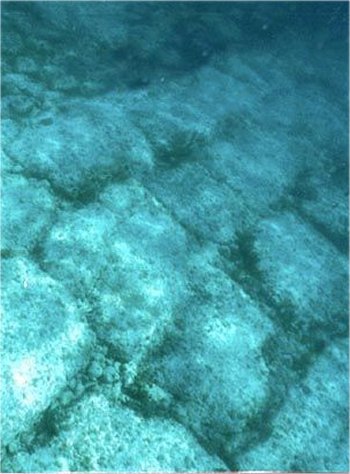
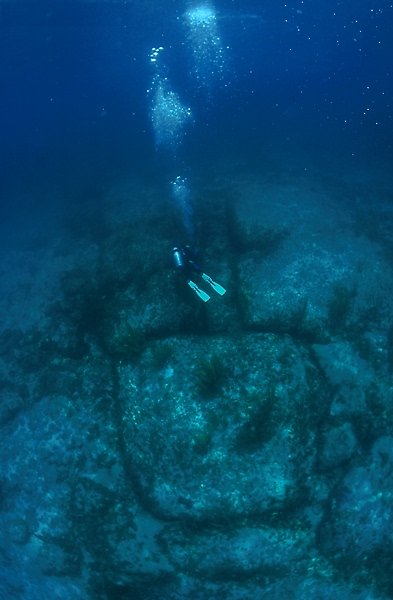
In September of 1968, on Bimini, a most exciting discovery was made. Dr Mason Valentine, zoologist, paleontologist, geologist, and underwater archaeologist was guided by Bonefish Sam to shore reef for some diving. When he looked down he saw hundreds of flat rocks eight to ten feet square arranged in regular patterns about a thousand yards from shore in about 10 feet of water. Today his discovery is called the „Bimini Road¾ and it is approximately 300 feet wide and 1600 feet long.
I was amazed to discern an extensive pavement of rectangles and occasionally polygonal flat stones of varying size and thickness, obviously arranged and accurately aligned to form convincing engineering courses. These stones had evidently been submerged over a long span of time for the edges of some had become rounded giving the blocks the appearance of giant loaves of bread or pillows. My personal feeling is that the whole fantastic complex represents the intelligent utilization by ancient man of material provided by nature and appropriate for the creation of some sort of ceremonial center.¾
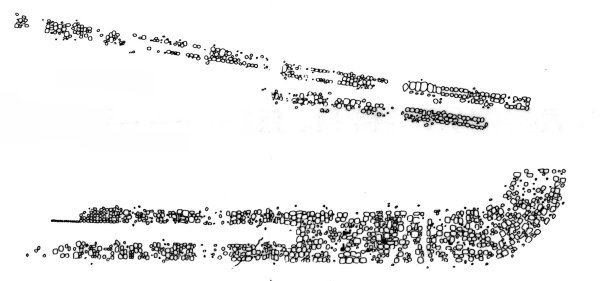
After researching the area, Dr. Valentine has refuted the scientific claims that the road site is natural beach rock by explaining that many of the stones are of flint-hard micrite, unlike soft beach rock; that the stones do not follow the curving beach rock lines; that some of the enormous flat stones are propped up at the corners by pillar stones like dolmens and one end of the complex swings into a beautiful curved corner before vanishing under the sand. Dr. Valentine has studied the Bahamas for 30 years and has numerous sites for potential investigation. Dr. Valentine¼s discovery occurred precisely the time that Edgar Cayce had predicted that the remains of Atlantis would be found near Bimini.
Since that time many others have studied this amazing complex. Veteran French engineer, diver and pilot Dimitri Rebikoff, a pioneer of underwater photography and inventor of the Pegasus, an underwater platform, has carried out underwater and aerial photomapping of the Bimini Site. From 1969 to 1978, Dimitri Rebikoff has compiled a stereoscopic mosaic survey of the Bimini Road and continues to investigate the support pillars under some of the huge blocks.
In 1974 Dr. David Zink, prehistorian, and explorer came to Bimini to investigate the mysterious stones. Dr Zink has conducted extensive underwater surveying and archaeological work on Bimini that has included professional surveys, use of side-scan sonar and nuclear activation analysis. His scientific approach of exploring ancient mysteries has utilized U.S. Navy divers, as well as psychics in conjunction with standard archaeological practices. Dr Zink has led 10 expeditions to Bimini and is author of The Ancient Stones Speakand The Stones of Atlantis. More of Dr. Zink¼s discoveries are discussed in his revised 1990 edition of The Stones of Atlantis. Dr Zink has concluded the site was built by man as a megalithic temple similar to Stonehenge.
It has been 22 years since the discovery of the Bimini Road Site and much has happened. In the last two decades advances in technology, breakthroughs in consciousness and the greater understanding of the sophistication of prehistoric civilizations has occurred.
In 1989, Dr. Joan Hanley, founder of the Gaea Project, Dr David Zink and myself, came together and created Quest for Atlantis. We developed a conference with a multilevel approach that included on-site investigation, underwater exploration, aerial fly-bys and Healing Well experiences.
During the project, our group headed out for Paradise Point looking for the ancient stones in the vast ocean. Visibility was unlimited as our diving boat stopped and the divers and snorkelers entered the water. We were amazed at the incredible site we saw. Large regular boulders far more impressive than we had imagined, all fitted neatly in rows extending beyond our sight. Later during the conference while conducting aerial fly-bys with Dimitri Rebikoff as pilot, members of the flight observed a mysterious fish like mound over 500 feet long in the mist of the mangrove swamp. Although there were reports of a fish mound before it does not appear on any maps.
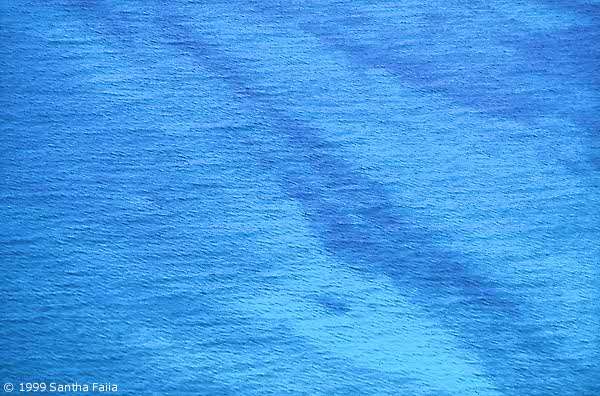
Enthusiasm was high as the group pondered the significance of a possible man made mound similar to the earthen works of the American Mound Builders on this remote island in the Bahamas. Later in the week we headed out for the Legendary Healing Well or possible Fountain of Youth. The ocean shimmered in various colors of unbelievable hues of blue as we left for the Northeast tip of the island. We arrived at a dense mangrove area and anchored in shallow water. A narrow path had been cut and we carefully waded through the root tangled path that led to a small pond.
The surface was warm sea water floating over that cool spring below. The water was abnormally buoyant and we floated effortlessly in the small pond. After getting used to the greenish water and the initial giggles, a peaceful feeling came over us. We meditated allowing the sense of well-being to spread and enfold our bodies. We left feeling emotionally balanced, and with a sense of profound peace.
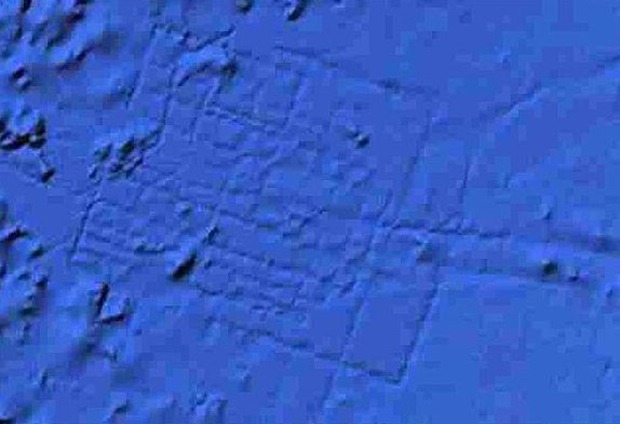
After the conference, Raymond E. Leigh, a land surveyor commissioned a Miami aerial surveying firm to take infrared aerial photographs over Bimini at various heights. In the process of exploring the fish-mound from the air he discovered a rectangular mound and a cat mound. By conducting an in depth study of the mathematical data on Bimini, Raymond feels he has found similarities between ancient units of measurement. The fish fin has an east-west orientation. Calculations of the various dimensions of the mounds and painstaking analysis of the aerial photos revealed a recognition Golden Section (1 to 0.618) in the geometry of the Bimini Mounds.
In May 1990, Quest for Atlantis II again brought diverse expertise together. Dr. Joan Hanley, Dr. Doug Richards, zoologist and Director of Research for Atlantis University and myself created the second conference. Various explorers with diverse expertise attended. The conference focused on investigating mounds, a search for other wells and interviews with the elders of the island to preserve their stories and experiences.
The Quests were filled with adventure and opportunities in mind body and spirit to assimilate and integrate greater wholeness. The Quest is to touch something of the Divine and move from seeking to deep inner knowingness. The Quest stirs each generation. It asks us to remember and bring forth the truth about our spiritual and historical heritage. The time of revealing ancient records is dawning.
Old forms are giving way to new possibilities and the key to the new forms is in personal and group empowerment that include freedom and self-expression, integrity, interdependence, partnership, trust and action. We are all learning to understand the process of shared vision and right human relationship with ourselves, others and Mother Earth.
Mystery still surrounds the discoveries man made in ancient times and by others to be natural formation of beach rock, the Bimini Road Site has launched a multitude of questions and the controversy continues to this day. If these sites are not part of the sunken continent of Atlantis, they are very likely remains of some other ancient Old World Civilization and when identified will shed more light on our ancient past and who discovered the New World.
I know in my heart that the Healing Well is real and there is definite evidence of a very ancient culture in Bimini. There are many who have dedicated their lives and resources to research the evidence on this small island and there are many more to follow. The people drawn to Bimini and these projects are drawn together by a deep bond and a love of prehistory and Atlantis lore. The full realization of what the Lost Atlantean wisdom represents contains the seed of hope. Can we live together in harmony with universal energies? I know by bringing diverse disciplines and expertise together in a co-operative spirit we can help solve the mysteries and realize greater peace.
Today the possibilities of new discoveries as we search for the truth are limitless. It seems that mystery and imagination are vital in rediscovering the clues of the past. Paradoxically as science advances its storehouse of knowledge even more imagination and spirit are needed.¾ Albert Einstein in 1930.


Thursday, August 6, 2009

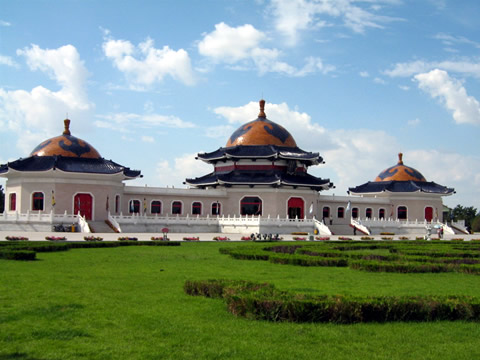
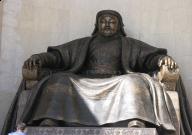
Genghis Khan Tomb

According to legend, Genghis Khan lies buried somewhere beneath the dusty steppe of Northeastern Mongolia, entombed in a spot so secretive that anyone who made the mistake of encountering his funeral procession was executed on the spot.
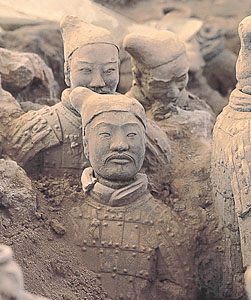
Once he was below ground, his men brought in horses to trample evidence of his grave, and just to be absolutely sure he would never be found, they diverted a river to flow over their leader's final resting place.

What Khan and his followers couldn't have envisioned was that nearly 800 years after his death, scientists at UC San Diego's Center for Interdisciplinary Science in Art, Architecture and Archaeology (CISA3) would be able to locate his tomb using advanced visualization technologies whose origins can be traced back to the time of the Mongolian emperor himself.

"As outrageous as it might sound, we're looking for the tomb of Genghis Khan," says Dr. Albert Yu-Min Lin, an affiliated researcher for CISA3. "Genghis Khan was one of the most exceptional men in all of history, but his life is too often dismissed as being that of a bloodthirsty warrior. Few people in the West know about his legacy — that he united warring tribes of Mongolia and merged them into one, that he introduced the East to the West making explorations like those of Marco Polo possible, that he tried to create a central world currency, that he introduced a written language to the Mongol people and created bridges that we still use today within the realm of international relations.

"But as great a man he was, there are few clues and no factual evidence about Genghis Khan's burial, which is why we need to start using technology to solve this mystery."

Lin and several colleagues — including Professor Maurizio Seracini, the director of CISA3 and the man behind the search for Leonardo da Vinci's lost "Battle of Anghiari" painting — are hoping to use advanced visualization and analytical technologies available at the California Institute for Telecommunications and Information Technology (Calit2) to pinpoint Khan's tomb and conduct a non-invasive archaeological analysis of the area where he is believed to be buried. Lin plans to work with Seracini to establish a position at UCSD that will allow him to spearhead the three-year Valley of the Khans project, which will require $700,000 in funding for eight researchers (including all expedition costs).

Khan's grave is presumably in a region bordered by Mongolia's Onon River and the Khan khentii mountains near his birthplace in Khentii Aimag, and some experts believe his sons and other family members were later buried beside him. The researchers, however, have little additional information to go on. Directly following Khan's death in 1227, the area around his tomb was deemed forbidden by the emperor's guards, and later in the 20th century, by strict Russian occupation, which prohibited Mongolians from even talking about Genghis Khan because they felt it might lead to nationalist uprising. Only since the 1990s have researchers been allowed in the area, and several other research teams have tried unsuccessfully to locate the tomb.

Lin hopes of success are based on his access to unparalleled technology at Calit2 and CISA3 to pinpoint the area where Khan might have been laid to rest, find the tomb itself and then develop a virtual recreation of it using various methods of spectral and digital imaging.

Explains Lin : "If you have a large burial, that's going to have an impact on the landscape. To find Khan's tomb, we'll be using remote sensing techniques and satellite imagery to take digital pictures of the ground in the surrounding region, which we'll be able to display on Calit2's 287-million pixel HIPerSpace display wall. But we also want to make this an interactive research project and get the public involved. One of our ideas is to utilize something like the International Space Station's 'EarthCam' program at UCSD, which recruits middle school students to control a satellite camera and take pictures of the earth. We'd have them do the same thing, only they'd be taking pictures of the area where Genghis' tomb might be located."

Lin says another approach would be to combine social networking with visualization techniques to replicate something like the online "Find Steve Fossett" project, which enlisted members of the general public to flag anomalous satellite images in the hopes that they could locate the missing adventurer.

"Once we've narrowed down this region in Mongolia to a certain area," Lin continues, "we'll use techniques such as ground penetrating radar, electromagnetic induction and magnetometry to produce non-destructive, non-invasive surveys. We'll then work with people in UCSD's electrical engineering department to develop visual algorithms that will allow us to create a high-resolution, 3-D representation of the site."

Notably, these computer-based technologies are modern evolutions of moveable type and the printing press — innovations that historian Jack Weatherford argues were spread by way of the Mongols as they conquered parts of Europe (Chinese printing technologies predated Gutenberg's printing press by several hundred years). Lin speculates that remnants of those international conquests might even turn up in Khan's tomb, but, he adds, "The process of doing an archaeological dig is up to the Mongolian government."

Lin says he's hoping to collaborate with the Mongolian government and national universities, through the help of Amaraa and Bayarsihan Baljinnayam — siblings from what he endearingly calls his "Mongolian family." They will assist with language interpretation and expedition coordination, and most importantly, local media and political support — connections that will prove very useful as Lin navigates through the often complex arena of international relations.

Noting that his project team also includes San Diego State University Professor of Chemistry and Biochemistry William G. Tong, UCSD Field Systems Engineer Nathan Ricklin, UCSD Computer Vision Engineer Shay Har-Noy and Independent Engineering Geologist Charles Ince, Lin says he sees parallels between the collaborative work he's doing with CISA3 and Genghis' own push to adapt to new technologies.

"He took the best resources of entire world — whether weaponry or medicine -- and adopted those technologies into his own methodology. We're trying to implement that same adaptation to many disciplines into our own work. We're taking the great work that's already been done in archaeology and further developing it by using technologies from other disciplines -- computer vision, social networking, electrical engineering — while at the same time never forgetting fundamentals of historical search.

Despite the technologies and expertise available to him, Lin says he is well aware of the great challenges the project poses. "One consistent fact is that there is no fact," he admits. "It's a story of secrets upon secrets and myths upon myths.

"If I could meet Genghis Khan today, I would ask how he would have wanted to be remembered in history," Lin muses. "The fact that he died in his bed surrounded by people who loved him and never had a single General turn his back on him, the fact that the loyalty of his people is so sound it can be heard across the world — these are the marks of one of the most impressive military heroes of all time. This is an example of a leader who was ruthless, strict, disciplined, and in a lot of ways, extremely honorable. If he was able to rewrite his own history, I wonder how he'd want it heard."

Thursday, July 2, 2009

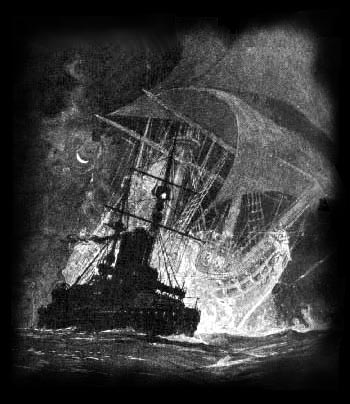
Flying Dutchman

If you have heard of Captain Jack Sparrow in relation to At World's End, chances are you have at least heard the name, "Flying Dutchman". Although the movie gives scant detail of the actual legend, it does play it out at least in part. More than just the magnificent brainchild of screenwriters and the "magicians" at Industrial Light & Magic (ILM), the Flying Dutchman has roots in folklore as old as the pirates themselves-perhaps much older.
In keeping with "campfire ghost stories", the legend of the Flying Dutchman is one of those stories that crews might pass along during a nerve-itching fog or in waters where veteran sailors may have warned of horrendous beasts and ghosts of shipwrecked sailors. True maritime mysteries like the Marie Celeste would-in their day-only add to the mystique and fear of the Flying Dutchman's reputation. Like many legends, the story of the Flying Dutchman has many versions, all with certain similarities. Those similarities, in turn, share some commonality with legends and myths that precede it. As an overall principle, the legend states that the Flying Dutchman is a ghost ship that serves as a warning of impending tragedy. The first of such legends was written in 1795, when Irish pickpocket George Barrington wrote Voyage to Botany Bay. According to his report, sailors told a story of a Dutch Man-of-War (a type of ship) lost at sea during a horrendous storm. That same ship was later imagined to harrass and wreck other ships in bouts of ghastly fog. A suspected personage for the ship's captain was Bernard Fokke, a captain known for what some would call "devilish" speed on trips from Holland to Java. Some quite seriously postulated that Fokke was aided by the Devil, and thus he became ideal for the legend of the Flying Dutchman. Others claim to have seen the ship at the Cape of Good Hope, and the tutor of Prince George of Wales claimed to have seen the ghost ship near Australia in the late 19th century.
Despite the descriptions of ghoulish glows and the like, scientists have offered a more, well, scientific explanation. Called Fata Morgana (named for the legendary sorceress half-sister of King Arthur), the mirage would occur when warm air rested (in calm weather) right above dense, cold air near the surface of the ocean (though the effect also takes place on the ground in mountainous regions). The air between these two masses acts as a refracting lens, which will produce an upside-down, distorted image of the upright object within these masses of air. Even though a ship may be beyond the horizon, the observing ship may see an inverted, blurry image of the "mirage ship". The mirage ship could appear several times larger than its actual size, it may appear much closer, and the colors (due to the sun's position) may be distorted.
Despite modern scientific explanations, legends of the Flying Dutchman serve to stimulate the imaginations of sailors, movie audiences, authors, and others in the creative arts. Like the headless horseman of Sleepy Hollow or the creatures of The Village, such legends can serve to entertain us or frighten us into submission. Unlike Pirates of the Carribean, very few of the tales of the Flying Dutchman involve a giant sea beast, but instead serve as a warning of coming disaster. Whatever their intent at their advent, such tales-as benign as they seem in the modern world of scientific explanations-serve well to keep even the most veteran sailors on the lookout for true-to-life maritime dangers.

Flying Dutchman, Selected Sightings

While most people agree the “history” of the ship is a legend, the Flying Dutchman has been sighted by reliable witnesses. All of these were in the Cape of Good Hope. Lighthouse keepers reported seeing her.
  • 1823: Captain Owen, HMS Leven, recorded two sightings in the log.
  • 1835: Men on a British vessel saw a sailing ship approach them in the middle of a storm. It appeared there would be a collision, but the ship suddenly vanished.
  • 1881: Three HMS Bacchante crewmembers, including King George V, saw the ship. The next day, one of the men who saw it fell from the rigging and died.
  • 1879: The SS Pretoria’s crew saw the ghost ship.
  • 1911: A whaling ship almost collided with her before she vanished.
  • 1923: Members of the British Navy saw her and gave documentation to the Society for Psychical Research, SPR. Fourth Officer Stone wrote an account of the fifteen minute sighting on January 26th. Second Officer Bennett, a helmsman and cadet also witnessed the ship. Stone drew a picture of the phantom. Bennett corroborated his account.
  • 1939: People ashore saw the Flying Dutchman. Admiral Karl Doenitz maintained U Boat crews logged sightings.
  • 1941: People at Glencairn Beach sighted the phantom ship that vanished before she crashed into rocks.
  • 1942: Four witnesses saw the old ship enter Table Bay, then vanish. Second Officer Davies and Third Officer Montserrat, HMS Jubilee, saw the Flying Dutchman. Davis recorded it in the ship’s log.
  • 1959: The Straat Magelhaen nearly collided with the ghost ship.

The Legend

The legend of The Flying Dutchman is said to have started in 1641 when a Dutch ship sank off the coast of the Cape of Good Hope: Captain van der Decken was pleased. The trip to the Far East had been highly successful and at last, they were on their way home to Holland. As the ship approached the tip of Africa, the captain thought that he should make a suggestion to the Dutch East India Company (his employers) to start a settlement at the Cape on the tip of Africa, thereby providing a welcome respite to ships at sea. He was so deep in thought that he failed to notice the dark clouds looming and only when he heard the lookout scream out in terror, did he realise that they had sailed straight into a fierce storm. The captain and his crew battled for hours to get out of the storm and at one stage it looked like they would make it. Then they heard a sickening crunch - the ship had hit treacherous rocks and began to sink. As the ship plunged downwards, Captain VandeDecken knew that death was approaching. He was not ready to die and screamed out a curse: "I WILL round this Cape even if I have to keep sailing until doomsday!" So, even today whenever a storm brews off the Cape of Good Hope, if you look into the eye of the storm, you will be able to see the ship and its captain - The Flying Dutchman. Don't look too carefully, for the old folk claim that whoever sights the ship will die a terrible death. Many people have claimed to have seen The Flying Dutchman, including the crew of a German submarine boat during World War II and holidaymakers. On 11 July 1881, the Royal Navy ship, the Bacchante was rounding the tip of Africa, when they were confronted with the sight of The Flying Dutchman. The midshipman, a prince who later became King George V, recorded that the lookout man and the officer of the watch had seen the Flying Dutchman and he used these words to describe the ship: "A strange red light as of a phantom ship all aglow, in the midst of which light the mast, spars and sails of a brig 200 yards distant stood out in strong relief." It's pity that the lookout saw the Flying Dutchman, for soon after on the same trip, he accidentally fell from a mast and died. Fortunately for the English royal family, the young midshipman survived the curse.

source 1 2 3