Showing posts with label Aliens (3td kind). Show all posts

Thursday, February 2, 2012

Hollow moon - alien base?

The United States and the Soviet Union started to send probes to the Moon in the late fifties. Most of these initial probes met with miserable failure. It is posited here that the reason for these early failures were due to a miscalculation of the lunar gravitational gradient.
This is because in the case of a hollow spheroid the center of mass is much closer to the surface of the moon if in fact the moon is hollow than if it really were a homogenous mass of rock. The location of the center of mass of any celestial object is critical in determining it's gravitational gradient, hence the final velocity of any object required to soft-land or otherwise come in contact with the moon would not be known unless the location of the center of mass is somehow determined.

Saturday, December 31, 2011

Valley of the Pyramids in the Peru


Peru is rapidly becoming the capital of the pyramid world. Not only does it have the oldest officially recorded pyramid in the world (Caral), with each archaeologist’s spade dig, more pyramid complexes are uncovered.

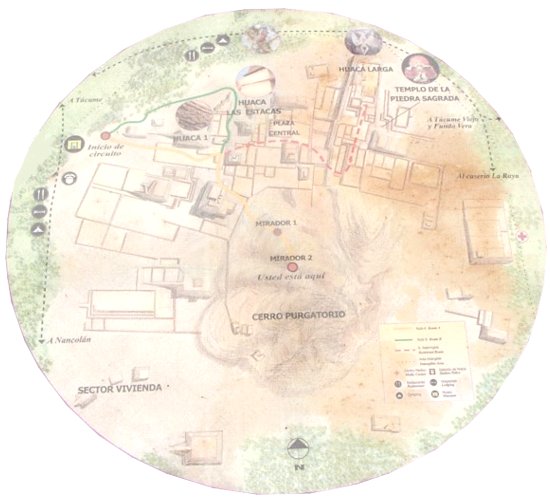
Purgatorio (purgatory) is the name by which local people refer to the dozens of prehispanic pyramids, enclosures and mounds found on the plain around La Raya Mountain, south of the La Leche River. The Lambayeque Valley boats scores natural and man-made waterways. lt is also a region of numerous pyramids.

It has no less than three pyramid cities, which together have a stunning total of 250 pyramids. The three cities were built in succession of each other, each abandoned before a new one was built.
The first is known as Pampa Grande and was built between 600 and 750 AD. In 700 AD, the pyramid of Pampa Grande, known as Huaca Fortaleza, was built, reaching fifty metres high, and measuring 200 metres in width. Though much of the structure remains intact, visually, it is not all that impressive. The next complex was that of Batan Grande, built between 750 and 1100 AD. The city had 34 pyramids, including the Huaca de Oro (Pyramid of Gold), in front of which a series of royal tombs were located. The pyramids are now badly eroded, due to El Niño rains in 1982 and 1998. But the biggest destruction to the site was man-made when in ca. 1100 AD, the pyramid was burnt and the town abandoned, to be succeeded by Tucume, from 1100 AD until 1500 AD.

The site of Tucume, covering an area of over 540 acres and encompassing 26 major pyramids and platforms, is part of the Lambayeque Valley, the largest valley of the North Coast of Peru. The local shamans still invoke its power and of the gods that once resided in these structures. Specifically, the gods lived in the mountains, but the pyramids were seen as replica mountains, in the hope of being able to work with the forces of nature. The local shamans are also the record keepers of the legends, including one legend recorded by Father Cabello de Balboa in 1586 AD. It relates how Cala, a grandson of Naymlap, the founder of the Lambayeque royal dynasty, declared that Tucume would become the new metropolis for his people. Cala seems to have been an exile from Batan Grande.

Tucume lies on what was once the southern margin of the valley, but thanks to the Taymi irrigation canal (over 43 miles long), which brings water northward from the Chancay river, it is surrounded by fertile agricultural land. lt seems very likely that the construction of the Taymi canal coincided with the foundation of Tucume, an important center of the region throughout its 400-year history. Modern Tucume, which lies very close to the site and boasts its own prehispanic village pyramid, Huaca del Pueblo, is located 17 miles north of the city of Chiclayo.

The largest and most impressive pyramids are found in the monumental sector of the archaeological site, to the north and northeast of La Raya Mountain (“Mountain of the Ray”). Investigations carried out in conjunction with Thor Heyerdahl, the famous Norwegian seafarer and explorer, have concentrated on three major structures: Huaca Larga, Huaca 1 and The U-shaped "Temple of the Sacred Stone". Excavations in non-monumental areas have yielded many details about the functioning of the site -some prefer the term city- and about the lives of its inhabitants.
The "Temple of the Sacred Stone" is a small, unpretentious, rectangular U-shaped structure to the east of Huaca Larga. lt is considered a major temple that travelers had to pass by before entering the site. The walled roadway system of this section of the Lambayeque valley leads straight to this temple and then on to Huaca Larga.
The special, revered object of this temple appears to have been a large, upright boulder in the middle of the one-room building, but whom or what it represented remains unknown. Furthermore, archaeologists found an enormous number of offerings in and around the temple. These offerings included valuable Spondylus shells (a seashell) brought from the coast of Guayaquil, slaughtered lamas and intriguing sheet-metal miniatures representing a wide range of themes and objects (flora, fauna, ornaments, musical instruments, tools, etc.). The most delicate of Inca offerings, figurines made of solid silver or carved Spondylus and adorned with elaborate textiles, silver tupu-needles and miniature feather headdresses, were found deposited in ritual fashion by the doorway of the temple. Researchers have found similar offerings, sometimes together with human sacrifices, at other major Inca shrines. For example, just a few years back a researcher exploring the top of the snow-capped Ampato Mountain in the southern Peruvian department of Arequipa found the intact mummy of an Inca girl, whom he nicknamed "Juanita".

The Túcume area has been slated for tourism development in Peru, however, concerns have been raised over the development of the site without proper attention to conservation. The site's listing in 2004 attracted substantial private-sector support for the site's preservation, but a long-term plan for the conservation of its fragile and eroding remains has yet to be developed.


Wednesday, November 30, 2011

The Tikal/Mars mystery

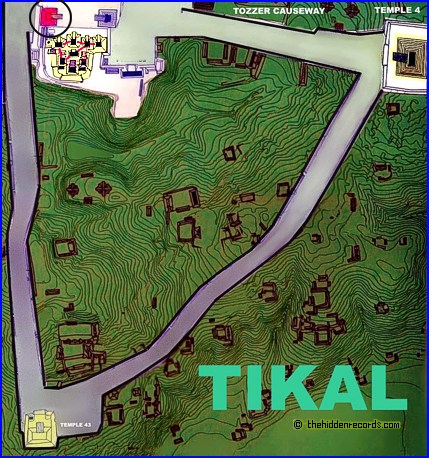
Many calling Tikal one of the most spiritually powerful spots on earth. The monumental site with its towering pyramids looms out of the thick jungle canopy like stoic sentinels of ancient mysteries.
The largest pyramid in Tikal - the most sacred monument of the ancient Mayan.
Tikal was once a wealthy metropolis of 100,000 inhabitants and the seat of power for the great Jaguar clan lords. Today, Tikal attracts archeologists from all around the globe and the wild-live surrounding the ruins makes it a naturalist's dream.
The earliest pyramids in Guatemala display exactly the same layout plan to that of a series of ruins found on another planet… Mars!
The pyramids ruins of Mars and at Tikal mirror the Pleiades stars. Note also how the Maya pyramids of Tikal match the grouping of pyramids on Mars on their own. Is this just a coincidence? There is more. Every little anomaly in the Mars image has its counterpart. The important meaning of these star maps is the 'x' that marks the spot monument. It is the most accurate correlation to date! As already suggested, the star that correlates with the ‘face’ structure only fits if we set a star atlas computer program to run back in time to an ancient epoch!
All in all, the Tikal pyramids, Pleiades star map in our sky, and the Cydonia on Mars all match.


Thursday, November 24, 2011

Triangle-shaped ‘alien skull’ found in Peru

Just like every other time an inexplicable artifact surfaces only to be later discredited in a far less high profile news story, a supposed alien skull has allegedly been located in Peru.
Peruvian anthropologist Renato Davila Riquelme has discovered what appear to be the mummified remains of an alien-like creature, including a "triangle shaped" skull nearly as big as its 20-inch-long body.
Has the Kingdom of the Crystal Skull --the setting for the underwhelming 2008 Indiana Jones vehicle--finally been discovered? Well, don't be expecting a victory lap from Steven Spielberg or George Lucas anytime soon.
Riquelme himself posits that the remains are those of a child. Peruvian news site RPP however, has interviewed several (conveniently anonymous) Spanish and Russian scientists who claim the remains are actual those of an extraterrestrial, supported by the clearly "alien" skull.
The remains of an eyeball in the right socket will help determine its genetic DNA – and clear up the controversy if it is human or not. Another possible explanation for the skull is tribal ritual, which has in certain regions been known to involve skull modification. The practice has been known to occur for at least the past 9,000 years, and the paper says:
To achieve the desired shape, the head was wrapped in tight cloth. In the case of cranial flattening, the head was placed between two pieces of wood. The technique would usually be carried out on an infant, when the skull is at its most pliable. The cloth would be applied from a month after birth and be held in place for about six months.

Do you think there’s any chance at all the alien skull in Peru is a true extraterrestrial find?

Wednesday, December 15, 2010

Eerie Creature from Berwick

A deer hunter captures a spooky image wandering through the Louisiana woods at night.A hunter near Baton Rouge says he found this freaky photo on his deer stand camera.The hunting camera was broken but the memory card was still there and so was this bizarre image.It looks like a cross between a human and an animal, with long slender appendages and glowing eyes.The hunter says he just hopes it's a vegetarian, if he runs into it in the woods again.

Most people suspect it’s a hoax. I mean; how cold it not be? There’s nothing on whether the camera was supposed to be recording video or a series of stills. Either way; you’d expect more evidence from the memory card.
Most people suspect it’s a hoax. I mean; how cold it not be? There’s nothing on whether the camera was supposed to be recording video or a series of stills. Either way; you’d expect more evidence from the memory card. Most people suspect it’s a hoax. I mean; how cold it not be? There’s nothing on whether the camera was supposed to be recording video or a series of stills. Either way; you’d expect more evidence from the memory card. Most people suspect it’s a hoax. I mean; how cold it not be? There’s nothing on whether the camera was supposed to be recording video or a series of stills. Either way; you’d expect more evidence from the memory card.
Most people suspect it’s a hoax. I mean; how cold it not be? There’s nothing on whether the camera was supposed to be recording video or a series of stills. Either way; you’d expect more evidence from the memory card.

Read more about The Berwick woods monster by http://nullMost people suspect it’s a hoax. I mean; how cold it not be? There’s nothing on whether the camera was supposed to be recording video or a series of stills. Either way; you’d expect more evidence from the memory card.

Friday, June 25, 2010

The Baigong Pipes

Do modern metal pipes buried in ancient Chinese stone prove that aliens must have visited?

Should you happen to visit Tibet anytime soon, be sure to stop by the city of Delingha. It's a town of most extraordinary beauty, nestled on the edge of the Qaidam Basin below a range of Himalayan hills. There you'll find the local residents proudly displaying their most famous distinction. For a few yuan you can probably get someone to take you to see it. Only a short journey outside of town is said to be a cave, and in this cave are a series of ancient metal pipes. These pipes predate all known history, and are embedded into the rock itself. They are said to lead through the very mountain, and connect to a nearby salt lake. The explanation? Ruins of a construction project 150,000 years ago, by alien visitors.

The Baigong Pipes are an example of what paranormal enthusiasts refer to as "out of place artifacts", modern objects discovered in ancient surroundings. The Baigong Pipes are described as a sophisticated system of metal pipes, buried in geology in such a way that precludes the possibility of having been installed in modern times. They are located on Mt. Baigong in the Qinghai province of China, about 40 kilometers southwest of Delingha. Most accounts describe a pyramid-shaped outcropping on the mountain, and the cave containing the pipes is on this pyramid. 80 meters from the mouth of this cave is a salt lake (the twin of an adjacent freshwater lake), and more pipes can be found poking up along the shore. Most of the information you can find online about the Baigong Pipes appears to be originally sourced from a 2002 article from the Xinhua News Agency, talking about preparations by a team of scientists about to embark to this remote area to study the pipes. "Nature is harsh here," said one. "There are no residents let alone modern industry in the area, only a few migrant herdsmen to the north of the mountain."

The two lakes are broad, shallow sinks at the low point of the vast Qaidam Basin. Searching for Mt. Baigong is likely to be fruitless: First, the area is largely flat and the nearest mountains are 20 or 30 kilometers away; second, baigong is a local word for hill and could mean anything in this context. The southernmost of the two lakes, Toson Hu or Lake Toson, has some low bluffs here and there along its southern and western sides (Google Maps link), and it is in one of these bluffs (about 50 or 60 meters in height) that author Bai Yu once happened to find what he described as a small cave, according to his book Into the Qaidam.

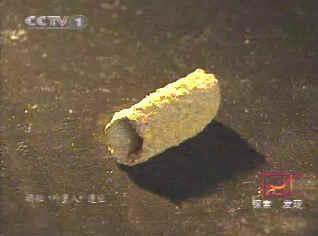
Bai was traveling the area in 1996, and described a lifeless lake surrounded by cone-shaped hills. The cave appeared to have been artificially dug, and was triangular, about six meters deep. Nearby were two similar caves, but they had collapsed and could not be entered. But what struck Bai was the array of manufactured metal pipes protruding up through the floor of the cave and embedded within its walls, one 40 cm wide. Following their path outside, Bai discovered more pipes protruding from the surface of the conical hill, and even more of them 80 meters away from the cave along the shore of the lake. Excited, he removed a sample and sent it to the Ministry of Metallurgical Industry. The result was 92% common minerals and metals, and 8% of unknown composition.

Bai proceeded about 70 kilometers to the Delhi branch of China's Purple Mountain Observatory, a high vantage point from where he knew he could get a birds-eye view of the whole region. He saw great expanses of flat, open terrain, and putting two and two together, he concluded that this would make for a fine alien landing site. Unknown minerals and plentiful landing space meant that the Baigong Pipes had to be of alien origin.

Scientists from the China Seismological Bureau visited the lake in 2001 to examine the pipes. Samples brought back to the Beijing Institute of Geology were examined by thermoluminescence dating, a technique that can determine how long it's been since a crystalline mineral was either heated or exposed to sunlight. The result came back that if these were indeed iron pipes that had been smelted, they were made 140-150,000 years ago. Human history in the region only goes back some 30,000 years, and so the alien theory seemed to have been confirmed. The following year the Xinhua news story was published, and the Baigong Pipes entered pop culture as, supposedly, genuine, tangible evidence of alien visitation.

If you visit the area today, you'll find a locally-built monument to the aliens off the main highway, replete with a mockup metallic satellite dish. Internet forums buzz with the absence of followup articles by Xinhua; the natural conclusion is that it turned out the alien explanation was the true one and the Chinese government is suppressing any further reporting. Cracked.com touts the Baigong Pipes as one of Six Insane Discoveries that Science Can't Explain.

And although that's where most reporting of the Baigong Pipes stops, it's also where responsible inquiry should begin. When you settle on a paranormal explanation, it means you've decided there is no natural explanation. In fact, when you don't yet know the explanation, you don't yet know the explanation; so you can't reasonably decide that the time is right to stop investigating. But so many do.

Skeptical hypotheses have already been put forward, seeking a natural explanation for the Baigong Pipes that doesn't require the introduction of a wild assumption like alien visitation. The first thing we turn to are geological processes that might explain them. The Chinese have put forth several such hypotheses, including one involving the seepage of iron-rich magma into existing fissures in the rock.

A 2003 article in Xinmin Weekly described how this might work. Fractures caused by the uplift of the Qinghai-Tibet plateau could have left the ground riddled with such fissures, into which the highly pressurized magma driving the uplift would have been forced. Assuming this magma was of the right composition that, when combined with the chemical effects of subsequent geological processes, we might very likely expect to see such rusty iron structures in the local rock. But evidence of this has never surfaced, and the Chinese dismissed this theory. They also noted that the Qaidam oil field would not be able to exist if there were active volcanism in the area as recently as 150,000 years ago.

It was their next theory that ultimately led to a satisfactory explanation, and this theory involved the same hypothesized fissures in the sandstone. But, instead of being filled with iron-rich magma, the fissures could have been washed full of iron-rich sediment during floods. Combined with water and the presence of hydrogen sulfide gas, the sediment could have eventually hardened into the rusty metallic pipelike structures of iron pyrite found today. This theory was not fantastic, in part because there was no logical reason why the sandstone might happen to be laced with pipe shaped fissures. But the idea of flooding did make sense, given the geological history of the Qaidam Basin.

Three years before Bai Yu took his first peek into the cave at Lake Toson, researchers Mossa and Schumacher wrote in the Journal of Sedimentary Research about fossil tree casts in Louisiana. They found cylindrical structures in the soil, thermoluminescence dated from 75-95,000 years ago. The chemical composition of the cylinders varied depending on where and when they formed and in what type of soil. The authors found that these were the fossilized casts of tree roots, formed by pedogenesis (the process by which soil is created) and diagenesis (the lithification of soil into rock through compaction and cementation). The result of this process was to create metallic pipelike structures, which by comparing the descriptions offered by researchers, appear to be a perfect match for the Baigong Pipes.

The Chinese scientists eventually did come to the same conclusion, according to the Xinmin Weekly article. They used atomic emission spectroscopy to conduct a detailed chemical analysis of the rusty pipe fragments, and found them to contain organic plant matter. Under the microscope they found tree rings, consistently throughout the samples. Once they established that the Baigong Pipes were simply fossilized tree casts, they set about to discover how they got there.

The Qaidam basin was once a vast lake, which has disappeared as the Qinghai-Tibet plateau uplifted the basin to its current elevation of about 2800 meters. Over the millennia, various floods filled the sink with runoff, alluvium, and debris including such fossils. They can now be found wherever such ancient flows deposited them, and it seems that Bai Yu was lucky enough to discover just such a pocket.

And so we end up with a complete story of how rusty iron pipes, tens of thousands of years older than any people who might have forged them, can end up embedded in solid sandstone in such a way as to baffle the average observer. Like many amateur researchers, Bai Yu stumbled upon an extraordinary discovery, but through his lack of applicable knowledge, misinterpreted what he saw. Those who underestimate the Earth's ability to produce fascinating effects are often left to grope for goofy explanations like alien construction projects. I find that the Baigong Pipes are one of the better examples of the folly of stopping at the paranormal explanation, compared to the rich rewards offered by following the scientific method to uncover what's really going on.

Monday, March 29, 2010

The "Starchild"


We finally have a recovery of nuclear DNA from the Starchild!

This past weekend I met with the geneticist working on the Starchild's DNA. He explained how he can now prove the Starchild is not entirely human, which has been our position for years. Now it is no longer a question of "if," but of "when" and "how" we spread this astounding new reality beyond the mailing list. First, though, let me bring the list's newcomers up to speed.

In 2003 we had a DNA analysis that used human-only primers to recover the Starchild's mitochondrial DNA, the DNA outside the nucleus, which comes from the mother and her genetic line. That meant its mother was human. But we could not recover its nuclear DNA, which comes from both mother and father, which meant its father was not a human. Unfortunately, with the recovery technology of 2003 we couldn't prove what he was, which left us in scientific limbo. The "no result" from the search for the nuclear DNA clearly meant Dad wasn't human, but we could not prove that fact beyond all possible doubt.

Now, in 2010, there have been many improvements in the recovery process, and those improvements have been applied to the Starchild skull with the stunning result you see below. This is a gel sheet that shows a clear recovery of its nuclear DNA, which could not be done in 2003.


The next two screen shots are taken from the national genetic database at the National Institute of Health, NIH. That public-access database is a centralized repository of all genetic information generated by geneticists all over the world, and now covers essentially all living organisms on Earth, from various kinds of viruses and bacteria, to various kinds of crustaceans and fish, to all kinds of animals and plants, including great apes and humans.

For many species, humans included, there are already nucleotide sequences covering entire genomes. Therefore, sequences from the Starchild's DNA can be directly compared against this vast database to look for any matches. In one such comparison below, you see the text below the blue line at the bottom (if you can read it, sorry it's so fuzzy) that 265 base pairs (a good length) of recovered Starchild nuclear DNA matches perfectly with a gene on human chromosome 1. This verifies beyond any degree of doubt that some of the nuclear DNA seen in the gel sheet is from a human being.


In the one below, and again at the bottom, you see the stunning report that in a string of 342 base pairs (another good length), "No significant similarity (is) found." To recover a stretch of base pairs as long as that with NO reference in the NIH database is astounding because it means there is no known earthly corollary for what has been analyzed! This incredible anomaly will put the Starchild in history books!!!


Please understand that this result has now been verified several times, and a few more different fragments have been identified that cannot be matched in this database to anything known. Despite that fact, mainstream skeptics will be obligated by their positions to try to say it's some kind of gibberish or some kind of mistake because in their world view it simply can't be true.

Luckily, their bleating protests can be easily overcome with continued repetition of the result, finding more and more similar fragments in the library that will be created from the Starchild's DNA, which is what the geneticist is confident will happen over the next weeks and months---nothing but verification that a significant part of the Starchild's genome is not found on Earth.

I should add that I still can't reveal the name of the geneticist or where he works until we are ready to formally present his results to the world. However, trust me, he is a well-established professional and his facility is large and very credible. They don't want to be bombarded by media until they are prepared for it, and neither do I for that matter. Just know that you are a part of the "inner circle" of those who have put your faith in a dream that is now coming true.


Two more issues of importance:

(1) I still don't know where the recent "MonsterQuest" episode "Lizard Monster" can be viewed on the internet by people outside the U.S. If anyone knows how that can be found, please let me know and I'll share with the list. Thanks!

(2) The expenses for materials doing our research has now outstripped the amount donated by the list. It is now coming out of my pocket and I could use some help to bridge that gap. However, look on the bright side. This should be the last time I ever have to ask for your help in this way.

Wednesday, October 14, 2009

Mexican Alien Baby

Mexican TV revealed the almost unbelievable story - in 2007, a baby alien was found alive by a farmer in Mexico. He drowned it in a ditch out of fear, and now two years later scientists have finally been able to announce the results of their tests on this sinister-looking carcass.
At the end of last year the farmer, Marao Lopez, handed the corpse over to university scientists who carried out DNA tests and scans. He claimed that it took him three attempts to drown the creature and he had to hold it underwater for hours.
Tests revealed a creature that is unknown to scientists - its skeleton has characteristics of a lizard, its teeth do not have any roots like humans and it can
stay underwater for a long time.
But it also has some similar joints to humans. Its brain was huge, particularly the rear section, leading scientists to the conclusion that the odd creature was very intelligent.
But it has seemingly left experts stumped.


And in a further mystery, Lopez has since mysteriously died...
According to American UFO expert Joshua P. Warren (32), the farmer burned to death in a parked car at the side of a road.
The flames apparently had a far higher temperature than in a normal fire!
Now there are rumours that the parents of the creature Lopez drowned were the ones who in turn killed him out of revenge.
There are frequent UFO sightings and reports of crop circles in the area where the creature was found. Perhaps it was left behind deliberately by aliens.
Mexican UFO expert Jaime Maussan (56) was the first to break the story. He claimed it was not a hoax. Farmers also told him that there was a second creature but it ran away when they approached.

The puzzle has caused intrigue amongst BILD's readers. Some say it is a mutant, others wonder why aliens would leave a baby behind - and one reader asked why aliens don't wear clothes...


Friday, August 14, 2009

Band of Holes near Pisco Valley, Peru

These strange holes, stretching for a mile over uneven mountain terrain, were here for so long that the local people have no idea who made them, or why. Funny thing is no one really saw the big picture until the area was seen from the air.


Thousands of man-sized holes are carved into the barren rock near Pisco Valley, Peru on a plain called Cajamarquilla.
Click on the image to enlarge.

Satellite photo of the Pisco Valley with marked location of
the "Band of Holes" . Click on the image to enlarge.
Archeologists have speculated they were dug to store grain in. Two problems with this, say the folks thinking out of the box: there were a lot easier ways to create storage containers than the hard work and decades it must have taken to chip out all of these, and it would have made more sense, if these were to store grain, to build several huge chambers.
Ok, said the archeologists. Perhaps they were used as one-person tombs? Vertical graves of some sort? But no bones, artifacts, scraps, inscriptions, jewelry...not even a tooth or strand of hair has been found in them. They have no covers to seal them as you might a tomb and no sacred history or even myth was passed down to label them as such. Some sections have holes in rigid and perfect precision; some run in rows that curve up in arches, some staggered lines. They vary in depth to about 6-7 feet deep yet some are merely shallow indents as if not completed - though surrounded by those that are. To date, no one has a clue why they're here, who made them or what they were.
Satellite photo of the "Band of Holes" near Pisco Valley.
Note: The location of the band of holes is highlighted brown.
Click on the image to enlarge.
Even von Daniken's work begins to take on a realness when one finds an old National Geographic from 1933 corroborating the "Band of Holes," that he personally inspected a few years ago. Each hole is a meter wide and just as deep. There are eight holes spanning 24 meters in width, marching in repetitive uniform fashion, from the Pisco Valley rolling over a mile through mountain terrain -- finally disappearing in the misty mass of Peru. These holes remind this old West Texas boy of the traces left by a massive drilling rig moving along methodically, testing the geology of the Andes for precious metals. Lasers have also left such tracings in the ground. Archaeologists say they represented defensive positions or graves for the ancient ones, except why would you bury anyone on a slope in rocky soil at more than a 45-degree angle? If you look at the most northern part of the band, you will notice that it ends within unnaturally darkened area (it almost looks like a remnants of an explosion)... see the photo below:
Strangely dark area where the "band of holes" ends.
Click to enlarge
Few miles east from the band, satellite photo shows structures that look like a remnants of an ancient settlement (these formations do not look natural and there is nothing similar in the entire area): 13 42'36.80" S, 75 51'4.07" W
Remnants of an ancient city?
Click on the image to enlarge
For the reference here is satellite photo of Machu Picchu:
Ruins of Machu Picchu, Peru (click to enlarge).


Wednesday, August 12, 2009

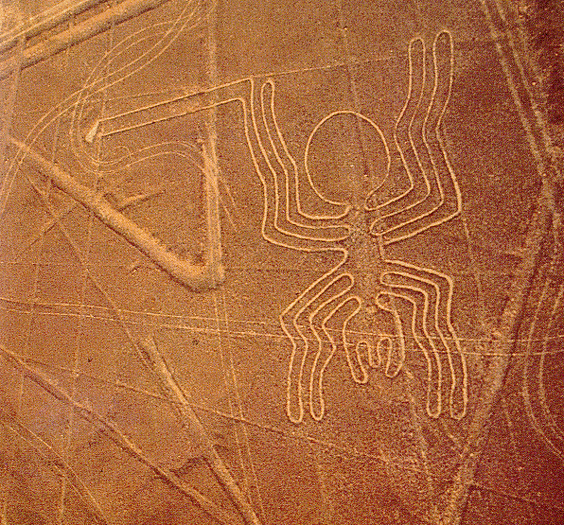
The Nazca Lines, Peru

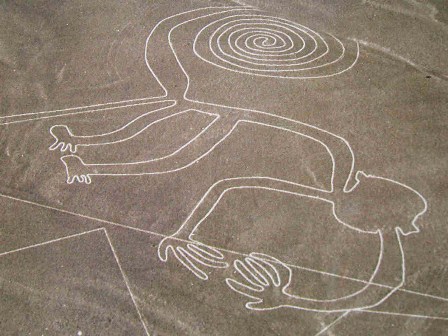
The Nazca Lines are giant sketches drawn in the desert of western Peru by ancient peoples. The drawings were created on such a large scale is such that the shapes can be readily discerned only from the air, leading to a variety of theories about their purpose.
The Nazca Lines were created in the time of the Nazca Indians, who flourished in the area from 200 BC to about 600 AD. Graves and ruins of their settlement have been found near the lines.
The lines would have taken a long time to create, perhaps several generations, and many people contributed to their creation. As to the purpose of the Nazca Lines, see below for some of the theories.
The area of the Peruvian desert in which the Nazca Lines were drawn is called the Pampa Colorada (Red Plain). It is 15 miles wide and runs some 37 miles parallel to the Andes and the Pacific Ocean. The desert is not sandy, but made of dark red surface stones and soil with lighter-colored subsoil beneath. The Lines were created by clearing away the darker upper layer to reveal the lighter subsoil.
It seems incredible that such simply-made drawings have survived for so many hundreds of years, and some have seen a mysterious element to this. But there is also a natural explanation: the surface is made of stone, not sand, and the climate of the area is such that there is practically no erosion. The Nazca peoples chose an excellent place for an enduring monument.
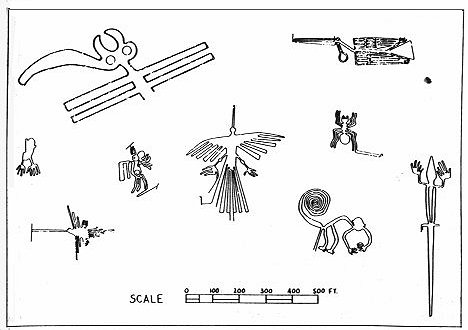
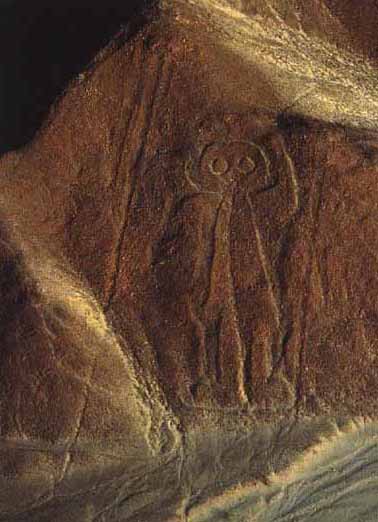
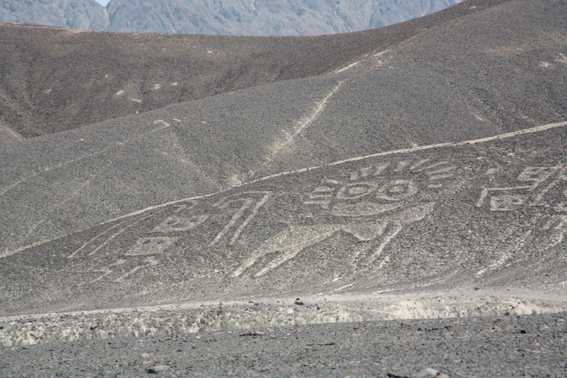
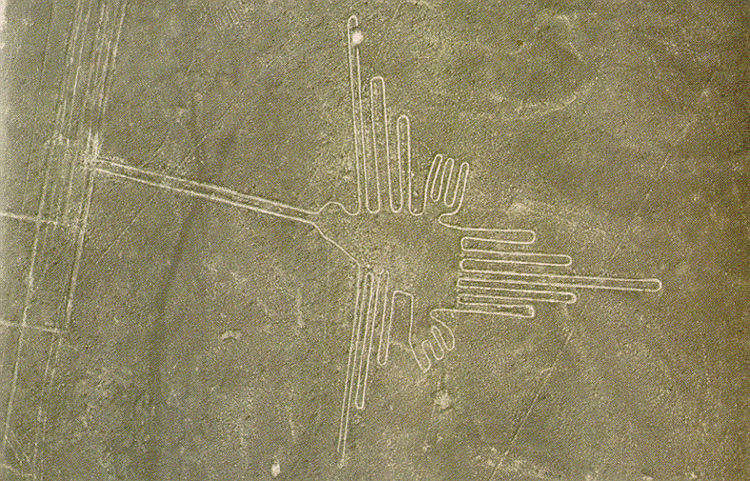
The Nazca Lines include straight lines and geometric shapes as well as stylized depictions of animals, humans and plants. The figures include:
  • monkey
  • condor
  • round-headed, rather friendly-looking human (known as "the astronaut")
  • another human figure
  • spider
  • hummingbird
  • hands
  • tree

Theories of the Nazca Lines mainly attempt to explain why these remarkable drawings were created, and some theories seek to address the "how" question as well. Especially in the earlier years of study, it was difficult for many anthropologists to believe that the ancient Nazca peoples could have created the Lines without help from a more advanced society - or species!
Perhaps the most famous theory of the Nazca Lines is that of Swiss writer Erich von Däniken. In his 1968 book Chariots of the Gods, he suggested that the lines were built by ancient astronauts as a landing field. He identifies the pictures as "signals" and the longer lines as "landing strips."
In 1977, Jim Woodman accepted that the Nazca people made the lines themselves, but puzzled over why they would make them so big that they couldn't even seen them. He hypothesized that the Nazca people used hot-air balloons for "ceremonial flights" to view their creations.
Woodman attempted to demonstrate the validity of his theory by constructing a hot-air balloon out of the materials that would have been available to the Nazca. Using cloth, rope and reeds, Woodman and his colleagues assembled the balloon then risked their lives on a balloon ride that reached a height of 300 feet. The balloon soon descended rapidly; the balloonists bailed out 10 feet above the desert before it crashed some distance away.
In recent years, the professional skeptic Joe Nickell has demonstrated that the drawings would not have been hard to accomplish with only the tools available to the ancient Nazca. Nickell has also shown that although the size of the figures suggests they were intended primarily for the enjoyment of the gods, the drawings can be appreciated from the ground as well.
The general consensus of archaeologists, anthropologists and scientists is that the Nazca Lines were created by the Nazca people themselves, without help from celestial visitors or aerial views. The figures drawn in the desert correspond with images found in other examples of Nazca art, such as pottery.
It is almost certain that the Nazca Lines had a sacred purpose, because: other artifacts of the Nazca culture show a preoccupation with death; other major monuments of the ancient world are known to be ritual in nature; and no plausible practical purpose has yet been discovered.
The Nazca Lines may have been ritual centers for helping the dead achieve immortality; they may have been an offering to the gods; or they could have been a major pilgrimage site.
We may never know why the Nazca peoples put so much time and care into a project that they could barely see. In spite of all that we have learned about them in recent years, the Nazca Lines remain a fascinating mystery.


Tuesday, June 9, 2009

Secrets of Roswell memory metal revealed


Was the Roswell memory metal secretly "seeded" to industry and to others who could exploit its potential benefits? How was the technology transferred while keeping its origin disguised? Why were bizarre "mind-over-matter" tests performed by government psychics on the shape-recovery metal Nitinol? What is the hidden meaning of the morphing metal? Newly developed information provides the stunning answers to these questions.

Prior articles in this series showed that Wright Patterson Air Force Base contracted Battelle Memorial Institute -in the months immediately following the Roswell crash in 1947- to conduct studies on memory metal based on a Nickel and Titanium alloy. Similar material that could "remember" its original shape when crumpled or deformed was reported at the Roswell crash debris site. Wright Patterson -the base that contracted Battelle- was the very base to which the Roswell debris was flown after the crash.

Evidence for the Roswell-Battelle Connection was drawn from:

Footnotes that were located within military studies to a Battelle report on memory metal conducted by the Institute for Wright Patterson in the late 1940s

The fact that -although footnotes citing these reports have been found- the actual reports are "missing" despite repeated efforts

Supporting information provided by two USAF Generals (including one from Wright Patterson) on the composition of the debris and the existence of the analysis reports

A senior-level Battelle scientist's confession that he had analyzed the UFO crash debris when employed at the Institute

A historical "backtracking" of the technical literature on the development of shape-recovery metals- leading back to the doors of Battelle and Wright Patterson, to late 1940s exotic metal reports and to the Roswell Incident

A telling examination of the life of Battelle's Dr. Howard Cross as both metallurgist and UFO researcher- showing his likely involvement in the debris analysis

In this last installment, the memory metal's secret history is further exposed- and the hidden meaning of the metal is finally revealed:


MEMORY METAL'S "OFFICIAL HISTORY" IS FALSE

Europeans in the 1930s conducting metal "bendability" and stress tests noted that some alloys (containing Aluminum) could exhibit a type of "pseudo-elasticity." In fact -since man began forging metal by fire- the "state of metal" was known to be "changeable."

But the Battelle studies conducted for Wright Patterson in the late 1940s represent something entirely different. They show that this was the very first time that a metal system that had the potential for genuine "shape recovery" was ever examined by the U.S. military. And these studies began immediately following the Roswell crash where similar material was reported to have been found. Importantly, even after decades, the Nickel-Titanium metal system (Nitinol) remains the material that defines "morphing metal." Any earlier observation of "pseudo-elasticity" was with a metal alloy that did not utilize Nickel and Titanium- and that was not developed for that property. Nitinol, however, has gone on to be used in a variety of things from eyeglass frames to aircraft to medical implants.

It is traditionally held that the Nickel-Titanium memory alloy (known as Nitinol) was "discovered by accident" in the early 1960s at the U.S. Naval Ordnance Lab in Maryland, by co-inventors Drs. Wang and Buehler. But the true history of Nitinol is purposely obscured- and it is riddled with holes and discrepancies.

The truth is that the first efforts at examining this remarkable Nickel-Titanium alloy had ocurred years previously, in the late 1940s after the Roswell crash. And the work was performed by someone else- Battelle Memorial Institute in Ohio. This work was contracted by Wright Patterson- the very base where the crash material was taken.

YEAR OF DISCOVERY UNCLEAR

One of the problems immediately evident with the "official" history of Nitinol is the exact year offered for its discovery. Simply "Google" the word Nitinol with any of the following years: 1958, 1959, 1960, 1961, 1962 or 1963. Search results will show links to sites that give each of those years as the "year of discovery" for Nitinol. Even Nitinol's "official" co-inventors Buehler and Wang have offered different years of discovery when at the Naval Lab. Scientific journals and articles found in the popular press give different years. When reached by this author and asked what was the exact year he "co-invented" the material, Wang gave a strange laugh and admitted that he wasn't exactly sure and that he would have to look it up!

DIFFERENT REASONS OFFERED FOR WHY IT WAS DEVELOPED

We are given at least three completely different reasons on why Nitinol was being investigated in the first place. In an oral history, Buehler said that he was conducting studies on intermetallic alloys for use in re-entry aeronautic nose cones. But a 1968 Time Magazine article quotes him that they were trying to find a non-magnetic, non-corrosive material for use as a tool in mine dismantling. Recently, a former Lawrence Berkeley scientist has related that to this author that he examined Nitinol while at that National Lab. He was told that the material was developed when trying to create new submarine ship hull material.

DIFFERENT EXPLANATIONS GIVEN FOR THE CIRCUMSTANCES SURROUNDING ITS DISCOVERY
In most re-tellings, the explanation for how Nitinol was "accidentally" discovered is something to the effect that "someone was bored and decided to take a match to it to see what heating would do." Nitinol requires energy -like heat- to morph.

But in another recounting, a researcher "RCW Wiley" had placed a Nickel-Titanium alloy into a hardness testing machine and a dent was made. Wiley then decided to warm up the block to see the effect of heat treatment- and to his surprise- the dent vanished. No mention is made if the Titanium was purified to the ultra-high levels required to make Nitinol.

Yet another reason is given in an oral history by Nitinol co-inventor Buehler. He says that for some reason he took a strip of the alloy into a managment meeting at the Naval Lab one day. He was "fidgeting" with the material and an associate named David Muzzey (of whom no record as ever been found) was compelled to take a pipe lighter (in some versions a cigarette match) to the material to see what would happen...and Voila, Nitinol!

Buehler is conflicted and offers two diametrically opposed explanations about the material. He at one time refers to it as a "planned discovery" and yet to another reporter he said that it came about as a result of "serendipity" or an accidental discovery. In an historical retelling late in life, Buehler exclaimed almost metaphysically that he was "drawn" to the alloy. When he struck it, Buehler says, "it rang out brilliantly" and he states that the "equiatomic Nickel Titanium was acoustically signalling that it was unusual or unique." Just how he knew that the Titanium must be of nearly 100% purity- or that the temperature, pressure and other dynamics must be precisely in place to create Nitinol and energy then introduced into the metal is a specific way- is never made clear.

BATTELLE PROVIDED THE U.S. NAVY WITH ROSWELL MEMORY METAL TECHNOLOGY

As described in a previous article, Battelle's Dr. Howard Cross -a metallurgist and secret Project Blue Book UFO researcher- was likely directing the Roswell debris analysis. Cross was "feeding" technical information on specially-processed Titanium (which is required to make Nitinol) as early as 1948. Cross is the author of a technical summary report entitled, "Titanium Base Alloys." It was presented by him to the Office of Naval Research in December of 1948. The Naval Lab is the very lab where Nitinol was "officially" discovered many years later.
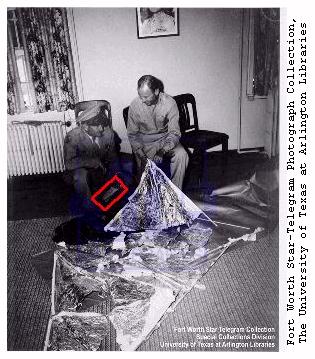
In fact, a research paper from Nitinol's "official" co-inventor, Dr. Wang, gives us confirmation that he was "fed" needed information on the alloy from the early Battelle report on memory metal done after Roswell. In footnote No. 6 in his "On the NiTi (Nitinol) Martensitic Transition, Part 1 1972 Naval Ordnance Laboratory, White Oak, MD" Wang cites the Battelle 1949 "Second Progress Report" on Nickel-Titanium system authored by Battelle scientists Craighead, Fawn and Eastwood.

This author reached Dr. Wang to ask him some questions about his research. When I eventually brought up the subject of the 1949 Battelle report that he had footnoted in his study on Nitinol, Wang got very "cagey" and appeared to not want to answer. When pressed, he said that "it must have related to a Phase Diagram on Nickel and Titanium." A phase diagram provides information on the "mixability" of metals that is needed to create an alloy. It details the individual metal's "boundaries" when attempting to combine them. Temperature, pressure and other dynamics are measured to determine the successful combination to create an alloy. Such information would absolutely have been required to create the memory metal Nitinol.

When I asked Wang who it was that had provided him with the Battelle report, he would only answer that he got it "from my superior, who may have gotten it from another agency." When I told Wang that this Battelle report was "missing" despite all attempts to locate it, he offered weakly, "well, I wouldn't know anything about that." When I asked if Wang knew one of the Battelle report scientists (Craighead.) Wang admitted, " I knew of Craighead."

I then "eased in" to telling the elderly scientist that his Nitinol seemed very much like the morphing metal that was reported by many people to have been recovered from the crash of an unidentified object at Roswell, NM in 1947. The scientist did not reply to me that he he was unfamiliar with the Roswell crash -or that he did not know to whIch event I was referring. Nor did he say that the idea of such a scenario was ridiculous or misguided. Instead, Wang was stunned silent. After a long pause he said, "I don't have any comment on that." With nothing to loose, I then quickly outlined my findings on the Battelle-Roswell connection. He only reiterated, "I told you that I am not going to discuss that." .


KEEPING THE SECRET WHILE TRANSFERING THE TECHNOLOGY KEEP THEM IN THE DARK

The key to keeping the origin of such a technology secret is "compartmentalization." You only give out pieces or parts -never the whole thing. And sometimes you provide only the technical information that was gained by others on the parts- not the parts themselves. You release these to different places. This is not done at once, but rather over periods of time. You give it to those holding high-security clearance, and then only to those with a "Need to Know." But most importantly, you never tell any of them the "backstory" about where it came from. "Blend" this technology so that it does not appear to be anything other than part of existing areas of research. Over the passage of decades, the truth remains even further and more easily buried. It is in this way that scientists today working on shape-recovery alloys are prevented from realizing the hidden history of their work. It is likely that even the Naval Lab's "official" inventors of Nitinol did not know the "Roswell impetus" of their research (though they may well have wondered.)

A report that bluntly and openly states "this is material that was recovered at Roswell" will never be found. It is only through carefully reviewing the "history of science" many decades later that these connections about the Roswell metal's history would be made. Only obscure footnotes found buried in military studies -coupled with sleuth work- would lead to the truth about the study of the Roswell metal.

It now appears that much of the work on the Roswell debris was skillfully and conveniently "folded into" military contracted work on "traditional" aeronautical or naval metals engineering projects of the time. It was the perfect guise. Nobody would put "two and two" together that this advanced materials work -actually inspired by Roswell- was anything "special." It would be seen as just "part of the program." Selectively "farming out" portions of this work assured that nobody would make any "connections." The "paper trail" on the study of the material could also be confused as "normal military work" that they were "already conducting."

MOVING THE METAL TO NASA AND INTO SPACE

One of the ultimate goals of the work on the memory metal was to return it to Outer Space. It came from a spacecraft at Roswell- and it would ultimately be used for this very purpose by us- through NASA.

This is confirmed by:

- Nitinol's "official" co-inventor William Buehler tellingly states in an oral history that after his "discovery" it was NASA that "independently retained Battelle to conduct further "characterization studies" on Nitinol. Buehler reveals two things as an elderly man recollecting his past: Battelle was still involved in directing the study of the material in the 1960s and that it was NASA that was "pulling the strings" about the direction of research on the material.

- An individual who was contracted by the U.S. Naval Lab to perform "mental influence" tests to attempt to bend Nitinol with the mind's energy said that NASA was there. He told me in a recent interview that "People in plainclothes from NASA were present at all times during these tests. I couldn't understand why." Why would NASA be at the US Naval Lab overseeing psychic tests on a metal? See this article's next section for details on these bizarre Mind-Over-Matter tests conducted on Nitinol.

- NASA sought to develop shape-recovery material for use in their own spacecraft. A "self-healing" material, or a material that can "remember" itself for future function would be very valuable. If the metal could morph, the shape of the craft could be changed to best suit the environment it is traversing. If the metal responds to direction given by the mind's energy, new control and navigation systems could be developed. This would be the ultimate in Mind-Machine interface.

- An extraordinarily telling video that can now be viewed online proves that NASA is perfecting such shape-recovery metals as "intelligent," adaptive materials of construction for spacecraft. This (short) video can be seen by "Googling" the phrase (in quotes) "NASA Morphing Metal." Any of the seven search results that appear will link to sites that show this technology-transfer film from NASA's Center for Excellence in Materials. You can then visually grasp just how amazing memory material can be: It can absorb the impact of a crash, like at Roswell. It can function as a novel actuator. It can even be used to create advanced craft with "flappable" or adaptable wings! And a craft that appears small when seen from the outside -once entered- can then appear very large when inside. Actuators and panels made of memory metal can create this effect by expanding the interior walls and floors and extending the craft's frame. Interestingly, this very effect has been reported by some who claim to have entered "flying saucers."


MIND, MATTER AND MORPHING
This unique metal combination holds a significance so special that it was tested by the U.S. Government to see if it could be altered by the human mind! This is revealed in a decades-old technical summary report found completed by the U.S. Naval Lab. In the early 1970's the U.S. government tested Nitinol to see if it could "morph" using only the mind's energy. Could "psychokinesis" affect this shape-recovery material? Would an "intelligent metal" like Nitinol respond to the energy generated by the intelligent mind?

Physical scientist Eldon Byrd was employed by the U.S. Naval Lab and other government agencies for decades. In his paper "Influence on Metal Alloy Nitinol" (1973 Naval Surface Weapons Center, White Oak Laboratory, Silver Spring, MD) Byrd outlines tests that were performed that year using "psychics" to try to change the hardness of the material, deform it in some distinct way or to alter its magnetic properties. The tests were in part successful. A permanent "knot" was induced in the material preventing its famous "snap back." Within this knotted section, unusual microscopic changes in its the material's structure were observed. The introduction of energy is required to create a morphing change in the metal. Typically this "introduced energy" is heat. But it appeared that the mind's "energy" could also create the morph.

Incredibly, it was none other than Dr. Fred Wang, Nitinol's "official" co-inventor who conducted these Mind-Over-Memory Metal tests, according to Wang's colleague Eldon Byrd! As mentioned earlier, it is also this very Dr. Wang who cites by footnote the (now missing) 1949 Battelle report on Nickel and Titanium in one of his own Nitinol studies! The scientist who conducted psychic influence tests on the material is the same scientist who had access to the "missing" late 1940's Battelle reports on memory metal likely inspired by the Roswell crash debris!

Some years ago in talking to skeptic Martin Gardner, Wang denied being present at the Naval Lab when these strange tests were conducted. But Eldon Byrd begs to differ. In a 2001 interview Byrd says that the scientist is lying. Byrd charges that Wang "yielded to the pressure put on him" and adds "he did the tests. I had the results in the form of photos and X-rays." When I asked of Wang what he thought of Byrd's assertation, Wang this time did not deny his presence at the tests but instead replied, "Byrd says a lot of things."

THE HIDDEN MEANING OF MEMORY METAL

Morphing metal may well be the stuff from which today's often-seen "morphing UFOs" are made. Such materials of construction may help to explain the "shape-shifting" craft. And it is likely that similar material accounts for some of the debris that was found at the crash at Roswell.

But there is an even deeper meaning to memory metal. It is found within the Morph. It represents "the potential for change." Such material reflects the value of adaptation. Without it, life ceases. The best material adapts itself to best suit its environment. The shape-memory qualities of the Roswell debris speak to the metal's "rememberance" of a malleable and ever-changing Universe. It reveals the Universe as Infinite Potential. And this Change is created by the unique and eternal interplay of Matter, Energy and Mind.

Sunday, June 7, 2009

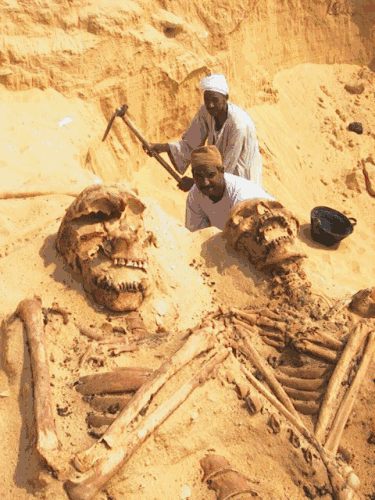
Giant Skeletons

The mystery surrounding reports of “giant skeletons” has always intrigued and fascinated me. Specifically, how it seemed to be a common ocurrence that human-like bone remains, often of giant proportions, were known for popping up everywhere in the mid-to-late 1800s, as featured in reports like these:

During an 1879 excavation of an Indian mound near Brewersville, Indiana, a nine-foot eight inch skeleton was found buried within. Around the same time, George W. Hill, M.D., also unearthed a skeleton said to be “of unusual size” while excavating a mound in Ashland County, Ohio. In 1880, American Antiquarian, volume three, reported that a Doctor Everhart allegedly found another large skeleton “reported to have been of enormous dimensions” in a strange clay coffin along with a sandstone slab marked with unidentified hieroglyphics near Zanesville Ohio. In 1881 in Medina County, Ohio, a succession of nine bodies were found below the cellar of a house, buried as though the corpses had been “dumped into a ditch.” Albert Harris, one of the residents, was twenty years old at the time of the grave’s discovery, and removing one of the large skeletons, said that he could literally fit the piece over his entire head and allow it to rest on his shoulders like a large helmet, even while wearing a cap underneath! Still, we’ve all heard of how even well known authors of the era, including Mark Twain, contributed to the telling of “whoppers” in their day; that is, many writers who got their feet wet as newspaper writers for dailies would occasionally cook up tall tales when local news just wasn’t doing it (see a great example of this here). Eventually, I decided to try and find out if there might be any reports that could be verified with more certainty, and after some digging around in public domain archives, I found a couple.

In their 1894 report to the secretary of the Smithsonian Institute, Cyrus Thomas and Thomas Powell of the Bureau of Ethnology wrote of several discoveries where large human skeletal remains were found, the first ocurring in Roane County, Tennessee:

“Underneath the layer of shells the earth was very dark and appeared to be mixed with vegetable mold to the depth of 1 foot. At the bottom of this, resting on the original surface of the ground, was a very large skeleton lying horizontally at full length. Although very soft, the bones were sufficiently distinct to allow of careful measurement before attempting to remove them. The length from the base of the skull to the bones of the toes was found to be 7 feet 3 inches. It is probable, therefore, that this individual when living was fully 7½ feet high.”

And yet another instance, this time in presumed Indian burial mounds at Dunlieth, Illinois:

“Near the original surface, 10 or 12 feet from the center, on the lower side, lying at full length on its back, was one of the largest skeletons discovered by the Bureau agents, the length as proved by actual measurement being between 7 and 8 feet. It was clearly traceable, but crumbled to pieces immediately after removal from the hard earth in which it was encased….”

Indeed, it seems that the Smithsonian at one time reported oddities like these which they uncovered, especially during the “giant boom” of the late nineteenth century. Still, I can’t help but ask; if these kinds of discoveries were ever at all commonplace, why aren’t skeletons and other anomalies like this found more frequently in modern times… or are they?

During an email exchange I had last year with my good friend and mentor, Brad Steiger, we began discussing a few similar reports which he had included in his book Worlds Before Our Own, where a few such skeletons were said to exist in private museums. ”After the book was published, I learned of even more and included photos of them in my lectures,” he told me. ”Soon, individuals beseeched me to cease; the private museums were mysteriously suffering unexplained fires.” One is left to ask; what about anomalous relics of this (or any) sort could be so worthy of censorship on such a level?

Further complicating the mystery of missing giant bones is the following exerpt from an article I wrote which included the inquiries of the late zoologist Ivan T. Sanderson, best known for his interest in the legends regarding America’s Bigfoot and the Abominable Snowmen alleged to reside in the Himalayas:

“Sometime in the 1960s, Sanderson wrote about an odd letter he received regarding an engineer who, during World War II, had been stationed on the Aleutian island of Shemya. While building an airstrip, the bulldozing of a group of hills in the area led the engineer and his crew to unearth several sedimentary layers of human remains. They noted the extraordinary length of the crania and leg bones at the site, having apparently belonged to people of gigantic proportions. The skulls were said to have measured up to 24 inches from base to crown, far greater than the length of an average human skull. Also of interest was that each was said to have been trepanned, the strange process of drilling or cutting a hole and removing a top center portion of the skull, thought by some ancient cultures to enable a variety of alleged “benefits”, including psychic abilities, etc. Sanderson actively began to search for more proof of this incident, and later was able to contact another member of the unit who also confirmed the bizarre story. By all accounts, the remains were said to have been gathered by the Smithsonian Institution, but no record of where they were taken was ever issued. Sanderson seemed convinced that the institute did indeed retrieve them however, going so far as to ask ‘is it that these people cannot face rewriting all the textbooks?’ “
Do I honestly think that there are MIBs out there spiriting away giant skeletons into an unmarked warehouse someplace? Not at all… but I think it’s safe to suppose (at least for the sake of a good pun) that someone may have a few “skeletons in their closet” that they just aren’t talking about!