What is Glowing in the Water? Bioluminescent Dinoflagellates
“……it is not the property of fire alone to give light;…small drops of the water, struck off by the motion of the oars in rowing, seem sparkling and luminous.”
Francis Bacon, 1605

What is glowing in the water? If you have visited the ocean and witnessed the water at night, you may be pondering this question. The first scientist to document observations of glowing water was Anixinemenes in the year 500 B.C. He described light emitted by the sea when it was struck with an oar. Light in the ocean has been observed thousands of times since; these “mysterious glowing things” may even be responsible for some of the ghost stories told by sailors who witnessed the glowing waters but did not know the cause. Sightings of aerial bioluminescence have been documented; it appears the sky is glowing. It is assumed that bioluminescent particles are somehow carried into the air from the ocean, but no evidence has been found. Theories as to what is responsible for the things that glow at night have been proposed and many scientists have tried to unravel this mystery. The mystery has not been completely solved, but science is closer to discovering the truth.
Basic Facts of Bioluminescence
Bioluminescence is the light produced by a chemical reaction that occurs in an organism. It occurs at all depths in the ocean, but is most commonly observed at the surface. Bioluminescence is the only source of light in the deep ocean where sunlight does not penetrate. Amazingly, about ninety percent of the organisms that live in the ocean have the capability to produce light.
Four main uses for an organism to bioluminesce have been hypothesized. It can be used to evade predators, attract prey, communcate within their species, or advertise (Nealson, 1985). For example, the angler fish uses the Lure Effect (attracting prey). This fish has a dangling lure in which bioluminescent bacteria live. The lure hangs in front of its mouth; fish swim toward the light and may become food for the angler fish. Some fish use bioluminescence for mating signals or as territorial signals (intraspecies communication), and some use it to communicate interspecies (advertisement). Some organisms employ it for more than a single reason.
Most bioluminescence is blue for two reasons. First, blue-green light travels the farthest in water. Its wavelength is between 440-479 nm, which is mid-range in the spectrum of colors. Second, most organisms are sensitive to only blue light. They do not have the visual pigments to absorb the longer or shorter wavelengths. Red light, which has a long wavelength, is quickly absorbed as you descend in water- this is why underwater pictures appear blue. As with every rule, exceptions exist. Some cnidarians emit green light and one family of fish, the Malacosteids (known as the Loosejaws) emit and are able to see red light. The red light they produce is almost infrared and not visible to the human eye. This is a huge advantage to these fish because they can produce light to see their prey, but their prey can not see them!
Each luminescent organism has a unique flash. Factors that can vary are color, rise time, decay time, and total flash time (Nealson, 1985). Some organisms can emit light continuously, but most emit flashes with varying durations and brightness. The luminescence of one dinoflagellete lasts for 0.1 seconds and is visible to humans. Larger organisms, such as a jellyfish, can luminesce for tens of seconds.
In most multi-cellular organisms, the ability to produce light is controlled neurally. However, the transmitter that signals the change to take place is unknown in most organisms. Luminescence can also be induced by the presence of another luminescing organism.
A few characteristics are common to all bioluminescent reactions. All bioluminescent reactions occur in the presence of oxygen. Two types of chemicals are required- a luciferin and a luciferase (lucifer means light bringing). The luciferin is the basic substrate of the reaction and produces the light. The luciferase catalyzes the reaction. In the basic reaction, the luciferase catalyzes the oxidation of luciferin, which results in two products- light and inactive oxyluciferin. In most organisms, new luciferin must be brought to the system either by diet or internal synthesis for each reaction. Sometimes the luciferin and luciferase are bound together in one unit called a photoprotein. The photoprotein is then triggered when a particular ion is added to the system- frequently calcium. Most of the energy released in this reaction occurs in the form of light, therefore, bioluminescence is commonly called “cold light.”

Five main types of luciferins are known. Bacterial Luciferin is a reduced riboflavin phosphate and found in bacteria, some fish, and squid. Second, Dinoflagellate Luciferin is thought to be derived from chlorophyll because it has similar structure and is found in dinoflagellates and euphasiid shrimp. The third type, Vargulin, is found in the ostracod Vargula and is also used by the midshipman fish Poricthys. This is an interesting dietary link because the fish can not luminesce until they are fed luciferin bearing food. Fourth, Coelenterazine is the most common luciferin; it is found in many phyla- the radiolarians, ctenophores, cnidarians, squids, copepods, chaetognaths, and some fish and shrimp. The fifth is firefly luciferin, which requires ATP as a cofactor in its reactions.
Dinoflagellates

Dinoflagellates are the most common source of bioluminescence and are also known as Pyrrophyta or fire plants. Dinoflagellates are unicellular protists and are usually planktonic- ninety percent are marine plankton. They are small; many are microscopic, although the largest, Noctiluca, is 2 mm in diameter. Dinoflagellates are motile and swim by two flagella, which are movable protein strands. The longitudinal flagella extends from the sulcal groove at the posterior part of the cell and is responsible for the cells forward movement. The flattened flagella extends from the cingulum groove around the equator of the cell and provides the dinoflagellate with the ability to maneuver. Because of these two flagella, the dinoflagellate spirals when it moves.
Dinoflagellates are usually covered by cellulose plates. The cell is surrounded by a series of membranes called the amphiesma. In some, cellulose is deposited between these membranes and forms rigid plates called thecae. When no thecae are present, the dinoflagellates are termed as naked.
Chromosomes are always condensed in dinoflagellates. When the chromosomes of a cell are condensed, the cell is classified as dinokaryotic. The DNA is not associated with the histones as it is in other eukaryotic cells. Dinoflagellates have a relatively large amount of DNA and a large nucleus. The metabolic requirements to support a large amount of DNA probably account for the relatively low growth rates of these protists.
Many dinoflagellates are photosynthetic and play a key role as producers in the food chains of the ocean. The luminescence of photosynthetic dinoflagelletes is very much influenced by the intensity of the previous days sunlight. The brighter the sunlight, the brighter the luminescence will be. Not all are photosynthetic, some are symbiotic- living in the cells of their hosts. Zooxanthallae are the most common symbiotic dinoflagellates and are found in many marine invertebrates such as sponges, corals, jellyfish, flatworms, and other protists. About one half are heterotrophic; they eat other plankton. Sometimes they eat each other by snaring or stinging their prey.
Usually, reproduction is asexual and occurs by the process of mitosis. Occasionally, sexual reproduction can occur when two motile gametes fuse forming a planozygote.
Bioluminescence in Dinoflagellates
Bioluminescence is used to evade predators and acts as a type of burglar alarm defense mechanism in dinoflagellates. Dinoflagelletes produce light when the deformation of the cell by minute forces triggers its luminescence. When the cell is disturbed by a predator, it will give a light flash lasting 0.1 to 0.5 seconds. The flash is meant to attract a secondary predator that will be more likely to attack the predator that is trying to consume the dinoflagellate. The light flash also makes the predator jump and worry about other predators attacking it, making the predator less likely to prey on the dinoflagellate.

In most dinoflagellates, bioluminescence is controlled by an internal biological rhythm. Dinoflagellates are on a circadian rhythm. Towards the end of daylight, luminous chemicals are packaged in vesicles called scintillons. The scintillons then migrate to the cytoplasm from the area around the nucleus. It is not currently known how the scintillons are moved to the cytoplasm. At night, light is triggered by mechanical stimulation. When action potential generates in the vacuole, the action potential propagates throughout the rest of the cell. This allows protons to pass from the vacuole to the cytoplasm (where they were kept). The cytoplasm becomes acidified, normally by hydrogen ions, and the process is activated in the scintillons.
In dinoflagellates, the luciferin is usually bound to a protein called a Luciferin Binding Protein or LBP. At a neutral pH, LBP stabilizes the luciferin from being spontaneously oxidized. When it is activated by a drop in pH, the luciferin dissociates from the LBP and associates with the luciferase. At a pH of 8, the molecule is stable. When the Ph drops to around 6, the luciferin and the LBP dissociate. In the process of being oxidized, luciferin briefly exists in an excited state, after which it decays to the ground state- releasing energy in the form of light. Most dinoflagellates produce much less bioluminescence during the day because there are fewer scintillons. Bioluminescence in dinoflagellates reaches its maximum levels two hours into darkness.

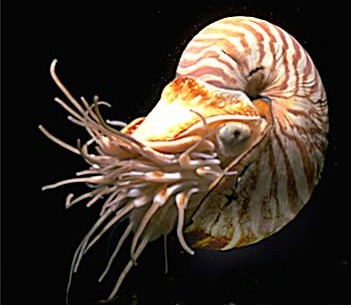 The curious-looking chambered nautilus, also known simply as the nautilus, is considered by many to be a living fossil. Nautilus pompilius is the largest and most common of about six species known to exist. Like the coelacanth, it has remained unchanged for over 400 million years. During prehistoric times, there were about 10,000 different species of nautilus, but only a small handful are known to survive today. The nautilus is a mollusk and a member of the cephalopod family. It is closely related to other cephalopods such as the squid, cuttlefish, and octopus. Like most cephalopods, it can use jet propulsion to attain speeds of over two knots. A small tube near the animal's tentacles, known as a siphon, expels water under pressure. This propels the nautilus in the opposite direction at high speeds.
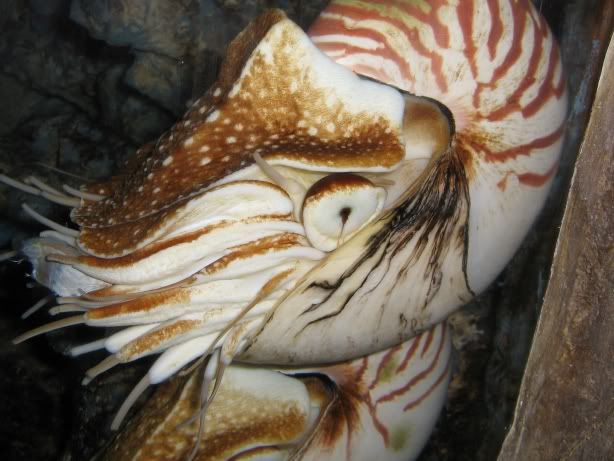 These tentacles are used to catch shrimp, fish and small crustaceans, which the animal crushes with its powerful beak. Nautiluses are active predators, but since their siphon system uses very little energy while swimming, they only need to eat about once a month. Their eyesight is very poor because their eyes contains no lenses. Instead, there is only a tiny hole to allow light into the eye. This system operates much like a pinhole camera. The nautilus is thought to rely mainly on its sense of smell when searching for food or looking for a mate. An adult nautilus can grow to about eight inches (20 centimeters) in length.

 The Nautilus reproduces by laying eggs. The eggs are usually attached to rocks in shallow water, hidden away from curious predators. These eggs require between eight and twelve months to fully develop. When a young nautilus first hatches from its egg, it is about an inch in diameter and has a shell with seven chambers. The young animal will drift and feed on plankton and other small prey as it grows. As it gets larger, it will add new chambers to its shell. Each new chamber will be a little larger that the last, allowing the opening of he shell to continually grow larger. The average life span of the nautilus is believed to be about 20 years, which is unusually long for a member of the cephalopod family.


