Space images taken by NASA reveal a mysterious ancient bridge in the Palk Strait between India and Sri Lanka. The recently discovered bridge currently named as Adam´s Bridge is made of chain of shoals, c.18 mi (30 km) long.
The bridge´s unique curvature and composition by age reveals that it is man made. The legends as well as Archeological studies reveal that the first signs of human inhabitants in Sri Lanka date back to the a primitive age, about 1,750,000 years ago and the bridge´s age is also almost equivalent.
This information is a crucial aspect for an insight into the mysterious legend called Ramayana, which was supposed to have taken place in tredha yuga (more than 1,700,000 years ago).
In this epic, there is a mentioning about a bridge, which was built between Rameshwaram (India) and Srilankan coast under the supervision of a dynamic and invincible figure called Rama who is supposed to be the incarnation of the supreme.
This information may not be of much importance to the archeologists who are interested in exploring the origins of man, but it is sure to open the spiritual gates of the people of the world to have come to know an ancient history linked to the Indian mythology. Comment From Hugh Joseph (10-12-02) I read the story headlined above with great interest. This is a story of major significance, as understanding its implications will turn the entire world of Science and History on its head. This bridge, according to accounts in the Ramayana and the Srimad-Bhagavatam, was constructed in the age know as Treta, over 2 million years ago.
How did the writers without super space-ranging satellites know about the existence of this bridge? In these ancient accounts, written over 5,000 years ago, we find discussions of, among other things, space travel, inter planetary travel, what we call UFOs and what we mistakenly call ETs. This is not only the History of the planet Earth, but also of this Universe, (a mediocre universe among many millions of universes.)
Here one can also learn the real undisguised and uncontaminated truth about God. Our man-made religions are of little or no value when compared to the stunning and breathtaking revelations found in the pages of the Srimad-Bhagavatam, Ramayan, Bhagavad-gita, etc.
Here is the way the "Srimad Bhagavatam" describes the event:
Translation:
"In the eighteenth incarnation (of Lord Krishna), the Lord appeared as King Rama. In order to perform some pleasing work for the demigods, He exhibited superhuman powers by controlling the Indian Ocean and then killing the atheist King Ravana, who was on the other side of the sea".
The Personality of Godhead Sri Rama assumed the form of a human being and appeared on the earth for the purpose of doing some pleasing work for the demigods, or the administrative personalities, to maintain the order of the universe. Sometimes great demons and atheists like Ravana and Hiranyakasipu and many others become very famous due to advancing material civilization by the help of material science and other activities, with a spirit of challenging the established order of the Lord. For example, the attempt to fly to other planets by material means is a challenge to the established order. The conditions of each and every planet are different, and different classes of human beings are accommodated there for particular purposes mentioned in the codes of the Lord. But, puffed up by tiny success in material advancement, sometimes the godless materialists challenge the existence of God. Ravana was one of them, and he wanted to deport ordinary men to the planet of Indra (heaven) by material means without consideration of the necessary qualifications. He wanted a staircase to be built up directly reaching the heavenly planet so that people might not be required to undergo the routine of pious work necessary to enter that planet. He also wanted to perform other acts against the established rule of the Lord. He even challenged the authority of Sri Rama, the Personality of Godhead, and kidnapped His wife, Sita. Of course Lord Rama came to chastise this atheist, answering the prayer and desire of the demigods. He therefore took up the challenge of Ravana, and the complete activity is the subject matter of the "Ramayana". Because Lord Ramachandra was the Personality of Godhead, He exhibited superhuman activities which no human being, including the materially advanced Ravana, could perform. Lord Ramacandra prepared a royal road on the Indian Ocean with stones that floated on the water. The modern scientists have done research in the area of weightlessness, but it is not possible to bring in weightlessness anywhere and everywhere. But because weightlessness is the creation of the Lord by which He can make the gigantic planets fly and float in the air, He made the stones even within this earth to be weightless and prepared a stone bridge on the sea without any supporting pillar. That is the display of the power of God.
Here's the account from the "Ramayana" of Sage Valmiki:
"At Rama's command, those lions among the monkeys entered the mighty forest with alacrity in hundreds and thousands on every side and those leaders on the simian tribes, tearing up the rocks, which in size they resembled, and the trees also dragged them to the sea and they covered the ocean with Sala, Ashvararna, (list of tree names).Those foremost monkeys transported those trees, with or without roots, bearing them like so many standards of Indra (the king of heaven) and they heaped (list of tree names) here and there. With the aid of mechanical devices, those powerful

colossi dug up stones as big as elephants and rocks, and the water suddenly spouted into the air only to fall instantly. Thereafter those monkeys churned up the sea by rushing into it on all sides pulling on the chains.
"That immense causeway constructed by Nala in the bosom of the sea was built by the arms of those monkeys of formidable exploits and it extended over a hundred leagues.
"Some brought trunks of trees and others set them up; it was by hundreds and thousands that those monkeys, like unto giants, made use of reeds, logs and blossoming trees to construct that bridge, rushing hither and thither with blocks of stone resembling mountains or the peaks of crags, which, flung into the sea, fell with a resounding crash.
"The first day those monkeys resembling elephants, or immense energy, full of high spirits and exceedingly merry, erected fourteen leagues of masonry. The second day, those highly active monkeys of formidable stature set up twenty leagues. Bestirring themselves, those giants threw twenty-one leagues of structure over the ocean on the third day and on the fourth, working feverishly, they built up twenty-two leagues in extent. The fifth day, those monkeys, industrious workers, reached to twenty-three leagues distance from the further shore.
"That fortunate and valiant son of Vishvakarma (architect of the demigods), leader of the monkeys, constructed a causeway worthy of his sire over the ocean and that bridge erected by Nala over the sea, the haunt of whales, dazzling in its perfection and splendor, was like the constellation of Svati in space.
"Then the gods, Gandharvas, Siddhas (living beings superior to humans) and supreme Rishis (great sages) assembled in the sky, eager to see that masterpiece, and the gods and Gandharvas gazed on that causeway, so difficult of construction, that was ten leagues in width and a hundred in length built by Nala.
"Those monkeys thereafter dived, swam and shouted at the sight of that unimaginable marvel that was almost inconceivable and caused one to tremble! And all beings beheld that causeway thrown over the ocean and by hundreds and thousands of kotis (millions), those monkeys, full of valor, having built that bridge over the immense repository of waters, reached the opposite shore.
"Vast, well-constructed, magnificent with its wonderful paved floor, solidly cemented, that great causeway like unto a line traced on the waves, resembled the parting of a woman's hair.
"Meanwhile Bibishana (brother of Ravana who joined Rama), mace (club) in hand, held himself ready at his post with his companions in case of an enemy attack. Thereafter Sugriva addressed Rama, who was valiant by nature, saying "Mount on the shoulders of Hanuman and Laxmana (brother of Rama) on those of Angada. O Hero, vast is this ocean, the abode of whales; those two monkeys who freely range the sky will transport you both."
"Then the fortunate Rama and Laxmana advanced thus and that magnanimous archer was accompanied by Surgriva. Some monkeys strode forward in the center, some threw themselves into the waves, some sprang into the sky, others marched on the bridge, some ranged through space like birds, and the terrific tumult of the trampling of that formidable army of monkeys drowned the roar of the ocean.
"When those simian troops had passed over the sea by the grace of Nala's causeway, the king ordered them to camp on the shore which abounded in roots, fruits and water.
At the sight of that masterpiece that had materialized under the command of Raghava (another name of Lord Rama), despite the difficulties, the gods, who had drawn near with the Siddhas and Charanas as also the great Rishis, anointed Rama in secret there, with water form the sea, and said: "Mayest thou be victorious over thy foes, O Thou, who are a God among men! Do Thou rule over the earth and the sea eternally!"
Thus in various auspicious words, did they acclaim Rama in the midst of the homage offered to him by the Brahmins.
Note: The monkeys mentioned here as comprising Rama's army, were not ordinary monkeys. They were in fact greatly powerful demigods who appeared on this earth to assist the Lord in his pastime of subduing this atheistic demon, Ravana. Note: There are 4 ages, or yugas, rotating through time like the 4 seasons: Satya, 1,800,000 yeas long;

Dvarapa, 1,200,000 years long, Treta, 800,000 years long and Kali, 432,000 years long. In this most recent yuga cycle, the Dvarapara and Treta yugas were reversed. This event took place about 2 million years ago. Ram Sethu: Scientific evidence of ancient human activity Ram Sethu ( called Adam's Bridge by the British ) which is seen as one of Hinduism's holiest sites, is an ancient chain of shoals that once linked India's southern areas to Sri Lanka's northwest. It is being destroyed by the Sethu Samudram Shipping Canal Project (SCCP) to create a navigable waterway in the narrow sea dividing the two countries. By S. Kalyanaraman copyright© 2004 Bharat Prakashan(Delhi) Ltd. Scientific evidences point to human activity in ancient times on both sides of Ram Sethu as found by Deptt. of Earth Sciences and ocean technologists of Bharatam. This area should be declared a protected monument under the Protection of Monuments Act and declared as a World Heritage site by the Government of India and advised to UNESCO.
The Geological and geophysical survey of the Sethu-samudram Project clearly reveal that Rama’s bridge appears to be a major Geological feature. The surveys reveal that to the north of Ram Sethu on the Palk Bay side, the formation have undergone down faulting and the Ram Sethu came up as an up thrown block. This geomorphic feature is seem to be continuous and verified both by bathymetry survey and NASA land image.
One could clearly see that this is but a continuous feature with minor depressions upto about 100m width. In consonance with these things there are inter tidal marine sandy islands. These depressions and the islands appear to be neotectonic feature resulting in changes in bathymetry.
It is a well established scientific phenomenon that there has been a major glaciation period (ice age) with glacial maxima at about 18,000 years BP. This feature has been observed and studied in several parts of the world with the help of submerged Corals. During the glacial Maxima, the sea level was about 130m lower than what is today. This is evidenced both on the east and west coast of India, where submerged Corals occur around 1 to 2m water depths and they are clear indicators of near coastal zone.
The Ram Sethu ridge is a major marine divide. It separates the furious Bay of Bengal sea and sediments in the Palk bay and the very calm placid waters of the Gulf of Mannar. This ridge like feature is similar to the “Allaband” that was formed after a major earthquake in Arabian Sea in the early 19th century. In the Allaband, a long stretch of about 90km length and about 0.5 to 4km wide zone got uplifted because of a major tectonic event that was responsible for the earthquake. Since this event occurred in the recent past and such huge track of land was raised, people called that it is happened due to the will of Allah and named it Allaband.
The Ram Sethu is a similar feature but formed much earlier due to tectonic causes that were prevalent in these areas. However, during the last ice age (18,000 year BP) the entire area from India to Sri Lanka and further south and southeast were contagious land due to the highly lowered sea level. As and when there were major melting of glaciers both from the mountains as well as from the Antarctic area, the sea level was rising. These features were well recorded and studied by several submerged Coral formations all over the world. About 7,300 years BP the sea level in the southern part of India was about 3.5 m above the present level. This has been deciphered by Dr. P.K. Banerjee, who studied Corals that found in the land part as of Pamban, Rameswaram, and Tuticorin etc. Subsequently the sea level went down and rose +2m above than what is today between 5000 to 4000 years B.P.
The Geological logging of the bore holes drilled by NIOT in the inter tidal areas of Ram Sethu reveals very interesting details. In all the bore holes the top portion is seen to be occupied by recent marine sands. In almost of all the boreholes between 4.5 and 7.5m the borehole intersected hard formations, which have been found to be calcareous sand stones and corals. It is to be pointed out here that Corals are comparatively less dense, compact and somewhat easy to carry. The Corals normally grow atop compact to hard formations for the purpose of stability, and as the sea level rises, the Coral colony grows up vertically to maintain water depth of 1 to 2 m, which is essential for their survival. It is always observed that these Corals have continuous vertical growth like Lakshadweep, Andaman’s, and Gulf of Mannar Natural Park. These have always been found to grow on hard rock bottom. In the case of Ram Sethu area, we observe that the Coral formations hardly occur 1 to 2.5m in length and resting on loose marine sands. Most of these coral rock pieces are seem to be rounded pebbles of corals. These things appear to point these coral rock pieces and pebbles have been transported and placed in these areas.
Since the calcareous sand stones and Corals are less dense than normal hard rock and quite compact, probably these were used by the ancients to form a connecting link to Sri Lanka, on the higher elevations of the Ram Sethu ridge and this is analogous to modern day causeway.
In support of these observations there are many archaeological and geoarchaeological evidences on the south east coast of India around Rameswaram, Tuticorin and the western coast of Sri Lanka. There are raised Teri formations that supported a rich assemblage of mesolithic—microlithic tools indicating the presence of strong human habitation and activity in these areas as early as 8000 to 9000 years B.P and as recent as 4000 years B.P. On Sri Lanka side there are indications of human habitation extending to late Pleistocene (about 13,000 B.P) based on bone and fossils of human and animal form.
All these point to a flourishing human activity on both side of Adams Bridge and probably when the sea levels were just right the link between India and Sri Lanka could have been established.

 Lin hopes of success are based on his access to unparalleled technology at Calit2 and CISA3 to pinpoint the area where Khan might have been laid to rest, find the tomb itself and then develop a virtual recreation of it using various methods of spectral and digital imaging.
 Notably, these computer-based technologies are modern evolutions of moveable type and the printing press — innovations that historian Jack Weatherford argues were spread by way of the Mongols as they conquered parts of Europe (Chinese printing technologies predated Gutenberg's printing press by several hundred years). Lin speculates that remnants of those international conquests might even turn up in Khan's tomb, but, he adds, "The process of doing an archaeological dig is up to the Mongolian government."
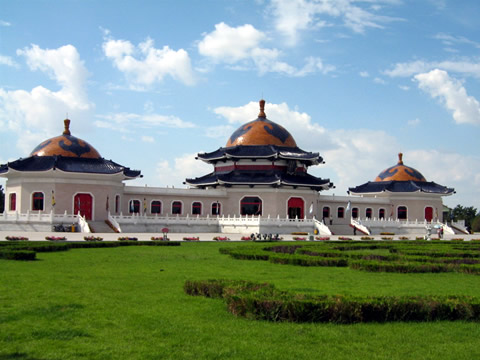 "He took the best resources of entire world — whether weaponry or medicine -- and adopted those technologies into his own methodology. We're trying to implement that same adaptation to many disciplines into our own work. We're taking the great work that's already been done in archaeology and further developing it by using technologies from other disciplines -- computer vision, social networking, electrical engineering — while at the same time never forgetting fundamentals of historical search.
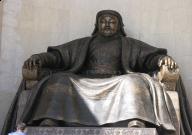 "If I could meet Genghis Khan today, I would ask how he would have wanted to be remembered in history," Lin muses. "The fact that he died in his bed surrounded by people who loved him and never had a single General turn his back on him, the fact that the loyalty of his people is so sound it can be heard across the world — these are the marks of one of the most impressive military heroes of all time. This is an example of a leader who was ruthless, strict, disciplined, and in a lot of ways, extremely honorable. If he was able to rewrite his own history, I wonder how he'd want it heard."