Friday, May 15, 2009

Cleopartras Tomb

CAIRO – Archaeologists will begin excavating sites in Egypt next week in an attempt to solve a mystery that has stymied historians for hundreds of years: Where is the final resting place of doomed lovers Cleopatra and Mark Antony?
Archaeologists looking for the tombs of the celebrated queen of Egypt and the Roman general will begin excavating three sites at a temple where tombs may be located, Egypt's Supreme Council of Antiquities said in a statement Wednesday.
Cleopatra and Mark Antony, whose relationship was later immortalized by William Shakespeare and then in a movie with Elizabeth Taylor and Richard Burton, could have been buried in a deep shaft in a temple near the Mediterranean Sea, the council said.
Archaeologists last year unearthed the alabaster head of a Cleopatra statue, 22 coins bearing Cleopatra's image and a mask believed to belong to Mark Antony at the temple.
The three sites were identified last month during a radar survey of the temple of Taposiris Magna, the council's statement said. The temple is located near the northern coastal city of Alexandria and was built during the reign of King Ptolemy II (282-246 B.C.)
Teams from Egypt and the Dominican Republic have been excavating the temple for the last three years. They found a number of deep shafts inside the temple, three of which were possibly used for burials. The lovers could be buried in a similar shaft, the statement said.
The lovers committed suicide in 30 B.C. after being defeated in the battle of Actium. Mark Antony is said to have killed himself with his sword, while Cleopatra is believed to have clutched a poisonous asp to her chest.
However, John Baines, an Egyptologist with Oxford University in England questioned why Augustus, who defeated Antony, would have chosen such a distinguished burial place.
"I don't really see why there should be a particular connection between that site and Antony and Cleopatra," Baines said.
Zahi Hawass, Egypt's top archaeologist, said the Cleopatra statue and coins — which show an attractive face — debunk a recent theory that the queen was "quite ugly."
"The finds from Taposiris reflect a charm ... and indicate that Cleopatra was in no way unattractive," said Hawass, according to the statement.
Academics at Britain's University of Newcastle concluded in 2007 that the queen was not especially attractive. Their conclusion was based on Cleopatra's depiction on a Roman coin that shows her as a sharp-nosed, thin-lipped woman with a protruding chin.
Excavators at the site near Alexandria have already discovered a large previously unknown cemetery outside the temple enclosure. They have also discovered 27 tombs — including a total of 10 mummies.
According to the statement, the style of the tombs indicates they were built during the Greco-Roman period. The presence of the cemetery also indicates that an important person — possibly royalty — could be buried inside the temple.

Amazing Discoveries in Egypt

King Tut Red
The discovery of jars of wine in King Tuts tomb prompted a team of Spanish scientists to try and determine if the boy king preferred red or white wine. An analysis of residues in 2005 revealed that the jars contained syringic acid, which implied that the wine was made with red grapes.
Big Toe
Archeologists explored a tomb near Thebes in 2005 and discovered an artificial big toe attached to the foot of a mummy. The fake body part could prove to be the earliest working prosthetic body part to date.
Child Mummy
The mummified remains of an Egyptian 6-year-old sat in the attic of its owners before being donated to the St. Louis Science Center in 1985. Researchers at the center have used CT scan technology to help unravel the mystery of its origins.
Queen Mummy
Authorities in Cairo announced in July of 2007 that the remains of a mummy discovered in the Valley of the Kings, was that of Queen Hatshpsut, a female pharaoh that ruled in the 15th century. DNA analysis was used to identify the first royal Egyptian mummy since King Tut in 1922.
Dwarf Statue
This statue was erected in honor of Seneb, an Egyptian dwarf who served under King Pepi II during the 6th Dynasty. A study published in December of 2005 concluded that dwarves, such as Seneb, were respected and even attained high positions in society

Preserved Ship
Archeologists announced in March of 2006 that an excavation near the Red Sea had unearthed a shipyard containing the world’s oldest sea-faring ships. The artifacts, such as wooden planks and cargo boxes, suggest that Egyptians had set sail 4,000 years ago.
Lost City

Satellites have located and zoomed in on a 1,600-year-old Egyptian city. Snapshots of the site taken from space as part of a project to map as much of ancient Egypt’s archaeological sites, or “tells,” as possible were released in July of 2007.
Sand Sea

The Great Sand Sea in the Eastern Sahara is currently nothing more than 45,000 square miles of desert land. But a climate study published in July of 2006, suggests that monsoon rains that occurred around over 10 millennia ago made it very hospitable for humans and wildlife
Ancient Frolicking
Ancient artistic depictions of swimming activities discovered inside a cave is evidence that people living in southwest Egypt once frolicked in rain pools 8,000 years ago. This was before monsoon rains ended and left the Sahara uninhabitable.
Best Mummies?

Archeologists exploring a 2,500 year old Egyptian tomb in 2005 found three intricate coffins, with one containing an amazingly well-preserved mummy. One of the archeologists called it perhaps “one of the best mummies ever preserved.”
Gimme!

Claiming that many of their artifacts were taken from Egypt illegally, Egyptian officials announced in April of 2007 that it would ask museums abroad to temporarily send back some of its most precious artifacts including the Rosetta Stone and bust of Nefertiti.
Pyramid Secrets Revealed
Evidence has been offered to suggest that some of the stone blocks used to construct the Great Pyramids of Giza were cast—not carved and then quarried, as some had thought. An examination of the stones revealed that the outer and inner casing stones were unlikely to have been chiseled from natural limestone.
King Tut

Forensic scientists and artists completed in 2005 the first ever facial reconstructions of King Tut using CT scans of his mummified remains. The pharaoh’s reconstructed facial composition turned out to be strikingly similar to ancient portraits of Tut.

Cambodia Dinosaurus

Conventional science has it that the dinosaurs were wiped out many millions of years ago either as the result of climate change or a meteorite hitting earth. Some researchers, however, claim that dinosaurs might have continued to roam remote parts of the earth as recently as a few hundred years ago. A few even claim that there might be some small populations of dinosaurs, otherwise believed to be extinct, surviving in the world’s most isolated forests.
A reader has sent to All News Web these photos of the stunning Ta Prohm Temple (pictured below) deep in the jungles of Cambodia.This temple is the work of the remarkable Khmer civilization which lasted from the 800’s AD until the 1400’s AD.
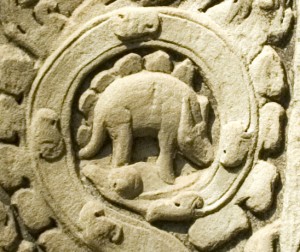
The temple is covered with the most intricate of carvings. The reader who was visiting the area noticed very distinct and clear images that seem to depict a Stegosaurus (pictured above), indicating that this creature might well have survived up until the Khmer era in the region. One expert on Khmer ruins has told us that it is unlikely that these images are a recent addition to the temple.
The stegosaurus (pictured below) was a spectacular beast best known for the row of kite shaped plates that ran along the length of its back. According to conventional science this species existed in North America and died out around 155 million years ago. Villagers in the vicinity of the temple are said to retain traditions of this animal existing until fairly recent times.

Yowie

So far as we have studied the mythical and legendary background of the Yowie mystery in ancient Aboriginal Australia, and the available fossil and archaeological evidence demonstrating that the "hairy man" was/is actually more than one race; as demonstrated by the physical descriptions of early European settler's eyewitness accounts, and which is about to be further vindicated in the modern-day reports gathered by the author from around Australia in the following chapters.
As we have seen, there were giant-size as well as modern human size "hairy men", and there were also the "little hairy men", pygmy-size forms found in Aboriginal traditions Australia-wide, all of which were collectively included under the overall title of "hairy man"by our Aboriginal people. While it is certain that many of the "little hairy people" were smallish forest-dwelling Australoids, such as the better known Atherton Tableland 'pygmy' Aboriginals - and it seems certain similar forms of these once inhabited [or still do] the mountainous forestlands further south, even to Tasmania - others have been claimed to exist in Australia's interior.
Yet what of the small, hairy ape-like forms recorded in Aboriginal traditions? These cannot be confused with the young of the larger creatures of this description, for the Aborigines claim they are a definite pygmy-size race on their own; and even here there are both herbivorous, as well as omnivorous tool-making, even fire-making forms. This chapter shall concern itself with these "little hairy people" before we move onto the modern-day evidence of surviving larger relict hominid and hominoid forms of the "hairy man".
The term "hairy man" was applied by the Aborigines to all non-Aboriginal races with whom they shared this continent, whether they were 'hairy' or not, and in the course of attempting to unravel the Yowie mystery I have had to work my way through a maze of hominid and hominoid forms, often linking a number of giant or smaller-size "hairy men" known by many different Aboriginal names scattered across vast distances of Australia under one single race or another. This book presents the reader with a selection of reports and other evidence that primitive survivors from the dawn of human evolution still roam remote regions of our continent, and yet it is but a small portion of the over 3,000 case histories and other evidence gathered by me in the course of a lifetime's dedicated, self-funded research, the results of almost 45 years of my life. I stand by the evidence I have presented.
Time will vindicate me. There is a mystery lurking in the dense rainforests of Queensland's far north, which after generations of European settlement of the region has still not been laid to rest. It concerns traditions of both Aborigines as well as European settlers, of a race of primitive stone-age people often confused with the Yowie in old folklore, called the 'Junjdy' or "little hairy red men", but who call themselves the Birranbindins. They are in effect, the lost pygmy tribes of far north Queensland.
They were described as little black-skinned hairy natives, no taller than 1 to 1.3 metres tall, who inhabited the forests feeding upon vegetable food, forest animals, killing and eating any Aborigines they happened to catch. The Aborigines ruthlessly hunted and killed the Birranbindins at every opportunity. This had the effect of driving them deeper into the mountains. The truth was, the Birranbindins were shy, timid natives who feared the Aborigines, avoiding them at every opportunity.
It was once thought by scientists that these little forest natives were a separate race which had preceded the Aborigines to Australia, for their negroid-like rounded heads and crinkly black hair is deceptive. However, these features and the smallish stature are typical of natives who have lived for generations in a darkened forest environment, existing upon forest foods. The north Queensland pygmy's are in fact Australoid rather than Negroid, and probably related to the former Tasmanian Aborigines whose features were identical, although these people were slightly taller.
Even so, the coastal and inland Aborigines did not regard these smaller Australoids as their own kind. Linking them with the Yowies, they were known as the 'Jundjdy', or "little hairy red men", alluding to their fine body hair, which could sometimes be a reddish colour. The 'Junjdy' traditions cover the length and breadth of the far north Queensland mountain ranges, but as it will also be demonstrated, they were also known to the forests of the Gulf country and Arnhem Land.
Further traditions also place tribal groups in southern Qld, far northern NSW, as far south as the rugged mountain country north of the Blue Mountains west of Sydney. Pygmy-size natives have also been reported seen in the vast Kanangra Boyd National Park, south-west of Katoomba, and on down the south coastal mountain ranges, while others will be met with even in Central Australia in the course of this book.
European settlers first learnt of the 'Junjdy' from coastal Aborigines about 125 years ago, that they had the tribal name of Birranbindin, and that they had a tribal language which the coastal Aborigines understood - Yidigii. It was not long before the Birranbindins began creating a nuisance of themselves, making frequent raids upon lonely farms stealing vegetables and killing stock. This soon led to reprisals by settlers, and a call for police protection.
In "Among Cannibals" by Carl Lumholtz, a Norwegian zoologist who spent 14 months, from 1882-1883 amongst the Aborigines of the Herbert River district, west of Ingham, Qld, it is said that the early settlers of the Atherton rainforest commented on the small stature of the forest tribes and Atherton's first policeman, Constable Hansen was dispatched to supply rations to these natives to reduce the incidence of foraging raids on crops grown by settlers.

Sunday, May 10, 2009

Titanboa - the largest snake ever lived

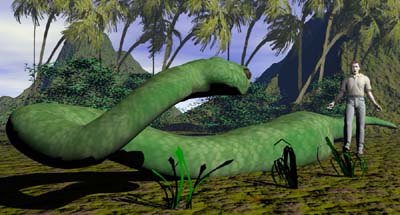
The largest snake the world has ever known — as long as a school bus and as heavy as a small car — ruled tropical ecosystems only 6 million years after the demise of the fearsome Tyrannosaurus Rex, according to a new discovery published in the journal Nature.

Partial skeletons of a new giant, boa constrictor-like snake named “Titanoboa” found in Colombia by an international team of scientists and now at the University of Florida are estimated to be 42 to 45 feet long, the length of the T-Rex “Sue” displayed at Chicago’s Field Museum, said Jonathan Bloch, a UF vertebrate paleontologist who co-led the expedition with Carlos Jaramillo, a paleobotanist from the Smithsonian Tropical Research Institute in Panama.

Researchers say the extinct snake was even larger than the wildest dreams of directors of modern horror movies.

“Truly enormous snakes really spark people’s imagination, but reality has exceeded the fantasies of Hollywood,” said Bloch, who is studying the snake at the Florida Museum of Natural History on the UF campus. “The snake that tried to eat Jennifer Lopez in the movie ‘Anaconda’ is not as big as the one we found.”

Jason Head, a paleontologist at the University of Toronto in Mississauga and the paper’s senior author, described it this way: “The snake’s body was so wide that if it were moving down the hall and decided to come into my office to eat me, it would literally have to squeeze through the door.”

Besides tipping the scales at an estimated 1.25 tons, the snake lived during the Paleocene Epoch, a 10-million-year period immediately following the extinction of the dinosaurs 65 million years ago, Bloch said.

The scientists also found many skeletons of giant turtles and extinct primitive crocodile relatives that likely were eaten by the snake, he said. “Prior to our work, there had been no fossil vertebrates found between 65 million and 55 million years ago in tropical South America,leaving us with a very poor understanding of what life was like in the northern Neotropics,” he said. “Now we have a window into the time just after the dinosaurs went extinct and can actually see what the animals replacing them were like.”

Size does matter because the snake’s gigantic dimensions are a sign that temperatures along the equator were once much hotter. That is because snakes and other cold-blooded animals are limited in body size by the ambient temperature of where they live, Bloch said.

“If you look at cold-blooded animals and their distribution on the planet today, the large ones are in the tropics, where it’s hottest, and they become smaller the farther away they are from the equator,” he said.

Based on the snake’s size, the team was able to calculate that the mean annual temperature at equatorial South America 60 million years ago would have been about 91 degrees Fahrenheit, about 10 degrees warmer than today, Bloch said.

The presence of outsized snakes and turtles shows that even 60 million years ago the foundations of the modern Amazonian tropical ecosystem were in place, he said.

Fossil hunting is usually difficult in the forest-covered tropics because of the lack of exposed rock, Bloch said. But excavations in the Cerrejon Coal Mine in Northern Colombia exposed the rock and offered an unparalleled opportunity for discovery, he said.

After the team brought the fossils to the Florida Museum of Natural History, it was UF graduate students Alex Hastings and Jason Bourque who first recognized they belonged to a giant snake, Bloch said. Head, an expert on fossil snakes, worked with David Polly, a paleontologist at the University of Indiana, to estimate the snake’s length and mass by determining the relationship between body size and vertebral — backbone — size in living snakes and using that relationship to figure out body size of the fossil snake based on its vertebrae.

Harry W. Greene, professor in the department of ecology and evolutionary biology at Cornell University and one of the world’s leading snake experts, said the “colossal” ancient boa researchers found has “important implications for snake biology and our understanding of life in the ancient tropics.”

“The giant Colombian snake is a truly exciting discovery,” said Greene, who wrote the book “Snakes: The Evolution of Mystery in Nature.” “For decades herpetologists have argued about just how big snakes can get, with debatable estimates of the max somewhat less than 40 feet.”