Friday, May 15, 2009

Cambodia Dinosaurus

Conventional science has it that the dinosaurs were wiped out many millions of years ago either as the result of climate change or a meteorite hitting earth. Some researchers, however, claim that dinosaurs might have continued to roam remote parts of the earth as recently as a few hundred years ago. A few even claim that there might be some small populations of dinosaurs, otherwise believed to be extinct, surviving in the world’s most isolated forests.
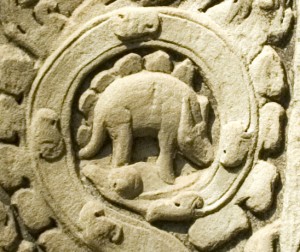
A reader has sent to All News Web these photos of the stunning Ta Prohm Temple (pictured below) deep in the jungles of Cambodia.This temple is the work of the remarkable Khmer civilization which lasted from the 800’s AD until the 1400’s AD.
The temple is covered with the most intricate of carvings. The reader who was visiting the area noticed very distinct and clear images that seem to depict a Stegosaurus (pictured above), indicating that this creature might well have survived up until the Khmer era in the region. One expert on Khmer ruins has told us that it is unlikely that these images are a recent addition to the temple.
The stegosaurus (pictured below) was a spectacular beast best known for the row of kite shaped plates that ran along the length of its back. According to conventional science this species existed in North America and died out around 155 million years ago. Villagers in the vicinity of the temple are said to retain traditions of this animal existing until fairly recent times.

Yowie

So far as we have studied the mythical and legendary background of the Yowie mystery in ancient Aboriginal Australia, and the available fossil and archaeological evidence demonstrating that the "hairy man" was/is actually more than one race; as demonstrated by the physical descriptions of early European settler's eyewitness accounts, and which is about to be further vindicated in the modern-day reports gathered by the author from around Australia in the following chapters.
As we have seen, there were giant-size as well as modern human size "hairy men", and there were also the "little hairy men", pygmy-size forms found in Aboriginal traditions Australia-wide, all of which were collectively included under the overall title of "hairy man"by our Aboriginal people. While it is certain that many of the "little hairy people" were smallish forest-dwelling Australoids, such as the better known Atherton Tableland 'pygmy' Aboriginals - and it seems certain similar forms of these once inhabited [or still do] the mountainous forestlands further south, even to Tasmania - others have been claimed to exist in Australia's interior.
Yet what of the small, hairy ape-like forms recorded in Aboriginal traditions? These cannot be confused with the young of the larger creatures of this description, for the Aborigines claim they are a definite pygmy-size race on their own; and even here there are both herbivorous, as well as omnivorous tool-making, even fire-making forms. This chapter shall concern itself with these "little hairy people" before we move onto the modern-day evidence of surviving larger relict hominid and hominoid forms of the "hairy man".
The term "hairy man" was applied by the Aborigines to all non-Aboriginal races with whom they shared this continent, whether they were 'hairy' or not, and in the course of attempting to unravel the Yowie mystery I have had to work my way through a maze of hominid and hominoid forms, often linking a number of giant or smaller-size "hairy men" known by many different Aboriginal names scattered across vast distances of Australia under one single race or another. This book presents the reader with a selection of reports and other evidence that primitive survivors from the dawn of human evolution still roam remote regions of our continent, and yet it is but a small portion of the over 3,000 case histories and other evidence gathered by me in the course of a lifetime's dedicated, self-funded research, the results of almost 45 years of my life. I stand by the evidence I have presented.
Time will vindicate me. There is a mystery lurking in the dense rainforests of Queensland's far north, which after generations of European settlement of the region has still not been laid to rest. It concerns traditions of both Aborigines as well as European settlers, of a race of primitive stone-age people often confused with the Yowie in old folklore, called the 'Junjdy' or "little hairy red men", but who call themselves the Birranbindins. They are in effect, the lost pygmy tribes of far north Queensland.
They were described as little black-skinned hairy natives, no taller than 1 to 1.3 metres tall, who inhabited the forests feeding upon vegetable food, forest animals, killing and eating any Aborigines they happened to catch. The Aborigines ruthlessly hunted and killed the Birranbindins at every opportunity. This had the effect of driving them deeper into the mountains. The truth was, the Birranbindins were shy, timid natives who feared the Aborigines, avoiding them at every opportunity.
It was once thought by scientists that these little forest natives were a separate race which had preceded the Aborigines to Australia, for their negroid-like rounded heads and crinkly black hair is deceptive. However, these features and the smallish stature are typical of natives who have lived for generations in a darkened forest environment, existing upon forest foods. The north Queensland pygmy's are in fact Australoid rather than Negroid, and probably related to the former Tasmanian Aborigines whose features were identical, although these people were slightly taller.
Even so, the coastal and inland Aborigines did not regard these smaller Australoids as their own kind. Linking them with the Yowies, they were known as the 'Jundjdy', or "little hairy red men", alluding to their fine body hair, which could sometimes be a reddish colour. The 'Junjdy' traditions cover the length and breadth of the far north Queensland mountain ranges, but as it will also be demonstrated, they were also known to the forests of the Gulf country and Arnhem Land.
Further traditions also place tribal groups in southern Qld, far northern NSW, as far south as the rugged mountain country north of the Blue Mountains west of Sydney. Pygmy-size natives have also been reported seen in the vast Kanangra Boyd National Park, south-west of Katoomba, and on down the south coastal mountain ranges, while others will be met with even in Central Australia in the course of this book.
European settlers first learnt of the 'Junjdy' from coastal Aborigines about 125 years ago, that they had the tribal name of Birranbindin, and that they had a tribal language which the coastal Aborigines understood - Yidigii. It was not long before the Birranbindins began creating a nuisance of themselves, making frequent raids upon lonely farms stealing vegetables and killing stock. This soon led to reprisals by settlers, and a call for police protection.
In "Among Cannibals" by Carl Lumholtz, a Norwegian zoologist who spent 14 months, from 1882-1883 amongst the Aborigines of the Herbert River district, west of Ingham, Qld, it is said that the early settlers of the Atherton rainforest commented on the small stature of the forest tribes and Atherton's first policeman, Constable Hansen was dispatched to supply rations to these natives to reduce the incidence of foraging raids on crops grown by settlers.
Sunday, May 10, 2009

Titanboa - the largest snake ever lived

The largest snake the world has ever known — as long as a school bus and as heavy as a small car — ruled tropical ecosystems only 6 million years after the demise of the fearsome Tyrannosaurus Rex, according to a new discovery published in the journal Nature.

Partial skeletons of a new giant, boa constrictor-like snake named “Titanoboa” found in Colombia by an international team of scientists and now at the University of Florida are estimated to be 42 to 45 feet long, the length of the T-Rex “Sue” displayed at Chicago’s Field Museum, said Jonathan Bloch, a UF vertebrate paleontologist who co-led the expedition with Carlos Jaramillo, a paleobotanist from the Smithsonian Tropical Research Institute in Panama.

Researchers say the extinct snake was even larger than the wildest dreams of directors of modern horror movies.

“Truly enormous snakes really spark people’s imagination, but reality has exceeded the fantasies of Hollywood,” said Bloch, who is studying the snake at the Florida Museum of Natural History on the UF campus. “The snake that tried to eat Jennifer Lopez in the movie ‘Anaconda’ is not as big as the one we found.”

Jason Head, a paleontologist at the University of Toronto in Mississauga and the paper’s senior author, described it this way: “The snake’s body was so wide that if it were moving down the hall and decided to come into my office to eat me, it would literally have to squeeze through the door.”

Besides tipping the scales at an estimated 1.25 tons, the snake lived during the Paleocene Epoch, a 10-million-year period immediately following the extinction of the dinosaurs 65 million years ago, Bloch said.

The scientists also found many skeletons of giant turtles and extinct primitive crocodile relatives that likely were eaten by the snake, he said. “Prior to our work, there had been no fossil vertebrates found between 65 million and 55 million years ago in tropical South America,leaving us with a very poor understanding of what life was like in the northern Neotropics,” he said. “Now we have a window into the time just after the dinosaurs went extinct and can actually see what the animals replacing them were like.”

Size does matter because the snake’s gigantic dimensions are a sign that temperatures along the equator were once much hotter. That is because snakes and other cold-blooded animals are limited in body size by the ambient temperature of where they live, Bloch said.

“If you look at cold-blooded animals and their distribution on the planet today, the large ones are in the tropics, where it’s hottest, and they become smaller the farther away they are from the equator,” he said.

Based on the snake’s size, the team was able to calculate that the mean annual temperature at equatorial South America 60 million years ago would have been about 91 degrees Fahrenheit, about 10 degrees warmer than today, Bloch said.

The presence of outsized snakes and turtles shows that even 60 million years ago the foundations of the modern Amazonian tropical ecosystem were in place, he said.

Fossil hunting is usually difficult in the forest-covered tropics because of the lack of exposed rock, Bloch said. But excavations in the Cerrejon Coal Mine in Northern Colombia exposed the rock and offered an unparalleled opportunity for discovery, he said.

After the team brought the fossils to the Florida Museum of Natural History, it was UF graduate students Alex Hastings and Jason Bourque who first recognized they belonged to a giant snake, Bloch said. Head, an expert on fossil snakes, worked with David Polly, a paleontologist at the University of Indiana, to estimate the snake’s length and mass by determining the relationship between body size and vertebral — backbone — size in living snakes and using that relationship to figure out body size of the fossil snake based on its vertebrae.

Harry W. Greene, professor in the department of ecology and evolutionary biology at Cornell University and one of the world’s leading snake experts, said the “colossal” ancient boa researchers found has “important implications for snake biology and our understanding of life in the ancient tropics.”

“The giant Colombian snake is a truly exciting discovery,” said Greene, who wrote the book “Snakes: The Evolution of Mystery in Nature.” “For decades herpetologists have argued about just how big snakes can get, with debatable estimates of the max somewhat less than 40 feet.”

Friday, May 8, 2009

Moa - The Last Big Bird

No animal has had more speculation heaped upon it than the Moa.These birds evolved around 85 million years ago on the southern Super-continent called Gondwanaland. They belonged to a group known as Ratites; the family includes Ostriches, Emus and the extinct Elephant Bird of Madagascar. Once New Zealand separated from Gondwanaland and became isolated it enabled the Moa to survive in a relatively predator free environment, filled with avian fauna, the only mammals present were three species of small bats.Recently discovered fossil evidence further seems to indicate there was a species of both Python and Crocodile which may have included Moa on the menu.This isolation enabled these birds to obtain a wide variety of sizes, from small Turkey sized species such as Euryapteryx curtus to the gigantic Dinoris giganteus which stood 4 meters tall and weighed in at 250 kilograms. All Moa species were herbivorous browsers. They ranged in habitat from the alpine regions to the coastal areas.

The main mysteries surrounding this bird is when did it become extinct, or if it is infact extinct. It has been implied the Moa was already on the decline before the human colonization commenced; evidence from Maori butchering and cooking sites show there must have been an abundance of birds, judging by the wasteful practices engaged in the butchering process. Meat from the thighs were primarily used, the remainder of the carcass was left to perish.This is rather surprising, Maori of old were very conservation conscious to ensure resources were not overtaxed. This was accomplished by oral traditionand folklore; seasons set out for hunting different species guaranteed a recovery period.Even the name Moa is somewhat of a conundrum, it does not appear among theoral traditional legends of the Maori, the term used to widely make reference to this bird was Tarepo.It seems generally accepted that the large species were supposed to have been extinct by the early 1800's, and if not already extinct by then, they had become extremely scarce. However if is plausible that some of the smaller species, neglected as a food source because of their bigger relatives may have persisted longer.The mid to late 1800's produced many reports of large birds witnessed inisolated areas of bush; this was an era of exploration, regions were being opened up for settlement. Many reports focused on the South Island, as gold prospectors and surveyors pushed into the isolated interior areas.One of the most curious reports of this period includes a confrontation between a sheep dog and a Moa, the Moa turned on the dog after being harassed, once the dog backed off, the Moa was witnessed to bob its headup and down in the direction of the dog in what seemed to be a possible threat posture.

1931 and 1960 saw further reports of large birds in the bush of the South Island, in 1989 a pair of birds were observed by trampers, once more in the South Island.All accounts seemed to involve the large species of Moa.In 1990 there were several sightings of large Birds, in the Arthur's Pass district, and tracks were found on two occasions.The most recent sighting caught World Media attention.On January 20th 1993 three companions were tramping the Craigieburn Rangearea, Paddy Freaney, Sam Waby and Rochelle Rafferty. Mr. Waby paused at a secluded stream for a drink; Paddy Freaney's attention was drawn to a large bird which was nearby watching them. Freaney drew the attention of his associates to the bird, which then panicked and fled. Freaney chased the bird, with camera in hand, and at an approximated 35 meters got the now famous photo of the bird; he further discovered and photographed, after loosing sight of it, wet bird footprints on a rock.These pictures were shown to a Department of Conservation Officer who expressed the opinion that the bird seemed very much like Megapteryxdidinus, a sub-alpine species of moa known to have populated the South Island.

Computer analysis was performed on the photo by Canterbury University,specialists at the University expressed the view that the photograph was of a genuine large bird and not some prop stage to look like one. Deer and other four footed animals were further ruled out. To add to the weight of evidence in support of the photograph being genuine,in the following year, 1994, a physician was tramping in exactly the same area the snapshot was taken; he came across browsing damage that was consistent with what is known of Moa feeding habits. In light of the corroborating evidence the Department of Conservation made no attempt to follow up on what certainly would have been the find of thecentury.Is the Moa extinct? Perhaps in some of New Zealand's remote areas, and there are still a few,the species may still hold a tenuous grasp on existence.The sad fact is if it were to be discovered how simple it would be to conclude what was started in those Maori middens hundreds of years ago.

Wednesday, May 6, 2009

Megalania

In this day and age, Australia is thought of as desert filled with eucalyptus trees and cotton plantations. The animals usually associated with this continent are koalas, kangaroo, wombats, and crocodiles, some of the largest to be found. There used to be other animals, commonly referred to as megafauna, that roamed this continent before being wiped out by plague or man. These were nightmarish versions of the creatures that we have today. Australia once held 10-foot tall kangaroos that fed on flesh rather than vegetation, and at one time had monitor lizards that dwarfed the Komodo dragon. This was megalania prisca, a reptile reaching 30 feet in length and weighing at least 1,000 pounds or more. The Komodo dragon is roughly the size of a lion, but megalania was bigger than an average dairy cow. Extinct megalania is listed with the many casualties of the Ice Age. Or is it extinct? The creature has been sighted many times in the last century, and some sightings suggest that it lives also in New Guinea.

Also believed to inhabit various parts of New Guinea, Megalania has been spotted many times throughout the years, but an equal number of skeptics maintain that the huge reptilian creature has long been extinct. Sightings have been reported as recently as the late Seventies, in which desert travelers discovered footprints in the sand, leading to apparent plaster casts of the creature's weighty impressions. Is that enough proof? We all know what thousands of plaster casts did to prove the existence of Bigfoot, don't we? Still, despite a lack of conclusive evidence, Bigfoot makes for good television. But when you're dealing with a giant lizard, that's must-see TV.

During the middle of the day, a surveyor returned to his truck. Tired, he wanted nothing more than to go home. He spied what he thought was a fallen tree near his car. Blaming his fatigue for his lack of details he climbed in his car and slammed the door. The "log" suddenly bolted away! It ended up being a lizard of 15 feet in length. Australian cryptozoologist Rex Gilroy is convinced these creatures are still alive and it is only a matter of time before one is captured or killed and brought in.

As recently as the late '70s there have been megalania sightings. In July 1979, Rex Gilroy was informed of footprints of the creature found in a recently plowed field. Across the field were 30 or so tracks from what looked like an enormous lizard. Rain had ruined most of the tracks but Gilroy was able to make a plaster cast of one that had been preserved. The footprint looked surprisingly like something that might have been made by a Megalania.

Also in 1979 a sighting of megalania arose, this time by the best possible witness. Herpetologist Frank Gordon, after conducting some field work in the Wattagan Mountains in New South Wales, returned to his vehicle. After starting his engine he saw, what he at first thought was a log, scampering off. It ended up being a lizard of some 30 feet or more in length.

Another incident includes a farmer who observed a gigantic lizard walking along one of his fields. It walked along a wire fence, so the farmer used a set of fence posts as a guide. His estimate of the beast was a length of twenty to twenty-five feet. The size corresponds with megalania.

Megalania might not be constrained only to Australia--some sightings suggest it may live in New Guinea. A French priest in the 1960's was traveling up river with a native guide in order to reach his mission. During the trip he spotted a large lizard lying on a fallen tree in the sun. He told the native to stop, but being badly frightened, the native continued the journey. The priest returned to the spot the following morning and measured the tree. It was 40 feet long, yet the lizard almost matched it.

As mentioned, the creature is not simply contained to Australia, as further sightings have tracked it to New Guinea where in the Sixties, a French priest witnessed Megalania resting on a downed tree. It was later discovered that the creature's momentary wooded bed was over 40 feet in length, further adding to the mystery that such a gargantuan lizard does indeed exist. What about the hard evidence?

Hard evidence has never stopped the imagination from seeing what we want to, nor has it disproved some of the world's great mysteries. If it did, we'd be able to reconstruct the Great Pyramids by hand. Without conclusive verification like the body of a deceased reptilian behemoth, Megalania will continue to remain the topic of strange Australian folklore. Although Megalania has been spotted many times by farmers and weary travelers, Megalania Prisca is indeed accounted for in the scientific community under the classification of extinct prehistoric species. Until one wanders out of the Australian Outback and into the bustling downtown core of Sydney in search of prey, we may never know what Megalania is truly capable of.

Whether or not megalania is still alive today is uncertain, but until a dead body, or perhaps a living one, is brought in we will forever find it in textbooks as an extinct animal of prehistoric times.

source 1 2