Tuesday, May 5, 2009

Lost World of Dinosaurs Survived Mass Extinction?

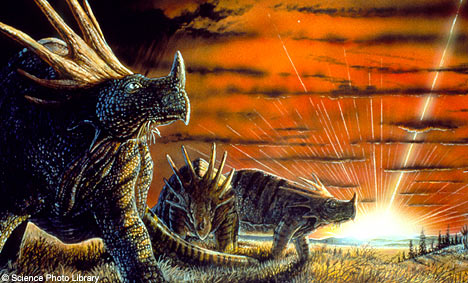
An isolated group of dinosaurs somehow survived the catastrophic event that wiped out most of their kind some 65.5 million years ago, a new study suggests.

Dinosaurs of this "lost world," in a remote region of the U.S. West, may have outlived their doomed relatives by as much as half a million years, according to James Fassett, an emeritus scientist with the U.S. Geological Survey in Santa Fe, New Mexico.

Fassett, who has argued for years that some dinosaurs survived the mass extinction, based his latest work on fossils from the San Juan Basin in what is now Colorado and New Mexico.

There, the bones of hadrosaurs, tyrannosaurs, anklyosaurs, and several other species were found together in a sandstone formation that dates to the Paleocene epoch—the time period after the so-called Cretaceous-Tertiary (K-T) extinction event, which is thought to have killed off the dinosaurs.

As with his past research, Fassett's latest find is likely to continue sparking controversy among paleontologists.

"Every few years someone claims to have [found] Paleocene 'surviving' dinosaurs," said Hans-Dieter Sues, associate director for research and collections at the Smithsonian Institution's National Museum of Natural History.

But so far, such fossils have eventually turned out to be older remains.

  • "Unequivocal Evidence"

In his new study, appearing in the April 2009 issue of the journal Palaeontologia Electronica, Fassett argues that a single hadrosaur fossil helps prove that the San Juan dinos really are from the Paleocene.

After previous "survivor" finds, it was determined that the dinosaurs in question, initially entombed in sand or mud, had their bones exposed again later by natural forces such as river erosion.

The bones were then redeposited in younger rock layers, making them appear to belong to an earlier era.

But paleontologists found a concentration of 34 bones from a single hadrosaur in the San Juan Basin sandstone.

"That's unequivocal evidence I think," Fassett said. River-washed bones would be widely scattered and also show signs of wear and tear—unlike the current fossils, some of which he describes as "pristine."

Working with colleagues at the USGS in Denver, Fassett also examined the concentrations of uranium and rare-earth metals in the fossil bones.

"I thought if we could determine the trace-element compositions of the bones, we might discover that the [older] Cretaceous bones had a different chemical fingerprint than the [younger Paleocene] bones do," he said, "and indeed that turned out to be the case."

  • No Reason Why Not

It's not known why some species, including crocodiles and birds, survived the K-T event while many others did not. The answer could be tied to what exactly caused the mass extinction.

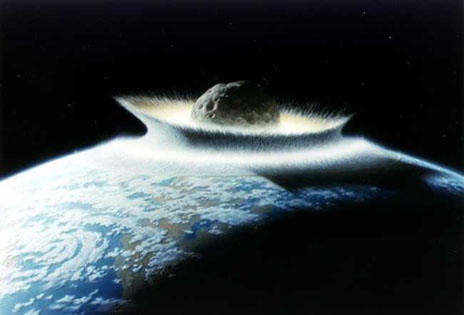
The popular theory is that a killer asteroid struck the Yucatán Peninsula, although experts have argued for massive volcanism, disease, climate change, or some combination of factors.

(Related: "'Dinosaur Killer' Asteroid Only One Part of New Quadruple Whammy Theory.")

Fassett, who supports the asteroid-strike theory, said he can't explain why dinosaurs may have survived longer in some areas but not others.

"One guess is that the survivors lived in the northernmost parts of North America, at the greatest distance from the impact site, and then migrated south," he said.

"But that doesn't explain why [dinosaurs that lived later] haven't been found elsewhere. We don't have an answer for that."

Despite his caution, the Smithsonian's Sues said that the idea of Paleocene dinosaurs can't yet be dismissed.

"There is no a priori reason that dinosaurs could not have survived in some places," he wrote in an email to National Geographic News.

"Indeed, other than in the [U.S.] western interior and in Europe, we have as yet no concrete evidence when dinosaurs vanished."

'Alien skull' spotted on Mars

At first glance it looks like a rocky desert - but this image of the Mars landscape has got space-gazers talking.

An oddly shaped space boulder appears to show eye sockets and a nose leading to speculation it might be a Martian skull.

Internet forums are full of chatter about the picture, taken by a panoramic NASA camera known as Spirit.

One alien-spotter speculated: "The skull is 15 cm with binocular eyes 5 cm apart. The cranial capacity is approximately 1400 cc.

"There appears to be a narrow pointed small mouth, so this creature most likely is a carnivore."

Another joked: "The coronal ridge shows ample structure to support the musculature of antennae, although none are visible in this view.

"The nose area is broad and blunted as you would expect to see in a cold and windy landscape. Is he decapitated or is he buried up to his neck?"

Previous images of a skull spotted on Mars in 2006 were believed to have been the result of tampering.

The famous Face on Mars, snapped by the Viking 1 spacecraft in 1976, which showed the shadowy likeness of a human face was late, was found to be a trick of the light when the area was re-photographed in 1998.

Thursday, April 30, 2009

New theory of Dinosaurus extincion

The popular theory that dinosaurs were wiped out by an asteroid 65million years ago has been challenged.

It was believed the Chicxulub crater in Mexico was the 'smoking gun' of the mass extinction event.

Molten droplets from the ancient asteroid impact were found just below the Cretaceous-Tertiary boundary - a geological layer of sediment linked with the extinction.

But soil samples from the 112-mile wide crater show the impact predates the disappearance of the dinosaurs by about 300,000 years.

The latest research has been published in the Journal of the Geological Society.

Study author Professor Gerta Keller from Princeton University suggested that the massive volcanic eruptions at the Deccan Traps in India may be responsible for the extinction, releasing huge amounts of dust and gases that could have blocked out sunlight and brought about a significant greenhouse effect.

Supporters of the Chicxulub impact theory suggest the impact crater and the mass extinction event only appear far apart in the sedimentary record because of earthquake or tsunami disturbance that resulted from the impact of the asteroid.

But Professor Keller said: 'The problem with the tsunami interpretation is that this sandstone complex was not deposited over hours or days by a tsunami.

'Deposition occurred over a very long time period.'

The scientists also found evidence that the Chicxulub impact didn't have the dramatic impact on species diversity that has been suggested.

At one site at El Penon, the researchers found 52 species present in sediments below the impact spherule layer, and counted all 52 still present in layers above the molten droplets or spherules.

'We found that not a single species went extinct as a result of the Chicxulub impact,' said Professor Keller.

This conclusion should not come as too great a surprise, she says.

None of the other great mass extinctions are associated with an impact, and no other large craters are known to have caused a significant extinction event.

The Channel Creature


‘Association of Maritime Research’ was created in 1901 in order to promote a better understanding of deep-sea life and the curious and unknown phenomena that occur in the depth of the oceans and on the sea- bed. Their approach to research is to gather testimonials and question scientists specialising in marine research in an attempt to find a scientific explanation for the various sightings.

The AMR’s intention is to communicate their findings to the general public and enable them to participate interactively in the continuing research.

Sightings

On 20th April 2009 Thierry and Sophie were enjoying a walk at the Boulogne Harbour. They are both passionate about boats and sea-life and intended filming the variety of boats sailing out of the harbour. As Thierry was filming, his eye glued to the lens, he suddenly became aware of a large shape which appeared on the horizon. Intrigued, he zoomed the camera in to focus more clearly and saw a huge, dark, rapidly moving object, which disappeared within a matter of seconds. Something of an amateur expert about the sea and marine life, he knew this was not simply the outline of a whale or any similar creature and was convinced that he had sighted some phenomenon as yet unseen by man. He decided to contact the AMR who are pursuing further investigations.

Subsequently the AMR has collected a substantial number of testimonials from different areas. The strong similarities between the descriptions seem to confirm the existence of a ‘gigantic’ and extremely ‘fast-moving’ creature off our shores.

Calling for Witnesses

The AMR’s success in identifying this marine phenomenon is dependent upon the participation of the general public. As the first report came from Dover they have put in place a multimedia campaign calling for witnesses to come forward. This will include the distribution of flyers, radio, press and online communications.

We are calling for all witnesses of sightings of any strange phenomena in the English Channel to contact the AMR immediately via our website

http://www.thechannelcreature.com/

A reward is being offered for evidence leading directly to proof of this creature’s existence.

www.thechannelcreature.com/what-is-the-amr/

Wednesday, April 29, 2009

2012 - The Year of Apocalypse

For scary speculation about the end of civilization in 2012, people usually turn to followers of cryptic Mayan prophecy, not scientists. But that’s exactly what a group of NASA-assembled researchers described in a chilling report issued earlier this year on the destructive potential of solar storms.

Entitled "Severe Space Weather Events — Understanding Societal and Economic Impacts," it describes the consequences of solar flares unleashing waves of energy that could disrupt Earth’s magnetic field, overwhelming high-voltage transformers with vast electrical currents and short-circuiting energy grids. Such a catastrophe would cost the United States "$1 trillion to $2 trillion in the first year," concluded the panel, and "full recovery could take 4 to 10 years." That would, of course, be just a fraction of global damages.

Good-bye, civilization.

Worse yet, the next period of intense solar activity is expected in 2012, and coincides with the presence of an unusually large hole in Earth’s geomagnetic shield. But the report received relatively little attention, perhaps because of 2012’s supernatural connotations. Mayan astronomers supposedly predicted that 2012 would mark the calamitous "birth of a new era."

Whether the Mayans were on to something, or this is all just a chilling coincidence, won’t be known for several years. But according to Lawrence Joseph, author of "Apocalypse 2012: A Scientific Investigation into Civilization’s End," "I’ve been following this topic for almost five years, and it wasn’t until the report came out that this really began to freak me out."