Thursday, July 1, 2010

Leviathan melvillei, 'Sea monster' whale fossil unearthed

Researchers have discovered the fossilised remains of an ancient whale with huge, fearsome teeth.

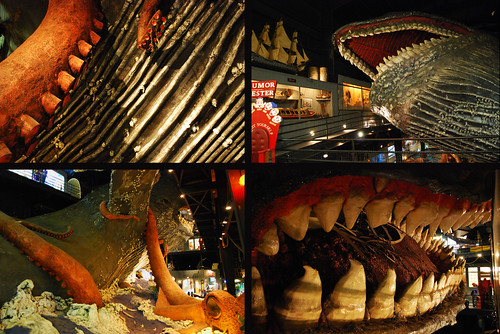
A Peruvian desert has turned out to be the final resting place of an ancient sperm whale with teeth much bigger than those of the largest of today's sperm whales. The fossil, dated at 12–13 million years old, belongs to a new, but extinct, genus and species described in Nature today1. Named Leviathan melvillei, it probably hunted baleen whales. A team of researchers recovered 75% of the animal's skull, complete with large fragments of both jaws and several teeth. On the basis of its skull length of 3 metres, they estimate that Leviathan was probably 13.5–17.5 metres long, within the range of extant adult male sperm whales (Physeter macrocephalus). Its largest teeth, however, are more than 36 centimetres long — nearly 10 centimetres longer than the largest recorded Physeter tooth.
Modern sperm whales lack functional teeth in their upper jaw and feed by suction, diving deep to hunt squid. Conversely, Leviathan had massive teeth in both its upper and lower jaws, and a skull that supported large jaw muscles. It may have hunted like raptorial killer whales, which use their teeth to tear off flesh. Co-author Klaas Post of the Natural History Museum Rotterdam in the Netherlands stumbled across the fossil in November 2008 during the final day of a field trip to Cerro Colorado in the Pisco-Ica Desert on the southern coast of Peru — an area that is now above sea level owing to Andean tectonic activities. The fossils were prepared in Lima, where they will remain.
Moby moniker

The name given to the creature combines the Hebrew word 'Livyatan', which refers to large mythological sea monsters, with the name of American novelist Herman Melville, who penned Moby-Dick — "one of my favourite sea books", says lead author Olivier Lambert of the National Museum of Natural History in Paris.
The authors think that Leviathan, like the extinct giant shark, preyed on medium-sized baleen whales, which were between 7 and 10 metres long, smaller than today's humpback whales and widely diverse at the time. The authors speculate that Leviathan became extinct as a result of changing environmental conditions. "Top predators are very sensitive to the changes in their prey," Lambert says. Changes in number, diversity or size of baleen whales, as well as the climate cooling that occurred at around Leviathan 's time, would have had dire impacts. The creature's surviving cousins — Physeter, pygmy and dwarf sperm whales — are specialized deep-diving squid hunters that occupy a different ecological niche from Leviathan. According to vertebrate palaeontologist Lawrence Barnes at the Natural History Museum of Los Angeles County, this discovery demonstrates that sperm whale-like cetaceans were much more diverse in the past and that the modern sperm whale and pygmy sperm whales are the "only surviving vestiges of a larger evolutionary radiation of related whales in the past".

Battering rams
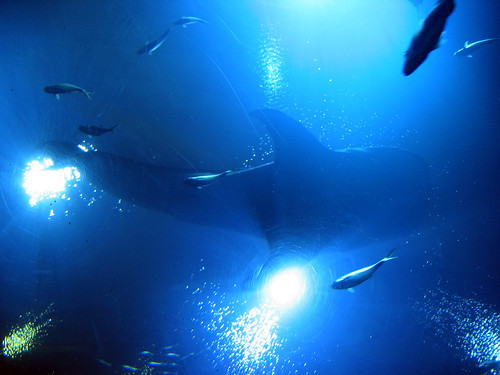
All sperm whales have characteristically large foreheads to hold their 'spermaceti organ', a series of oil and wax reservoirs buttressed with massive partitions of connective tissue. Scientists have long thought that this organ helps sperm whales to dive deeply to feed. The curved 'basin' atop Leviathan 's snout suggests that it also had a large spermaceti organ, even though it probably did not dive to feed. The authors speculate that, if Leviathan hunted baleen whales near the surface, the large spermaceti organ existed long before modern sperm whales became specialized for foraging squid at depth.
The organ could have served other functions, such as echolocation, acoustic displays or aggressive head-butting. "Spermaceti organs could be used as battering rams to injure opponents during contests over females," says evolutionary morphologist David Carrier of the University of Utah in Salt Lake City. According to Carrier, at least two nineteenth-century whaling ships were sunk when large males punched holes in their sides with their foreheads, Carrier adds, and Leviathan may have used forehead ramming to dispatch its prey.

Friday, June 25, 2010

The Baigong Pipes

Do modern metal pipes buried in ancient Chinese stone prove that aliens must have visited?

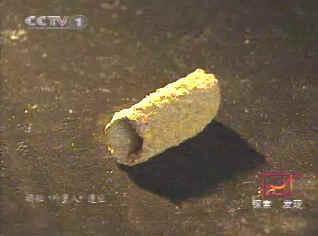
Should you happen to visit Tibet anytime soon, be sure to stop by the city of Delingha. It's a town of most extraordinary beauty, nestled on the edge of the Qaidam Basin below a range of Himalayan hills. There you'll find the local residents proudly displaying their most famous distinction. For a few yuan you can probably get someone to take you to see it. Only a short journey outside of town is said to be a cave, and in this cave are a series of ancient metal pipes. These pipes predate all known history, and are embedded into the rock itself. They are said to lead through the very mountain, and connect to a nearby salt lake. The explanation? Ruins of a construction project 150,000 years ago, by alien visitors.

The Baigong Pipes are an example of what paranormal enthusiasts refer to as "out of place artifacts", modern objects discovered in ancient surroundings. The Baigong Pipes are described as a sophisticated system of metal pipes, buried in geology in such a way that precludes the possibility of having been installed in modern times. They are located on Mt. Baigong in the Qinghai province of China, about 40 kilometers southwest of Delingha. Most accounts describe a pyramid-shaped outcropping on the mountain, and the cave containing the pipes is on this pyramid. 80 meters from the mouth of this cave is a salt lake (the twin of an adjacent freshwater lake), and more pipes can be found poking up along the shore. Most of the information you can find online about the Baigong Pipes appears to be originally sourced from a 2002 article from the Xinhua News Agency, talking about preparations by a team of scientists about to embark to this remote area to study the pipes. "Nature is harsh here," said one. "There are no residents let alone modern industry in the area, only a few migrant herdsmen to the north of the mountain."

The two lakes are broad, shallow sinks at the low point of the vast Qaidam Basin. Searching for Mt. Baigong is likely to be fruitless: First, the area is largely flat and the nearest mountains are 20 or 30 kilometers away; second, baigong is a local word for hill and could mean anything in this context. The southernmost of the two lakes, Toson Hu or Lake Toson, has some low bluffs here and there along its southern and western sides (Google Maps link), and it is in one of these bluffs (about 50 or 60 meters in height) that author Bai Yu once happened to find what he described as a small cave, according to his book Into the Qaidam.

Bai was traveling the area in 1996, and described a lifeless lake surrounded by cone-shaped hills. The cave appeared to have been artificially dug, and was triangular, about six meters deep. Nearby were two similar caves, but they had collapsed and could not be entered. But what struck Bai was the array of manufactured metal pipes protruding up through the floor of the cave and embedded within its walls, one 40 cm wide. Following their path outside, Bai discovered more pipes protruding from the surface of the conical hill, and even more of them 80 meters away from the cave along the shore of the lake. Excited, he removed a sample and sent it to the Ministry of Metallurgical Industry. The result was 92% common minerals and metals, and 8% of unknown composition.

Bai proceeded about 70 kilometers to the Delhi branch of China's Purple Mountain Observatory, a high vantage point from where he knew he could get a birds-eye view of the whole region. He saw great expanses of flat, open terrain, and putting two and two together, he concluded that this would make for a fine alien landing site. Unknown minerals and plentiful landing space meant that the Baigong Pipes had to be of alien origin.

Scientists from the China Seismological Bureau visited the lake in 2001 to examine the pipes. Samples brought back to the Beijing Institute of Geology were examined by thermoluminescence dating, a technique that can determine how long it's been since a crystalline mineral was either heated or exposed to sunlight. The result came back that if these were indeed iron pipes that had been smelted, they were made 140-150,000 years ago. Human history in the region only goes back some 30,000 years, and so the alien theory seemed to have been confirmed. The following year the Xinhua news story was published, and the Baigong Pipes entered pop culture as, supposedly, genuine, tangible evidence of alien visitation.

If you visit the area today, you'll find a locally-built monument to the aliens off the main highway, replete with a mockup metallic satellite dish. Internet forums buzz with the absence of followup articles by Xinhua; the natural conclusion is that it turned out the alien explanation was the true one and the Chinese government is suppressing any further reporting. Cracked.com touts the Baigong Pipes as one of Six Insane Discoveries that Science Can't Explain.

And although that's where most reporting of the Baigong Pipes stops, it's also where responsible inquiry should begin. When you settle on a paranormal explanation, it means you've decided there is no natural explanation. In fact, when you don't yet know the explanation, you don't yet know the explanation; so you can't reasonably decide that the time is right to stop investigating. But so many do.

Skeptical hypotheses have already been put forward, seeking a natural explanation for the Baigong Pipes that doesn't require the introduction of a wild assumption like alien visitation. The first thing we turn to are geological processes that might explain them. The Chinese have put forth several such hypotheses, including one involving the seepage of iron-rich magma into existing fissures in the rock.

A 2003 article in Xinmin Weekly described how this might work. Fractures caused by the uplift of the Qinghai-Tibet plateau could have left the ground riddled with such fissures, into which the highly pressurized magma driving the uplift would have been forced. Assuming this magma was of the right composition that, when combined with the chemical effects of subsequent geological processes, we might very likely expect to see such rusty iron structures in the local rock. But evidence of this has never surfaced, and the Chinese dismissed this theory. They also noted that the Qaidam oil field would not be able to exist if there were active volcanism in the area as recently as 150,000 years ago.

It was their next theory that ultimately led to a satisfactory explanation, and this theory involved the same hypothesized fissures in the sandstone. But, instead of being filled with iron-rich magma, the fissures could have been washed full of iron-rich sediment during floods. Combined with water and the presence of hydrogen sulfide gas, the sediment could have eventually hardened into the rusty metallic pipelike structures of iron pyrite found today. This theory was not fantastic, in part because there was no logical reason why the sandstone might happen to be laced with pipe shaped fissures. But the idea of flooding did make sense, given the geological history of the Qaidam Basin.

Three years before Bai Yu took his first peek into the cave at Lake Toson, researchers Mossa and Schumacher wrote in the Journal of Sedimentary Research about fossil tree casts in Louisiana. They found cylindrical structures in the soil, thermoluminescence dated from 75-95,000 years ago. The chemical composition of the cylinders varied depending on where and when they formed and in what type of soil. The authors found that these were the fossilized casts of tree roots, formed by pedogenesis (the process by which soil is created) and diagenesis (the lithification of soil into rock through compaction and cementation). The result of this process was to create metallic pipelike structures, which by comparing the descriptions offered by researchers, appear to be a perfect match for the Baigong Pipes.

The Chinese scientists eventually did come to the same conclusion, according to the Xinmin Weekly article. They used atomic emission spectroscopy to conduct a detailed chemical analysis of the rusty pipe fragments, and found them to contain organic plant matter. Under the microscope they found tree rings, consistently throughout the samples. Once they established that the Baigong Pipes were simply fossilized tree casts, they set about to discover how they got there.

The Qaidam basin was once a vast lake, which has disappeared as the Qinghai-Tibet plateau uplifted the basin to its current elevation of about 2800 meters. Over the millennia, various floods filled the sink with runoff, alluvium, and debris including such fossils. They can now be found wherever such ancient flows deposited them, and it seems that Bai Yu was lucky enough to discover just such a pocket.

And so we end up with a complete story of how rusty iron pipes, tens of thousands of years older than any people who might have forged them, can end up embedded in solid sandstone in such a way as to baffle the average observer. Like many amateur researchers, Bai Yu stumbled upon an extraordinary discovery, but through his lack of applicable knowledge, misinterpreted what he saw. Those who underestimate the Earth's ability to produce fascinating effects are often left to grope for goofy explanations like alien construction projects. I find that the Baigong Pipes are one of the better examples of the folly of stopping at the paranormal explanation, compared to the rich rewards offered by following the scientific method to uncover what's really going on.

Wednesday, June 23, 2010

The Bloop - a deep sea monster

It came from the depths of the South Pacific. Throughout the summer of 1997, a sound never before recorded burst from the abyss. News agencies scrambled; was this some new leviathan, an unknown monster from the deep? Nobody knew, and though this recording has taken its place among the permanent fixtures of the museums of the strange, the Bloop has never been identified.

The Bloop was on the loud side, to be sure. It was picked up on multiple sensors as far as 5,000 kilometers away. By triangulation, we know it came from somewhere right around 50°S, 100°W, which is about 1,750 kilometers west of Chile in the South Pacific. It's about as remote as you can get in any ocean. There are no islands or anything anywhere near it. The water is deep there, very deep, averaging around 4,300 meters. The Bloop was recorded several times during 1997, on the Eastern Equatorial Pacific autonomous hydrophone array, which was deployed in May, 1996 by NOAA (the National Oceanic and Atmospheric Administration) for long-term monitoring of seismic events on the East Pacific Rise.

Cryptozoologists love the Bloop, because to them it is evidence pointing to the existence of a gigantic unknown creature. Virtually every web page about the Bloop (and there are a lot of them) repeats this same quote, word for word:

Though it matches the audio profile of a living creature, there is no known animal that could have produced the sound. If it is an animal it would have to be huge — much larger than even a Blue whale, according to scientists who have studied the phenomenon.

I've been unable to find the original source of this quote. Only one web site on which I found it gave an attribution, saying it was a quote from NOAA. However this text does not appear on any NOAA web sites, and its wording is inconsistent with NOAA's typical descriptions of unknown sounds. When a sound is unknown, NOAA says it's unknown and leaves it at that; it is not their habit to editorialize or hypothesize about giant cryptids.

So, for now, the identity of these "scientists who have studied the phenomenon" remains a mystery. Many cryptozoologists have written about the Bloop, as is easily shown by a simple Google search; but from what I could tell, few legitimate zoologists have, and none who have concluded the Bloop has a biological origin.

Fortunately, we are not entirely without our own resources to test this suggestion that the Bloop "matches the audio profile of a living creature". There are three basic types of sounds in the oceans: Natural sounds like volcanoes and earthquakes, biological sounds from sea creatures, and man-made sounds from boats or other machinery. Usually you can take your unknown sound and compare it to a selection of known sounds, and get a pretty good idea what it is. Sounds can be represented on colorful graphs called spectrograms. Time is one dimension, and frequency is the other.

The amplitude is represented by the color. An ongoing sound with a certain frequency range, like a boat engine, creates a solid band across the spectrogram. A chirp from a dolphin would make a little streak. This gives us a two-pronged approach to trying to match the Bloop to a known source: We can listen to it to get a subjective feel for it, and we can also compare its spectrogram to known spectrograms to get a firmer, more quantifiable comparison.


The frequency of the sound meant it had to be much louder than any recognised animal noise, including that produced by the largest whales.

So is it a huge octopus? Although dead giant squid have been washed up on beaches, and tell-tale sucker marks have been seen on whales, there has never been a confirmed sighting of one of the elusive cephalopods in the wild.

The largest dead squid on record measured about 60ft including the length of its tentacles, but no one knows how big the creatures might grow.

For years sailors have told tales of monsters of the deep including the huge, many-tentacled kraken that could reach as high as a ship's mainmast and sink the biggest ships.

However Phil Lobel, a marine biologist at Boston University, Massachusetts, doubts that giant squid are the source of Bloop.

"Cephalopods have no gas-filled sac, so they have no way to make that type of noise," he said. "Though you can never rule anything out completely, I doubt it."

Nevertheless he agrees that the sound is most likely to be biological in origin.

The system picking up Bloop and other strange noises from the deep is a military relic of the Cold War.

In the 1960s the U.S. Navy set up an array of underwater microphones, or hydrophones, around the globe to track Soviet submarines. The network was known as SOSUS, short for Sound Surveillance System.

The listening stations lie hundreds of yards below the ocean surface, at a depth where sound waves become trapped in a layer of water known as the "deep sound channel".

Here temperature and pressure cause sound waves to keep travelling without being scattered by the ocean surface or bottom.

Most of the sounds detected obviously emanate from whales, ships or earthquakes, but some very low frequency noises have proved baffling.

Scientist Christopher Fox of the U.S. National Oceanic and Atmospheric Administration's Acoustic Monitoring Project at Portland, Oregon, has given the signals names such as Train, Whistle, Slowdown, Upsweep and even Gregorian Chant.

He told New Scientist that most can be explained by ocean currents, volcanic activity -- Upsweep was tracked to an undersea South Pacific mountain that had not been identified as "live."

"The sound waves are almost like voice prints. You're able to look at the characteristics of the sound and say: 'There's a blue whale, there's a fin whale, there's a boat, there's a humpback whale and here comes and earchquake," he says.

But some sounds remain a mystery he says. Like Bloop -- monster of the deep?

Sunday, June 6, 2010

Titan: Nasa scientists discover evidence 'that alien life exists on Saturn's moon'


Researchers at the space agency believe they have discovered vital clues that appeared to indicate that primitive aliens could be living on the planet. Data from Nasa's Cassini probe has analysed the complex chemistry on the surface of Titan, which experts say is the only moon around the planet to have a dense atmosphere.

They have discovered that life forms have been breathing in the planet’s atmosphere and also feeding on its surface’s fuel. Astronomers claim the moon is generally too cold to support even liquid water on its surface. The research has been detailed in two separate studies. The first paper, in the journal Icarus, shows that hydrogen gas flowing throughout the planet’s atmosphere disappeared at the surface. This suggested that alien forms could in fact breathe. The second paper, in the Journal of Geophysical Research, concluded that there was lack of the chemical on the surface. Scientists were then led to believe it had been possibly consumed by life. Researchers had expected sunlight interacting with chemicals in the atmosphere to produce acetylene gas. But the Cassini probe did not detect any such gas. Chris McKay, an astrobiologist at Nasa Ames Research Centre, at Moffett Field, California who led the research, said: “We suggested hydrogen consumption because it's the obvious gas for life to consume on Titan, similar to the way we consume oxygen on Earth. "If these signs do turn out to be a sign of life, it would be doubly exciting because it would represent a second form of life independent from water-based life on Earth.” Professor John Zarnecki, of the Open University, added: “We believe the chemistry is there for life to form. It just needs heat and warmth to kick-start the process. “In four billion years’ time, when the Sun swells into a red giant, it could be paradise on Titan.” They warned, however, that there could be other explanations for the findings. But taken together, they two indicate two important conditions necessary for methane-based life to exist.

Wednesday, May 26, 2010

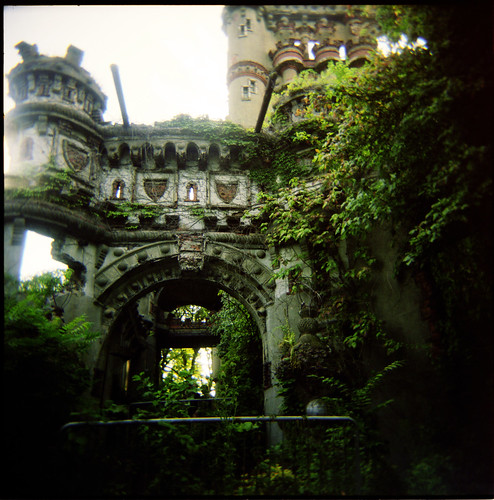
Ghosts of Bannerman’s Island

Beacon, NY—Just south of the Newburgh-Beacon Bridge lays a
mysteriously isolated island and on this island stands the ruin of a
once grand Scottish Castle, which in its time, stood as a fortress and
rose above the trees to create an impressive gateway to the Hudson
Highlands. This is the image I remember as I child, and I am still
captivated by the menacing vision of this dark lifeless structure
surrounded by the rushing tides of the Hudson River. Today this majestic
ruin, known as Bannerman’s Island Arsenal, rests on Pollepel
Island and crumbles before our eyes. The recent deterioration of
the ruin inspired me to not only witness and photograph the devastation,
but to write about its lingering legends.

Pollepel Island was just as mystifying nearly 400 years ago as it is
today. This dark deserted isle was the subject of an impressive
“arsenal” of storytellers’ tales. Storytelling was a common past time
and, just as with any story, over time these tales were naturally
embellished and grew into astounding historical accounts that were
passed down by the area’s early inhabitants giving us the great early
legends of angry spirits, lost lovers, and ghostly goblins.

The Early Legends

Long before Francis Bannerman built his castle, this six and
three quarter acre isle was uninhabited. The Native Americans feared the
island was possessed by evil spirits, which made it a prime location
for settlers to hide during periods of aggression with the Indians.
Over time, a number of legendary tales evolved. As I walked along the
shoreline, the crystalline ice formations glistened in the sun and I
thought of the legend of Polly Pell, a story that stakes claim for
naming the island. The story of Polly Pell (Pollepel) was shared among
Dutch settlers when newlywed Polly Pell was saved from the frozen Hudson
River following a romantic sleigh ride with her beau. The fierce
currents of the icy Hudson washed Polly and her new husband up on the
rocky shores when a slave rescued them and named the island after her
and the legend of Polly Pell was born.

The infamous Pollepel Island became well-known among Hudson River
sailors. The secluded island was the basis of much of fantastical
folklore that surrounds river travel through the Hudson Highlands.
The story The Storm-Ship written by famed storyteller and
Tarrytown resident Washington Irving, tells the tale of a dreaded tribe
of goblins that the Dutch feared inhabited Pollepel Island. These
goblins thrived under the reign of the Heer of Dunderburgh who is said
to control the gusty winds and treacherous waters of the Highlands. The
Dutch lived in fear of the Dunderburgh. The “storm ship”’ actually
refers to the legendary Flying Dutchman, a ship lost in a brutal storm
sinking just south of Pollepel Island. The story condemns the captain
and his crew to sailing the Hudson for eternity and it has been reported
that their cries for help can be heard during violent storms. Once a
ship ventured past Pollepel Island, the captain and crew earned right of
passage for a safe journey down the Hudson.

Whether or not the ghosts, goblins, and evil spirits existed was left
to the imagination. However, boat captains were known to cast off new
sailors on their inaugural voyages down the river as an initiation.
Often drunk and scared out of their wits these poor sailors were forced
to disembark to take their chances with the phantoms of Pollepel Island.
They were picked up on the return trip hopefully sobered up and
fearless.

Given the history of Pollepel’s influence on shipmen of that period,
it is ironic that the next ghost story would be that of a tugboat
captain angered by Bannerman himself.

A Ghost from the Bannerman Era

Francis Bannerman VI was the visionary behind the progressive growth
of the Scottish castle that bears the name of Bannerman’s Island
Arsenal. Bannerman purchased Pollepel Island in 1900 when his
insatiable hobby of scrap collecting gave way to becoming a massive arms
company. As his wealth increased, Bannerman was able to build a home
that would serve as a monument to his heritage. The castle itself was
comprised of six major sections; three arsenals, the lodge, the tower,
and the superintendent’s house. In addition, there is also a family
residence with magnificent views of the Highlands.

The property was protected by breakwaters, which were formed by the
sinking of old barges and boats. There is a legendary tale that the
tugboat captain of one of the boats requested that his prized vessel not
be sunk in his presence, but before anyone knew it, the boat was
sinking right before the former captains eyes. The captain cursed
Bannerman and swore revenge. It has been said that employees in the
lodge often heard the ringing of the boat’s bell at various times
signifying that the captain had returned to make good on his promise.

Just as the tugboat captain experienced a devastating loss that would
condemn him to Bannerman’s castle for an eternity, Bannerman would also
experience loss.

A Castle in Ruin

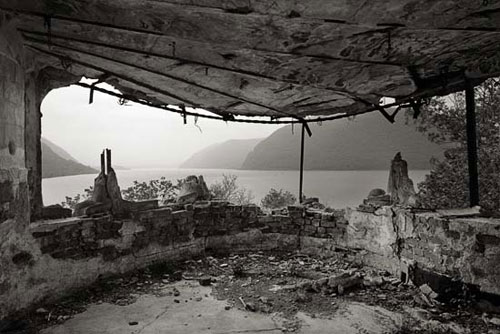
Bannerman’s Island Arsenal has had its share of disastrous events. A
1920 explosion of gun powder and shells blew a wall clear over to the
mainland. Three people were injured including Mrs. Bannerman and the
incident incurred $50,000 in damage. The most devastating event occurred
in August of 1969 in a fire that gutted all the buildings on the
island. It was undetermined as to what was the cause of the engulfing
blaze that would destroy the celebrated estate of the late Francis
Bannerman VI leaving it in ruin. This would not be the last disastrous
event that the castle would endure. In late 2009 and early 2010 the
castle saw increased damage that has forever changed the landscape of
this iconic structure. I wonder how much longer it will endure the
elements and how this rich haunted history will be remembered.

Remembering Bannerman’s Island Arsenal

The recent collapses have removed Bannerman’s name from his cherished
castle. As the castle fades into history, the legends will remain to
haunt us for a lifetime. As unbelievable as the stories may be, they add
to the allure of the island and someday may be all that remains of one
of the most captivating historical sites in the Hudson Valley. I think
that Jane Bannerman’s quote best describes how I feel about Polly Pell’s
island.

“No one can tell what associations and incidents will involve the island in the future. Time, the elements, and maybe even the goblins of the island will take their toll of some of the turrets and towers, and perhaps eventually the castle itself, but the little island will always have it’s place in history and in legend and will be forever a jewel in it’s Hudson Highland setting.”
- Jane Bannerman

Island Tours and Contributions

The island and castle is easily viewed from land. Take a short drive
south on Route 9D until you get to Breakneck Ridge. Park on the side of
the road and cross the bridge over the trains track. BE VERY CAREFUL OF
PASSING TRAINS!!